The vaporetto pulls away from the Zitelle stop and for a moment you are looking back at San Marco from the wrong side of the water — the basilica, the campanile, the whole improbable skyline — and it occurs to you that this may, in fact, be the right side.
Airelles Palladio Venice opened this month on Giudecca Island, the long, quiet spine of land that faces the Piazza across the Giudecca Canal. It is the first Airelles property outside France, and the choice of location tells you almost everything you need to know about the brand’s ambitions. They have not come to Venice to compete with the Cipriani or the Gritti Palace. They have come to offer something else entirely: a hotel that understands the city by turning its back to the crowd.
The property occupies the former Bauer Palladio complex, a site whose centrepiece is a sixteenth-century church designed by Andrea Palladio himself. It is worth pausing on that fact. Not “inspired by” Palladio, not “in the style of.” The actual architect, the man who gave Western architecture its vocabulary of columns and pediments and harmonious proportion, drew these walls. The building has served various purposes over the centuries — convent, military depot, sanatorium — but its bones have always been extraordinary.
The rooms
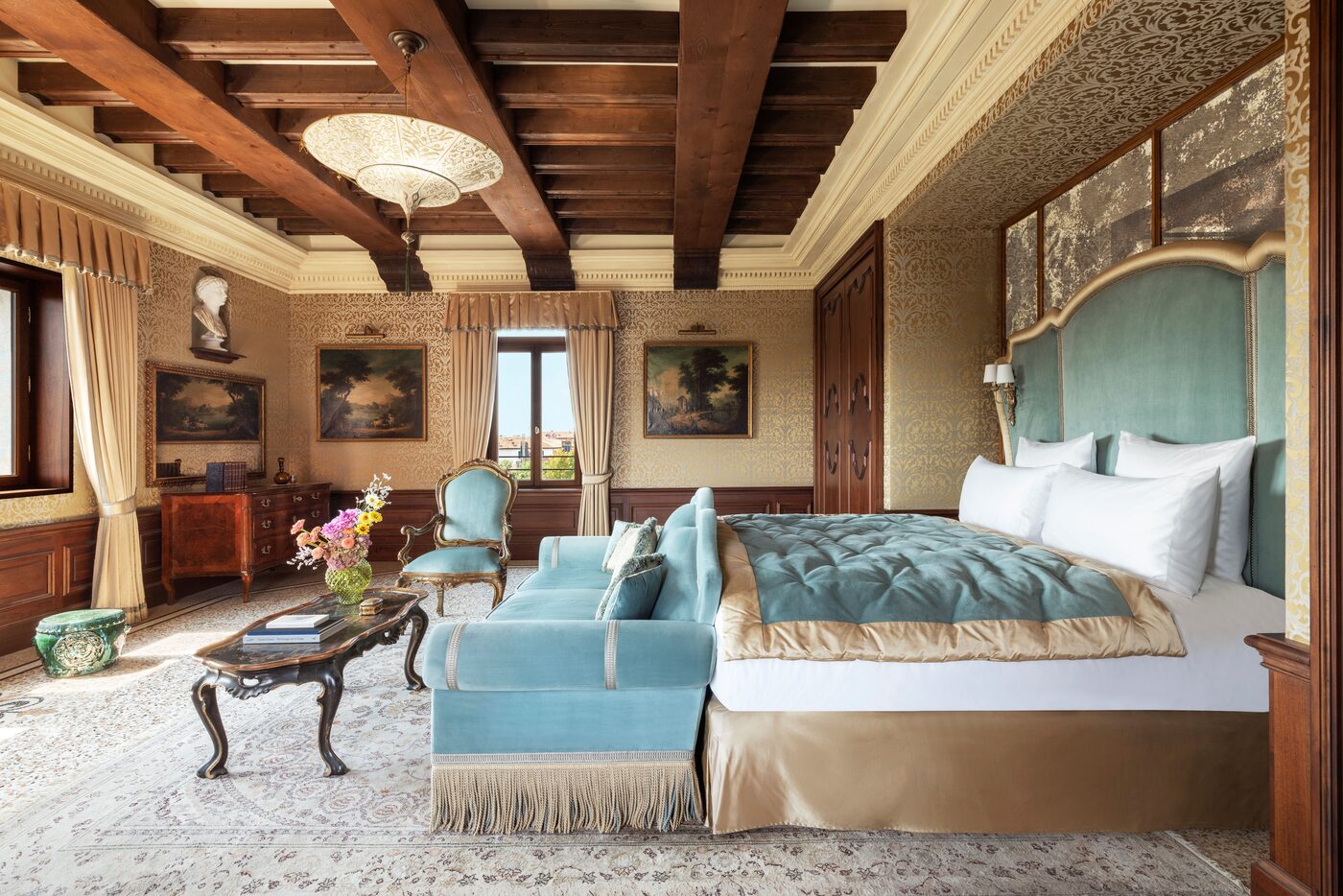
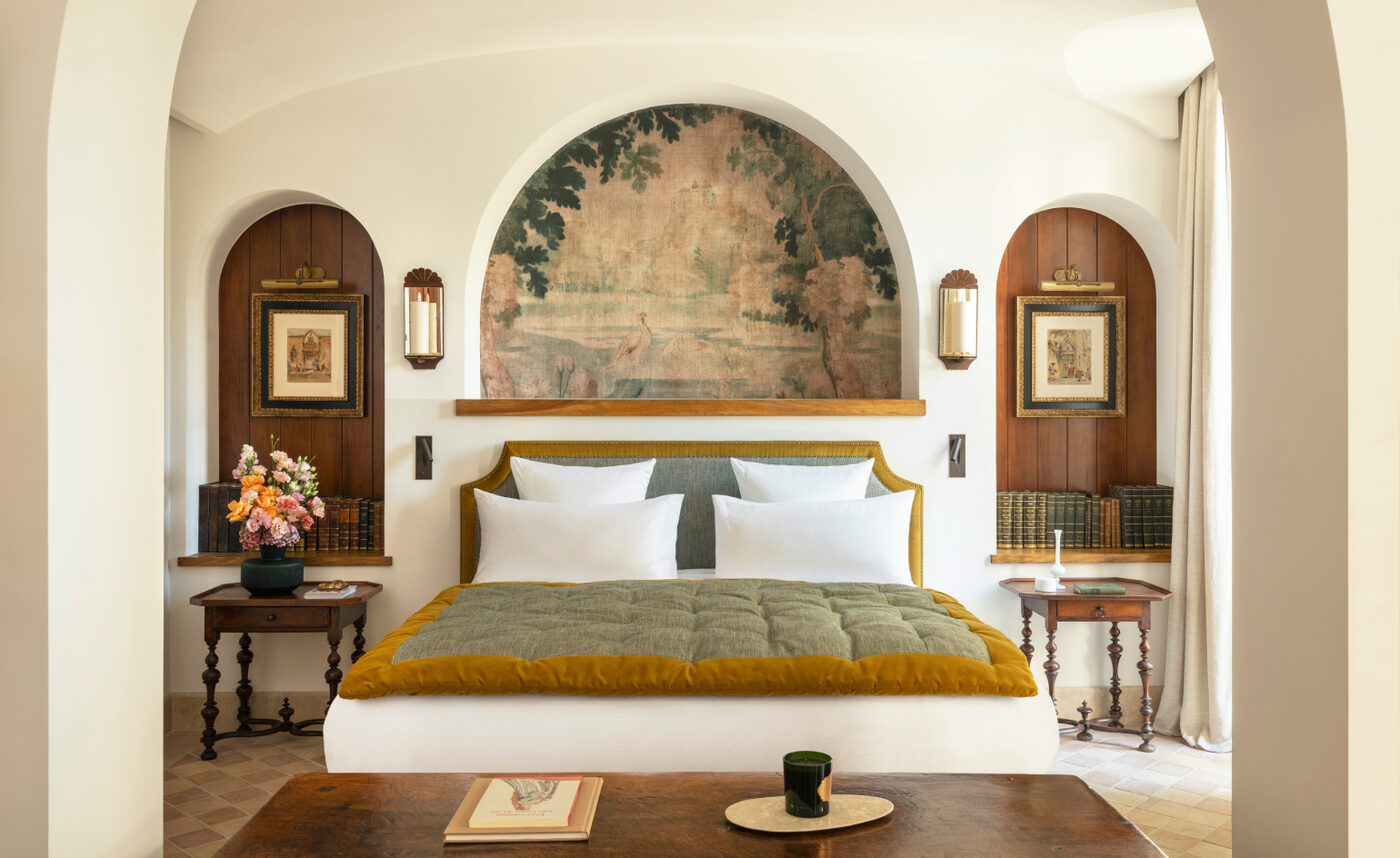
There are seventeen rooms, twenty-eight suites, and a three-bedroom private villa. The count is deliberately modest. Airelles has not carved the complex into the maximum number of saleable units; it has allowed space to breathe. The interiors, designed by Christophe Tollemer, walk the narrow line between opulence and restraint with uncommon confidence. Rubelli and Fortuny fabrics — both Venetian houses, both woven within a few kilometres of the hotel — dress the windows and upholster the furniture. Hand-painted frescoes adorn the ceilings. Antique pieces, sourced from estates across the Veneto, sit alongside custom millwork. The rooms do not announce themselves. They simply exist at a level of finish that makes most luxury hotels feel like they are trying too hard.
The best suites face north, toward San Marco. At night the basilica is lit gold and the water between the island and the Piazza becomes a dark mirror, and you understand why the residents of Giudecca have never been especially eager to cross the canal.
To stay on Giudecca is to see Venice the way Venetians have always preferred it — from the other side of the water, where the beauty is the view and not the crowd.
Elena VossThe tables
Five dining venues occupy the grounds, and each one is calibrated to a different register of pleasure. Matsuhisa, the Venetian outpost of Nobu Matsuhisa’s global restaurant programme, occupies a vaulted ground-floor space where the omakase unfolds with the same quiet theatre that defines the best seats in Malibu or Mayfair. abc kitchen brings a Mediterranean farm-to-table sensibility to the garden terrace. Villa Frollo, set in a standalone building within the grounds, serves Italian classics with a formality that stops just short of ceremony. The Cichetti Bar, a nod to Venice’s own aperitivo tradition, offers small plates and spritzes in an informal salon overlooking the water. The Palladio Bar, positioned beneath the loggia, is the sort of place where an afternoon Negroni becomes an evening Negroni without anyone quite noticing the transition.
Photography courtesy of Wallpaper*
The grounds
The gardens span nearly one hectare — a staggering luxury in a city where outdoor space is measured in windowsill pots. Three swimming pools are laid among the plantings: one for lengths, one for leisure, one for the villa guests who prefer not to share. The Guerlain Spa, the first in Italy, occupies a series of restored rooms where the treatments draw on the house’s century-old pharmacopoeia. A gym, discreetly positioned at the garden’s western edge, offers the kind of equipment that suggests Airelles knows its guests will use it but would prefer not to discuss it.
It is the gardens, though, that make the property feel unlike anything else in Venice. Giudecca has always been the city’s green island, the place where monasteries kept orchards and aristocrats retreated to their country villas without technically leaving town. Airelles has honoured that tradition. The planting is lush, unmanicured in the way that only very expensive gardens can afford to be. Wisteria and jasmine climb the cloister walls. Citrus trees line the gravel paths. The air smells of salt and blossom and, faintly, of the lagoon.
The context
Airelles built its reputation on a very specific model of French ultra-luxury. Les Airelles in Courchevel is the ski hotel against which all other ski hotels are quietly measured. Le Grand Contrôle, inside the grounds of the Château de Versailles, offered guests the singular experience of sleeping where courtiers once schemed. Both properties share a commitment to what the brand calls art de recevoir — the art of receiving, a philosophy rooted in the idea that hospitality, at its highest expression, is a form of generosity rather than service.
Venice tests that philosophy in new ways. The city is, famously, overwhelmed — by tourists, by cruise ships, by the sheer weight of its own mythology. To open a hotel on Giudecca, rather than on the Grand Canal or in the shadow of the Rialto, is to make an argument about what luxury means in a place where beauty has become a form of congestion. Airelles is not offering proximity to the sights. It is offering distance from them — and the implicit suggestion that the best view of Venice has always been the one from across the water.
The stay
Rates begin at €1,200 per night in the quieter months and rise to €2,500 during the Biennale and film festival seasons, when Giudecca briefly becomes the most desirable address in the lagoon. The price reflects not merely the rooms and the restaurants but the proposition itself: that a hotel can be a destination rather than a base camp, and that the most interesting thing about Venice may be the act of watching it from a slight remove.
On the last evening, I took the hotel’s private water taxi across the canal to San Marco. The piazza was dense with tour groups and selfie sticks and the ambient hum of modern mass tourism. I stayed twenty minutes. The return journey, the boat cutting a clean line through the darkening water toward the lit façade of Palladio’s church, was the best moment of the trip. Giudecca appeared ahead, silent and golden, and I understood what Airelles had understood before me: the grandeur was always on this side.
Airelles Palladio Venice opened April 2026. Rates from €1,200 per night. Book through airelles.com.
Photography courtesy of Wallpaper* / Future plc — © Airelles Collection