In 1986, six graduates of Antwerp’s Royal Academy of Fine Arts loaded a rented truck with garment bags and drove to London. They arrived at the British Designers Show with almost no money, no press contacts, and no appointments at the kind of showrooms that mattered. Forty years later, MoMu — the Fashion Museum of Antwerp — has opened the first major exhibition devoted to all six of them together, and it feels less like a retrospective than a reckoning.
The exhibition, titled simply The Antwerp Six, opened on 28 March and will run through January 2027. It gathers one hundred looks spanning four decades of work by Ann Demeulemeester, Dries Van Noten, Walter Van Beirendonck, Dirk Bikkembergs, Dirk Van Saene, and Marina Yee. Alongside the garments are sketches, photographs, show invitations, and archival ephemera drawn directly from the designers’ own collections. Guest curator Geert Bruloot, himself a foundational figure in Antwerp’s fashion ecosystem, has assembled the material with a scholar’s thoroughness and a partisan’s affection.
The myth and the truck
Every fashion origin story requires a vehicle. For the Antwerp Six, it was literally a truck. The legend has hardened into shorthand over the decades: six unknown Belgians crash London, buyers from Barneys place immediate orders, the press dubs them a collective because nobody can pronounce their names. It is a story that flatters the industry’s self-image as a meritocracy, where talent will always find its audience.
MoMu complicates this narrative without dismissing it. The exhibition’s opening rooms present the London moment as a beginning rather than a culmination, situating it within the broader cultural ferment of mid-eighties Antwerp. The city was experiencing a quiet artistic renaissance. Its academy, under the direction of Linda Loppa, had become a laboratory for rigorous conceptual training. The six designers who emerged from those classrooms were not a movement — they never shared a manifesto or an aesthetic programme — but they were shaped by the same pedagogical intensity.
What connected them was method, not style. Demeulemeester’s poetic deconstruction bore no surface resemblance to Van Beirendonck’s confrontational maximalism. Van Noten’s layered textile narratives operated in an entirely different register from Bikkembergs’s athletic severity. Yet each designer approached clothing as a form of intellectual enquiry, something to be interrogated rather than merely produced. The academy gave them that habit of mind, and the exhibition makes this shared inheritance visible.
One hundred looks, six vocabularies
The garments on display have been chosen to reveal process rather than greatest hits. A deconstructed Demeulemeester suit from the early nineties, its seams exposed and its silhouette deliberately destabilised, hangs near a feather necklace and rope belt from the same period. The ensemble communicates something that a single jacket on a hanger cannot: the way Demeulemeester thought about the body as a site of tension between fragility and armour.
Van Noten is represented through his characteristic fabric obsessions — a richly patterned jacket dense with appliquéd patches, textiles sourced from three continents and married in a single garment. Seeing these pieces in proximity to Van Beirendonck’s lurid S/S 2008 Sexclown collection, with its references to Bozo masks from Mali, produces a productive dissonance. Both designers work with cultural citation, but their methods could hardly be more different. Van Noten absorbs and harmonises. Van Beirendonck collides and provokes.
They did not decentralise fashion on purpose. They simply refused to move to Paris, and the centre shifted around them.
Margaux DelacroixBikkembergs, the pioneer of fashion’s fusion with sport, is given space to demonstrate just how radical his stadium runway shows in Milan and Barcelona once felt. Marina Yee, perhaps the least visible of the six internationally, emerges here as a designer of startling conceptual precision. Her S/S 1988 collection Marie, photographed by Andrew MacPherson, is represented through its original invitation and surviving garments, and the quietness of her work reads as deliberate restraint rather than absence. Van Saene, likewise, is presented with curatorial generosity, his eclectic output given the critical attention it has often been denied.
The weight of the archive
Bruloot’s decision to source material directly from the designers’ personal archives gives the exhibition an intimacy that institutional shows frequently lack. These are not loans negotiated through corporate PR departments. They are garments that have been stored in studios and apartments, folded into tissue paper by the people who made them. The sketches bear coffee rings. The show invitations carry the graphic fingerprints of long-standing collaborators — Patrick Robyn designing for both Demeulemeester and Van Noten, Paul Boudens working with Van Beirendonck.
A nearly four-hundred-page catalogue, published by Hannibal, accompanies the show. With contributions from Tim Blanks and Angelo Flaccavento, among others, it functions as both a scholarly resource and an act of cultural preservation. Fashion archives are notoriously fragile, subject to the whims of brand ownership and the physical deterioration of textiles. By committing this material to print and to public display, MoMu has performed a service that extends well beyond the exhibition’s closing date.
What Antwerp still means
The broader argument of the exhibition is one of geography. In 1986, fashion operated under an assumption of centralised authority. Paris dictated. Milan manufactured. New York commercialised. London occasionally disrupted. Antwerp was not on the map at all. The Six changed that, not through deliberate strategy but through the simple insistence on staying where they were. They built their houses in Antwerp. They showed in Paris when necessary but returned home to work. They proved that meaningful fashion could originate from a city of half a million people with no established industry infrastructure.
Four decades later, the lesson still resonates. Fashion remains concentrated in a handful of global capitals, but the monopoly has weakened. Copenhagen, Seoul, Lagos, Tbilisi — each of these cities owes something, however indirect, to the precedent the Antwerp Six established. The exhibition does not make this claim explicitly. It does not need to. The garments on the mannequins, made in a Belgian city that the fashion world had never heard of, make the argument on their own.
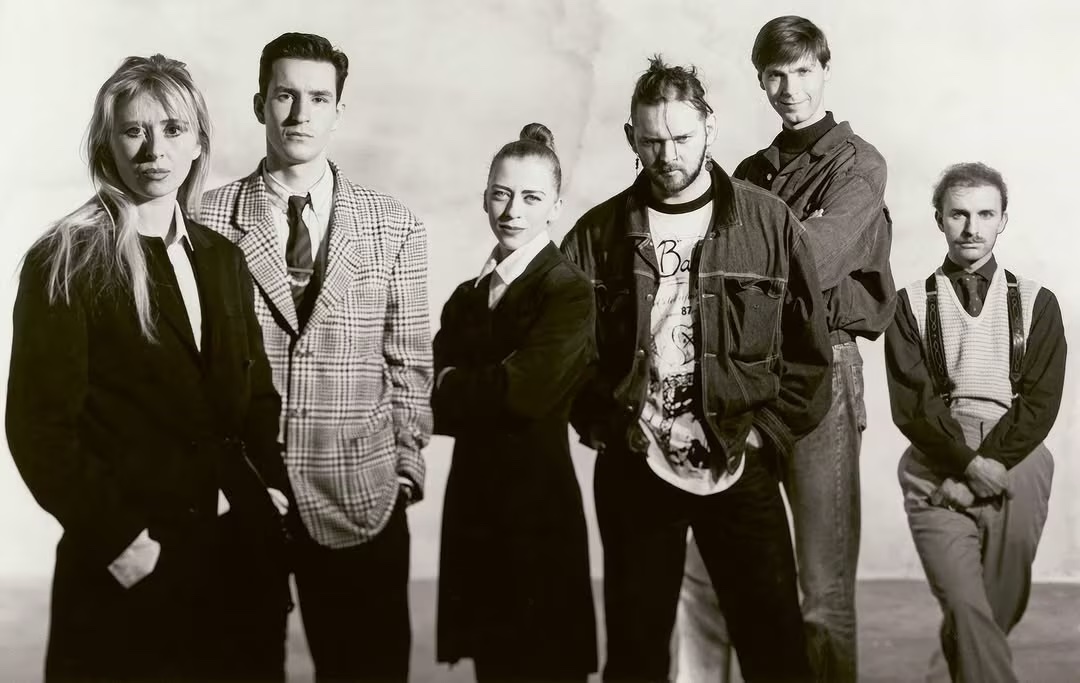
Photography courtesy of Wallpaper* / MoMu — Fashion Museum Antwerp
The show runs until January 2027. It deserves the pilgrimage. Not because it sentimentalises a moment from fashion history, but because it demonstrates, with patience and precision, how six individuals trained in the same rooms could produce work of such radical diversity. The Antwerp Six were never a group in any meaningful aesthetic sense. What they shared was a city, a school, and a refusal to treat fashion as anything less than a serious discipline. MoMu has honoured that seriousness in kind.