The Champs-Élysées became a darkened cinema. The space swallowed light, the runway cut through blackness with a single narrow strip of illumination overhead. Pierpaolo Piccioli walked eighty-one looks through that shaft of brightness. Screens surrounded the audience, fragments of Sam Levinson's unreleased Euphoria sequences bleeding color into the dark. Portrait close-ups of cast members appeared and vanished. Landscapes shifted and resolved. The collection moved beneath borrowed images from a television mythology.
This is Piccioli's second collection at Balenciaga. His first, shown in January, announced his intentions clearly. This second statement deepens them. ClairObscur references the Renaissance technique of contrasting light and shadow, the sculptural play of illumination across a surface. The collection itself lived this tension. Black upon black. Light-catching fabrics that caught almost nothing until the moment a body moved beneath the runway lights.
The structure of silhouette
Outerwear anchored everything. Leather bombers with rounded cocoon backs suggested protection and cocoon. Structured pea coats held their shape with architectural precision. Officer coats arrived with collars lifted away from the shoulders, a gesture directly inherited from Cristóbal Balenciaga's historical codes. The proportions felt contemporary yet classical, modern yet rooted in the house's DNA.
Face-framing collars appeared repeatedly. Funnelnecks on knits. Portrait collars on dresses. The collection seemed obsessed with the idea of framing the face, drawing the eye upward, creating a visual boundary between body and cloth. Draped jersey dresses cut with minimal seams suggested liquid form. High-waisted denim sat where denim should sit. Tailoring remained streamlined, refusing excess.
Piccioli gave the collection softness in unlikely places. The Hourglass bag reappeared, rounded at its edges, less rigid than its predecessors. Off-kilter brogues developed with J.M. Weston suggested a certain visual discomfort, a shoe that knew its own oddness and owned it. Details worked as counterpoint to the severity of the outerwear.
The collaboration as texture
The partnership with Sam Levinson shifted the collection's emotional register. Euphoria's visual language operates in neon and high saturation. Piccioli allowed those colors into his palette. A certain shocking pink appeared in printed patterns echoing the television show's graphic sensibility. Neon touches punctuated the vast field of black. The collection became a conversation between two visual systems: the Renaissance's chiaroscuro and contemporary television's synthetic hyper-color.
The idea of seeing and being seen came through clearly. The runway held models in light while the audience sat in relative darkness, watching them move through the illuminated space. The screens played footage of Euphoria's performers, a parallel set of figures visible and watched. Two types of presence occupied the same room. The runway became a kind of doubling, the live models and the screened images creating a dialogue about performance, image, and the nature of what gets broadcast into the culture.
The collection speaks from a place of certainty about what Balenciaga can be under his vision.
Léa FontaineWhat emerges in the darkness
Piccioli arrived at Balenciaga from Valentino, where he spent more than a decade building his vision. The house codes at Balenciaga are distinct and historically weighted. Rather than fight them or ignore them, Piccioli seems to be asking what they can become. How does a structured shoulder speak in 2026. How does a lifted collar resonate now. What does an officer coat mean when its wearing a person moving through an installation about television and youth culture.
The collection felt assured. Not anxious to please. Not desperate to show range. A designer confident in the clarity of his vision. The black became almost meditative, the light-catching fabrics creating subtle variations in an apparently monolithic palette. The silhouettes read clearly even in the dimness. The clothes trusted themselves.
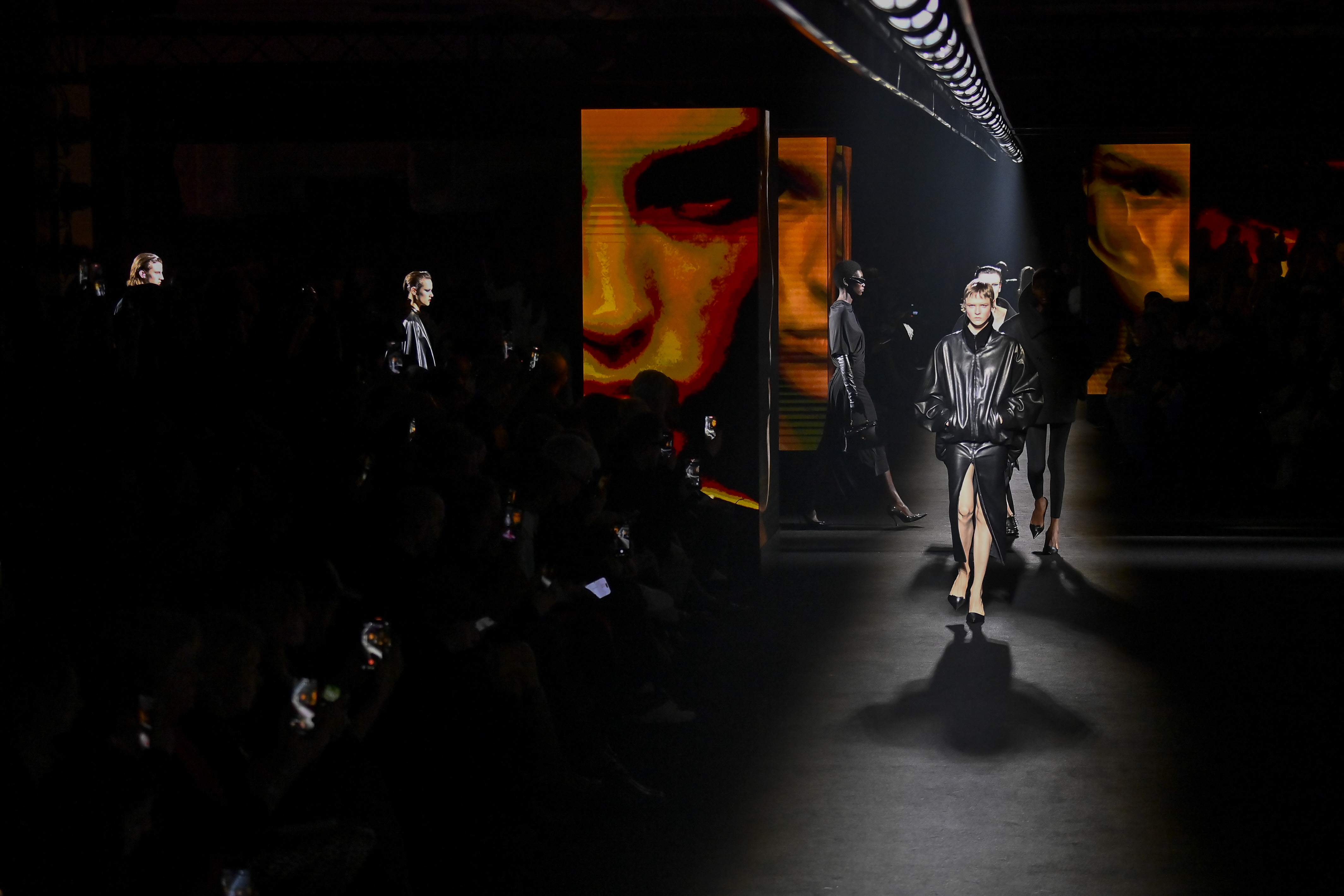
Balenciaga A/W 2026. Wallpaper*
For a moment on the Champs-Élysées, Piccioli created a space where fashion existed in conversation with the visual culture surrounding it. The runway became a kind of bridge between the codes of Balenciaga and the visual language of contemporary television. Two systems of representation met in darkness and made something that looked entirely new.