The Tennis Club de Paris filled with coral light on the first of October. Pierpaolo Piccioli sent out his third Balenciaga collection to the Fugees, and called it Les Coraux de la Liberte. The clothes were jeans and t-shirts, built the way couture is built.
This was Piccioli's third season at the house, and his clearest statement yet of what he wants it to be. He took the techniques developed for the 55th Balenciaga Couture collection and ran them through ready-to-wear, for women and men. Denim, bombers, leather jackets and cotton tees arrived reshaped by the atelier. The everyday wardrobe stayed legible while the construction underneath it changed.
Aude Franjou's sculpture Les Coraux de la Liberte sat at the center of the room, a mass of meticulously wrapped linen. It gave the show its title and its logic. Franjou's piece reads a house as a living structure rather than a building, and Piccioli built the collection as an extension of that idea.
The Fugees' Ready or Not opened the show over an orchestral arrangement, with Lauryn Hill in the front row. Coral oranges and warm pinks ran through the clothes, set against the pale linen of the sculpture. The mood stayed physical and unhurried.
The method
Piccioli has described couture as a working method rather than a red-carpet category, and the collection argued that garment by garment. A t-shirt had been draped and redrawn in the atelier before it reached the floor. It broke at the hip where the construction told it to. Nothing looked unobtainable. Everything carried the evidence of a hand.
That premise changes how a Balenciaga show reads. The spectacle lives in the making rather than the silhouette. A bomber earns its place through the way it has been cut and joined, and the viewer is asked to notice the labour rather than the logo.
Piccioli made a version of this argument for years at Valentino, where he built couture into a language of colour and volume. At Balenciaga the material is humbler and the point lands harder. If couture is a method, it can lift the floor of a whole wardrobe, a jean and a tee included, without pricing most of it out of reach. That is a commercial idea as much as a creative one.
The seam
The sharpest idea was a couture stitching technique moved from the inside of a garment to its surface. On leather jackets and cotton tees, that stitching drew basque shapes, the nipped waists and controlled volumes that run through the Balenciaga archive. The architecture that usually hides inside a couture dress became the visible structure of a daily jacket.
Bias cutting did similar work. Applied to evening dresses, jeans, shirts and men's suiting, it changed how each piece met the body. A pair of bias-cut jeans looked ordinary from across the room. In motion the denim moved with the walk, fluid without going slack.
The body
Cristobal Balenciaga treated the body as the basis for every design, and Piccioli returned to that rule. Calais lace and cutwork opened onto skin with the placement of an architect. Abstracted organza flowers held their volume on compressed air. The references to the founder stayed structural, read through cut rather than nostalgia.
The objects
The accessories followed the same logic. The draped Nodo bag was shaped by hand, the Silhou tote cut in supple leather, and the City bag returned alongside new denim. Seashell jewelry nodded to Getaria, the Basque fishing town where Cristobal was born. Sunglasses came with braided arms, and the Wave thong sandal and new Lounge sneaker were stripped to what lets a shoe move. Decoration earned its place through function.
Piccioli is building Balenciaga on method rather than spectacle, and the argument gets clearer every season.
The Splendid EditThe house
The timing sits inside a hard stretch for Kering. The group reported third-quarter revenue on the twenty-second of October, roughly flat at about 3.35 billion euros, with Gucci down six percent at constant rates as the newness of Demna's first collections faded. Balenciaga's leather goods held up while ready-to-wear and footwear met more pressure. Luca de Meo, who took over the group this year, is cutting costs and reshuffling creative seats.
Piccioli arrived at Balenciaga from Valentino, where he spent more than two decades, and took the seat Demna left for Gucci. Anthony Vaccarello's exit from Saint Laurent this month put another Kering house into transition. Against that backdrop, a collection this coherent is the kind of asset the group needs.
Les Coraux de la Liberte made its case without raising its voice. Couture, in Piccioli's hands, is a way of working that can sit inside a pair of jeans. Three seasons in, that reading of Balenciaga is starting to hold.
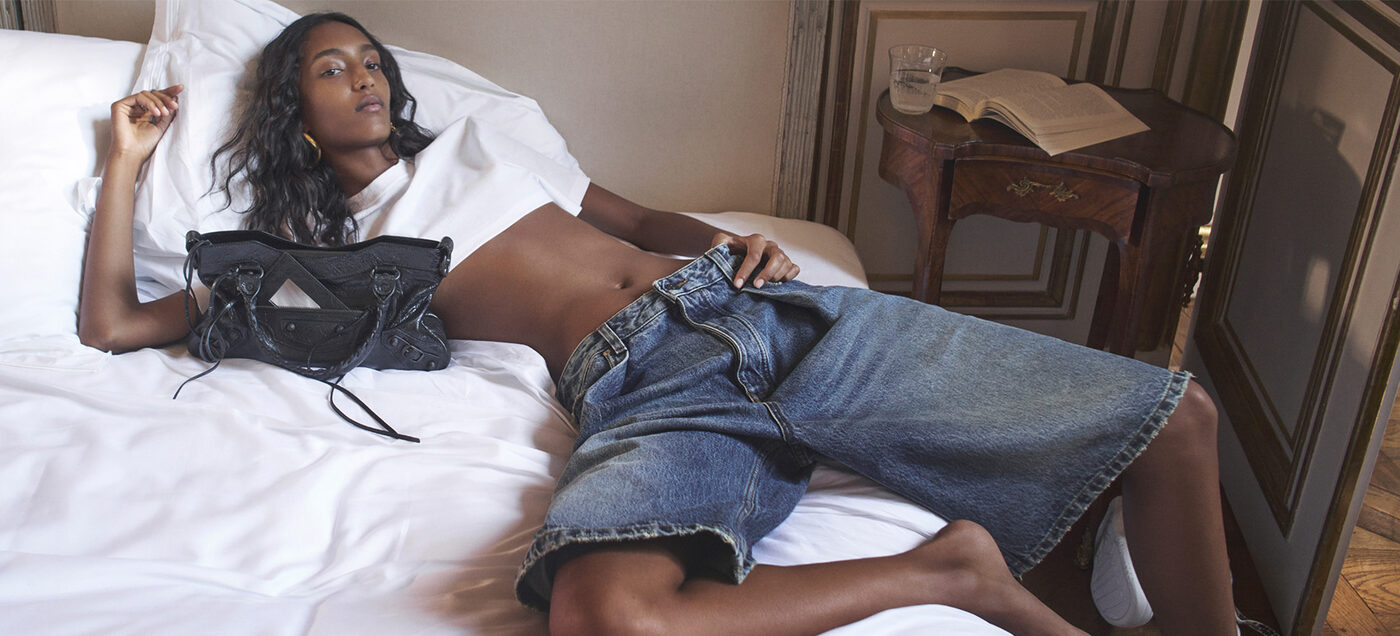
Denim and the archival City bag, from Balenciaga's current campaign. Courtesy of Balenciaga