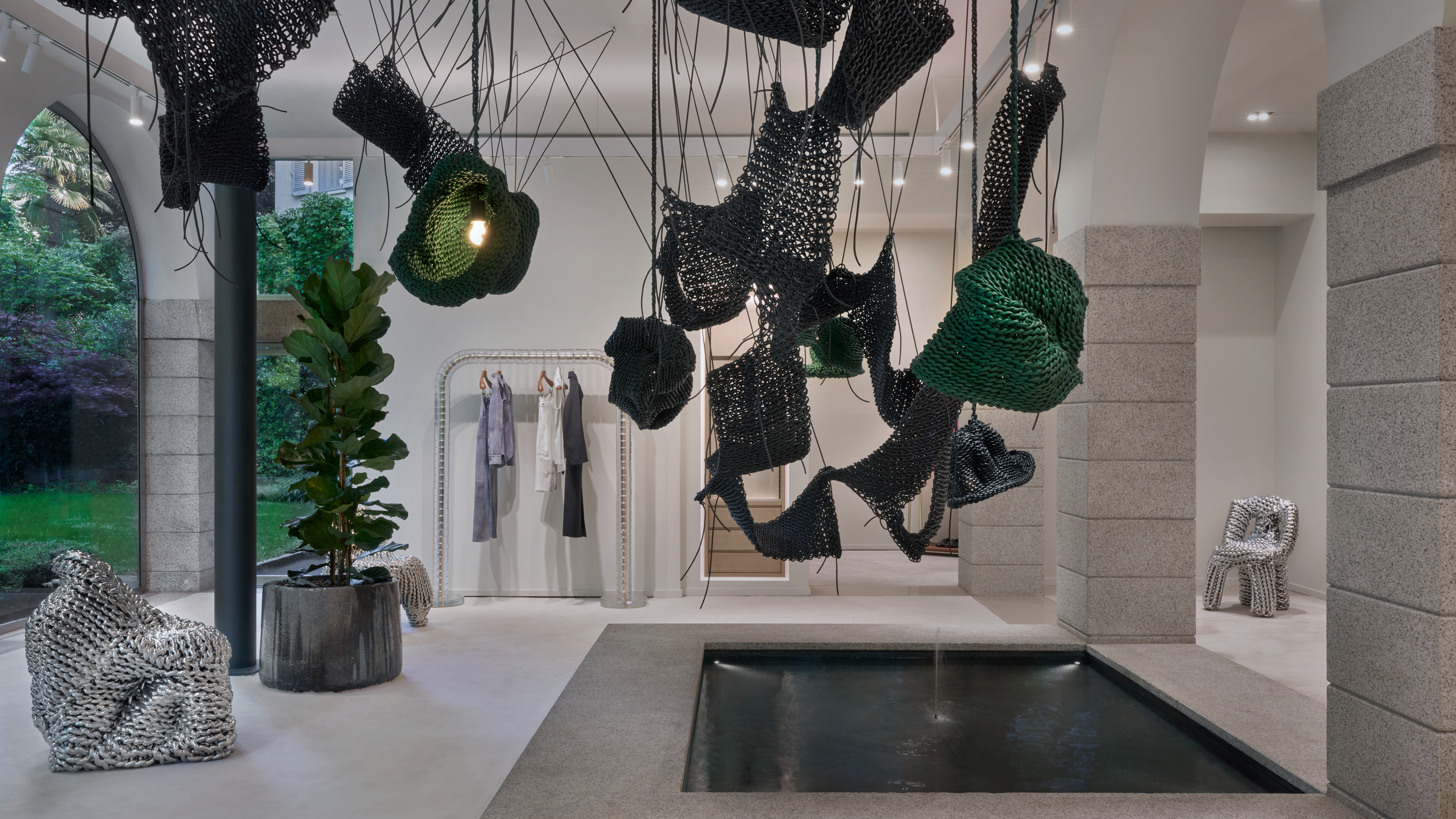
A Korean artist, a Milanese boutique, and an hour of improvisation with black and green leather pulled thread by thread through sponge tubing. Bottega Veneta has turned its Via Sant’Andrea storefront into something closer to a studio than a shop, and the week is richer for it.
For Milan Design Week 2026, the house has given Kwangho Lee the run of the Via Sant’Andrea flagship. The commission is not a limited capsule of handbags in a new finish. It is a sculpture, made in situ, by a Seoul-based artist who has spent the last decade teaching contemporary viewers to notice what weaving actually is when it stops pretending to be decoration.
Lee is not new to the house. His hand-plaited lamps walked the Spring-Summer 2026 show in leather fettucce that felt more like an extension of the artist's practice than a runway prop. Last June, he anchored the Seoul chapter of Bottega's travelling intrecciato exhibition, where he was shown alongside the Venetian artisans who have practised the basketweave for decades. This Milan commission completes a trilogy of sorts, and it is the quietest, most confident chapter of the three.
A language, not a logo
Intrecciato, the over-under leather weave that has become synonymous with Bottega Veneta, is the closest thing the house has to a signature. There is no monogram. There is no hardware stamped with a name. The weave itself does the talking. Louise Trotter, who took over as creative director this cycle and whose first Milan show landed to cautious approval, has been working on ways to speak about the weave without collapsing it into either heritage cosplay or industrial minimalism. Kwangho Lee was, on reflection, the obvious collaborator.
What Lee does differently is that he does not read intrecciato as a finish. He reads it as a grammar. In his studio in Seoul, he has adapted the traditional Korean basketry and chilbo enamelling techniques he was raised with into sculptures that look more like underwater flora than like furniture. Here, at Via Sant’Andrea, he has traded his usual materials for Bottega's black leather fettucce and a custom green cut specifically for this piece, threaded over sponge pipes and nylon rope, finished in polyurethane coating to hold the gesture.
He does not read intrecciato as a finish. He reads it as a grammar. The weave is not ornament laid over a surface. It is how the surface gets made in the first place.
Sienna CaldwellLee has spoken publicly about his experience with the Bottega material, noting that the level of detail already present in the leather when it arrived at his studio made the process of finding a form feel intuitive and, by his account, playful. The finished installation bears that out. There is no maquette behind it. The piece responds to the architecture of the store and to the rhythm of the week.
Seoul × Milan, a working axis
There is a bigger story underneath the collaboration. Seoul has spent the past two years being quietly insistent about its place on the luxury craft map. Seoul Fashion Week has held its own against larger cities on the back of a new generation of designers whose fluency in handwork reads as an antidote to the algorithm. Major houses have noticed. Chanel, Loewe and now Bottega Veneta have all run Seoul chapters of their design programmes over the past eighteen months.
Bottega's bet is more specific than most. Rather than import a Milanese narrative and translate it for a Korean audience, the house has been asking Korean artisans to come to Milan and sit alongside the Vicenza ateliers who built intrecciato's reputation. Lee's commission at Via Sant’Andrea is the cleanest expression of that instinct. He is not being asked to interpret intrecciato. He is being asked to add to it.
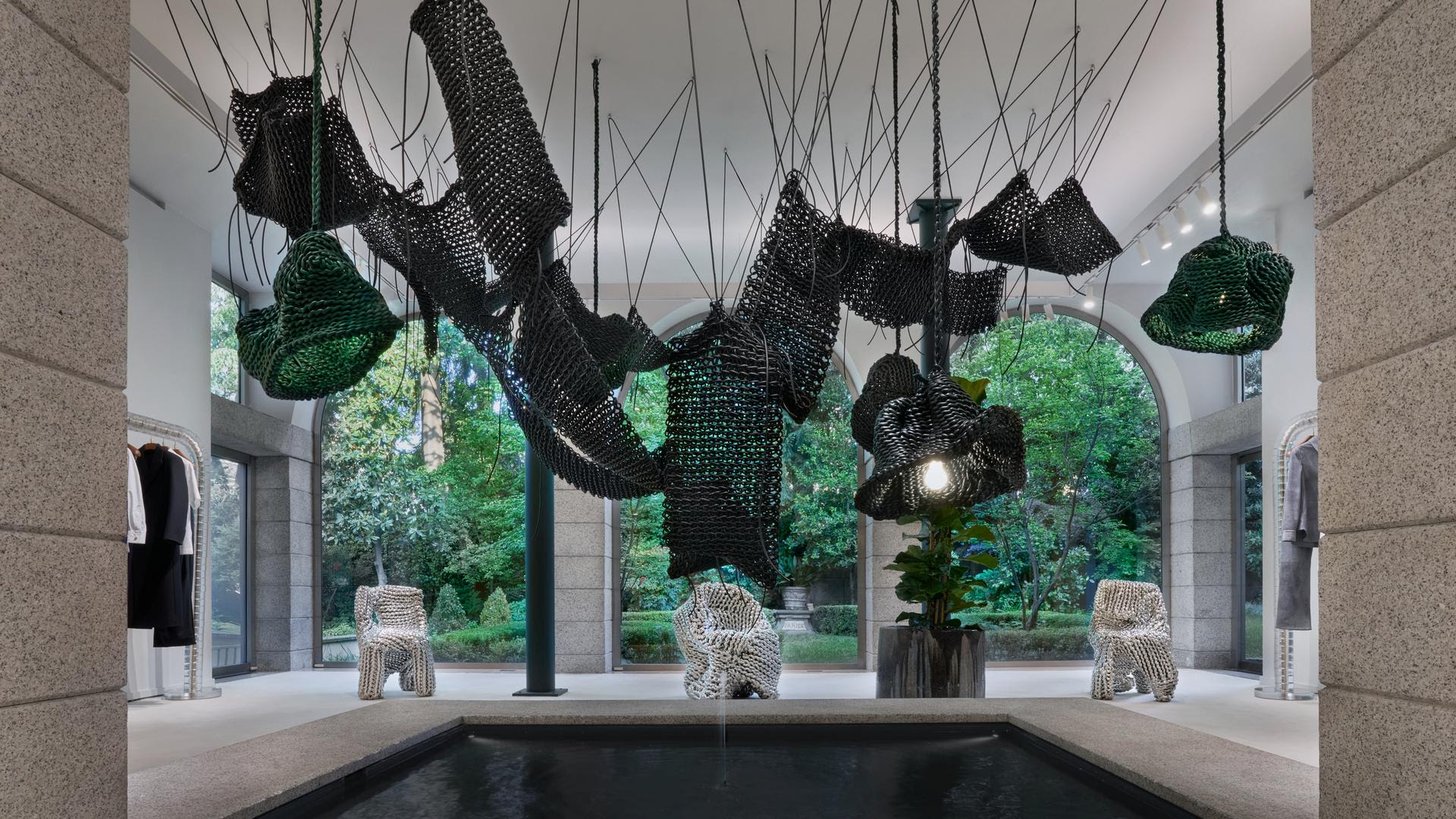
Kwangho Lee, in residence at Bottega Veneta, Via Sant’Andrea, Milan. Photography courtesy of Bottega Veneta / Wallpaper*
The store as workshop
There is a quiet provocation in the choice to stage the piece inside the flagship rather than in a white-walled gallery or the usual Salone satellite. Via Sant’Andrea is a working retail address. Handbags sit on shelves within view of the sculpture. Clients walk in and out during the day. A woman in cream trousers can buy a top-handle bag two metres from where Lee's piece turns a corner of the ceiling into a kind of lattice cloud.
That adjacency is the point. A luxury house that treats its own shop floor as a site for contemporary art has to be certain of the work it is selling. The bag, the Cassette, the Intrecciato tote, the pouch collapsed into a fan, all of them are quietly strengthened by sitting next to a piece that interrogates their making. The sculpture is a credential.
What follows
Bottega Veneta has declined to say what happens to the piece when Milan Design Week closes its doors. Some of Lee's collaborations with the house have travelled after their first showing. Others have dismantled and gone home with the artist. The working assumption inside the Via Sant’Andrea team is that this work will have a second life, either in an exhibition touring Asia or as part of the house's growing archive of contemporary commissions.
Whatever the fate of the installation, the commission itself signals where Trotter's Bottega is willing to place its attention. Craft is an argument the house has always been unwilling to abandon. What it has needed is an interlocutor who could keep the conversation moving. Kwangho Lee, on the evidence of this week, is that person.
Milan Design Week often produces installations that look good in photographs and hollow in person. The Via Sant’Andrea piece is the inverse. It rewards the second, slower visit. It asks something from the viewer. The bag on the shelf, by proximity, begins to ask for the same.