Bottega Veneta has put its name on a show at the Solomon R. Guggenheim. The artist is Taryn Simon, the room is the rotunda, and the move belongs to Louise Trotter. Her Bottega keeps drifting toward the art world, and this is the clearest sign of it yet.
The house gathered an audience under Frank Lloyd Wright's spiral in late October. Trotter hosted the dinner with the museum's director, Melissa Chiu, and Mariet Westermann, the foundation's director and chief executive. Julianne Moore came. So did Solange and Meadow Walker. The tables sat inside the rotunda while Simon's work climbed the walls above them.
The exhibition is called Taryn Simon: Father Country I Do Love You. It opened on 18 September and stays up until 14 March. Photographs, text, video and sculpture share the floor as one installation, built to be walked through rather than filed past. Bottega Veneta supports the show without curating it, a backer rather than an author.
The room
Wright's rotunda resists most things placed inside it. The ramp curves, the light falls from the oculus, and a flat picture on a flat wall tends to lose the argument. Simon works in more than one medium at once, which gives the space something to hold. The house described the evening as a meeting point for people from different creative fields, and the setting made the claim without anyone needing to.
That is the value of the gesture. A collection launch places a brand next to its own product. A night like this one places its creative director next to a museum, an artist and a room that carries its own weight. Bottega gets a cultural address in New York for the price of a dinner and a line of support.
Simon is a careful fit for a house that prizes patience. She builds projects out of photographs set against dense blocks of text, cataloguing bloodlines, contraband, and the systems that run under ordinary life. The work is cool and forensic, closer to an archive than a gallery wall. Dropped into a spiral designed for painting, it asks the visitor to read as much as look.
Bottega keeps choosing the museum over the billboard, and the choice is starting to read as a signature.
The Splendid EditVenice again
The thread runs back to the lagoon. Michele Taddei and Renzo Zengiaro founded Bottega Veneta in the Veneto in 1966, and the name means the Venetian workshop. Peggy Guggenheim kept a house on the Grand Canal for thirty years, the Palazzo Venier dei Leoni, and held court there until her death in 1979. Venice called her the last dogaressa.
Trotter has pulled on that figure since she arrived in January 2025. The Spring 2026 campaign dressed its models in oversized sunglasses and fibreglass coats cut like fur, loose around the Lido, a wink at Guggenheim's own theatrical wardrobe. The red woven bag and the red fringed coat in this season's images carry the same idea forward. The reference is a mood, not a costume.
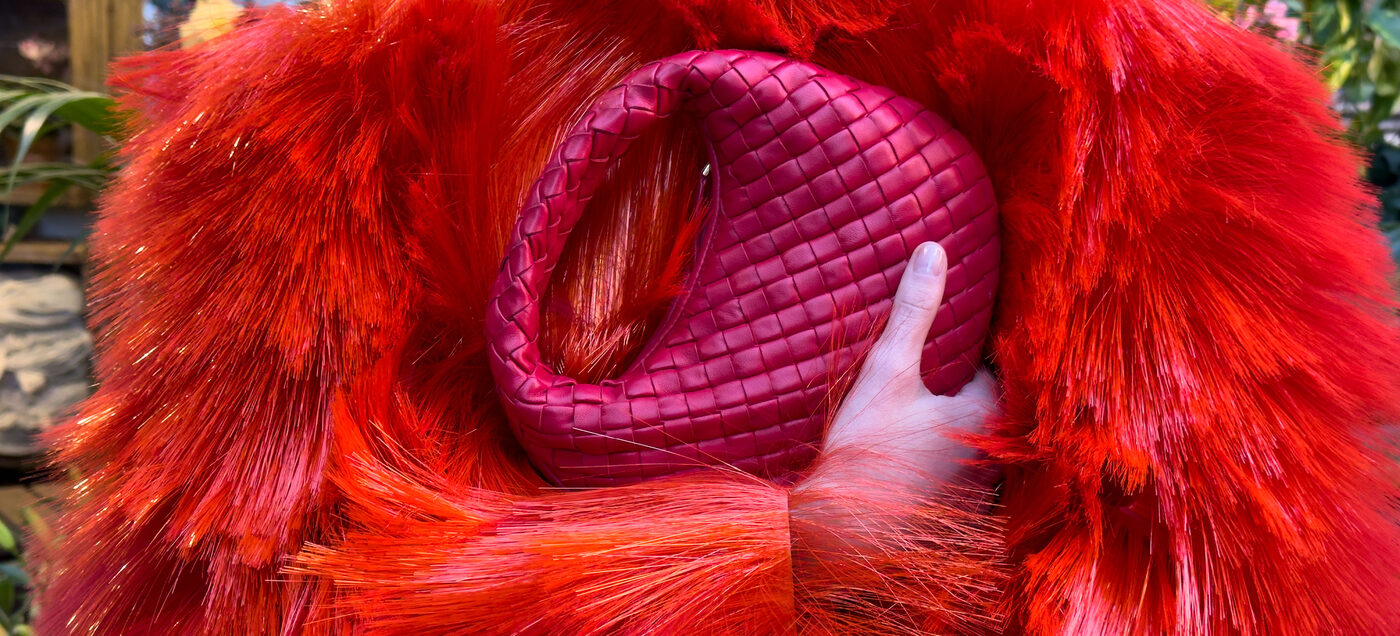
Bottega Veneta, Spring 2026 · Courtesy of Bottega Veneta
There is a family logic to the New York choice too. Peggy Guggenheim was Solomon's niece, and the rotunda she sits beneath this season bears the uncle's name. A house that adopted the Venice collector as its muse is now a guest in the New York museum her family built. The rhyme is too neat to have been an accident.
A pattern
New York joins a map that is filling in fast. Bottega lent quiet support to a Lucio Fontana ceramics show at the Peggy Guggenheim Collection in Venice. It is funding the London stop of Peggy Guggenheim in London: The Making of a Collector, which opens at the Royal Academy in November and returns the collector to the city where she ran her first gallery in 1938. With the Mexican house La Cuadra, it marked the inaugural Barragan Prize, given to the architect Junya Ishigami.
Four cultural projects inside a single year is a programme, not a coincidence. Trotter is the first woman to lead Bottega Veneta, and the art calendar is reading more like her signature than any one handbag has. She is spending the house's name on rooms, artists and institutions, and letting the clothes answer for themselves on the runway.
The timing is worth noting. Bottega sits inside Kering, where Luca de Meo has spent his first months cutting costs and changing designers. Saint Laurent parted with Anthony Vaccarello this month after a decade, and Alexander McQueen let Sean McGirr go days later. Trotter has stayed put, with Romain Spitzer running the house as chief executive, and the art programme is the kind of brand-building that does not show up in a quarterly line. It compounds slowly and it travels well.
The weave was always the point here, one strip of leather carried patiently over another. The museum work moves at the same speed. No slogan, no spectacle, just a name set quietly beside the right things until the association sticks. On present form, it is sticking.