On 23 February, Daniel Lee turned Old Billingsgate into London after midnight. Tower Bridge rose at the far end of a resin-slicked runway; blue light caught the puddles. The clothes came next, and they were the most assured thing Lee has put on a runway in three years at the house.
The choice to move from Kensington Palace's lawns to a Victorian fish market on the Thames was deliberate. Billingsgate is a building mid-transformation, its iron bones still showing behind renovation work that has continued for decades. Lee built a Tower Bridge replica within it, dressed in scaffolding. The set read as monument and construction site at once, a city perpetually in process.
Show notes spoke of Hackney carriages gliding down wet roads, night buses humming with tinny phone speakers. Lee wrote: "We all walk the same roads. We're all lit by the same streetlamps. We all feel the same buzz of the city at night." DJ Benji B scored the journey; FKA twigs filled the space with tracks drawn from EP2, Magdalene, and Eusexua. The combination gave the evening an unexpectedly intimate register for a house of Burberry's scale.
The trench
Burberry's trench coat has served as the house's primary argument for 170 years. Lee did not retire it. He took it apart. A pale grey version opened the show, its lapels turned to ruffles, the belt drawn tight to assert a waist that previous iterations kept deliberately loose. Midnight-blue variants appeared in both exaggerated and cropped scales, testing the garment's proportional range. The logic was clear: a house does not abandon its signatures; it interrogates them season by season until they yield something new.
Leather arrived in quantity alongside. A black boiler suit closed the body with the ease of a uniform. A quilted moto jacket sat above high-waist trousers in the same olive green as a tuxedo shown later in the sequence. Burgundy bombers closed out the palette. The colours moved from pale dawn to deep night, a gradient that suggested London at its least performative: the hours before the morning tube, when the city belongs to no one in particular.
We all walk the same roads. We're all lit by the same streetlamps. We all feel the same buzz of the city at night.
Daniel Lee, Burberry A/W 2026 show notesAfter dark
Fur trim returned at cuffs and collars, lending warmth to garments that were otherwise spare. Iridescent fabrics caught the blue stage lighting and sent flashes across the runway at irregular intervals. Daisy Edgar-Jones and Kate Moss sat front row alongside Barry Keoghan and Skepta, Erin O'Connor and Kristin Scott Thomas. The guest list read as London's various constituencies gathered under one roof, which was precisely the point Lee was making with the clothes.
Romeo Beckham walked. Rosie Huntington-Whiteley walked. Edie Campbell walked. Stray Kids occupied a row of seats near the runway's edge. What the evening communicated, without making any particular declaration about it, was Burberry's expanded sense of its own community. Lee has spent three years at the house building a picture of who wears it and who it wants to address. This collection felt like the fullest articulation of that picture.
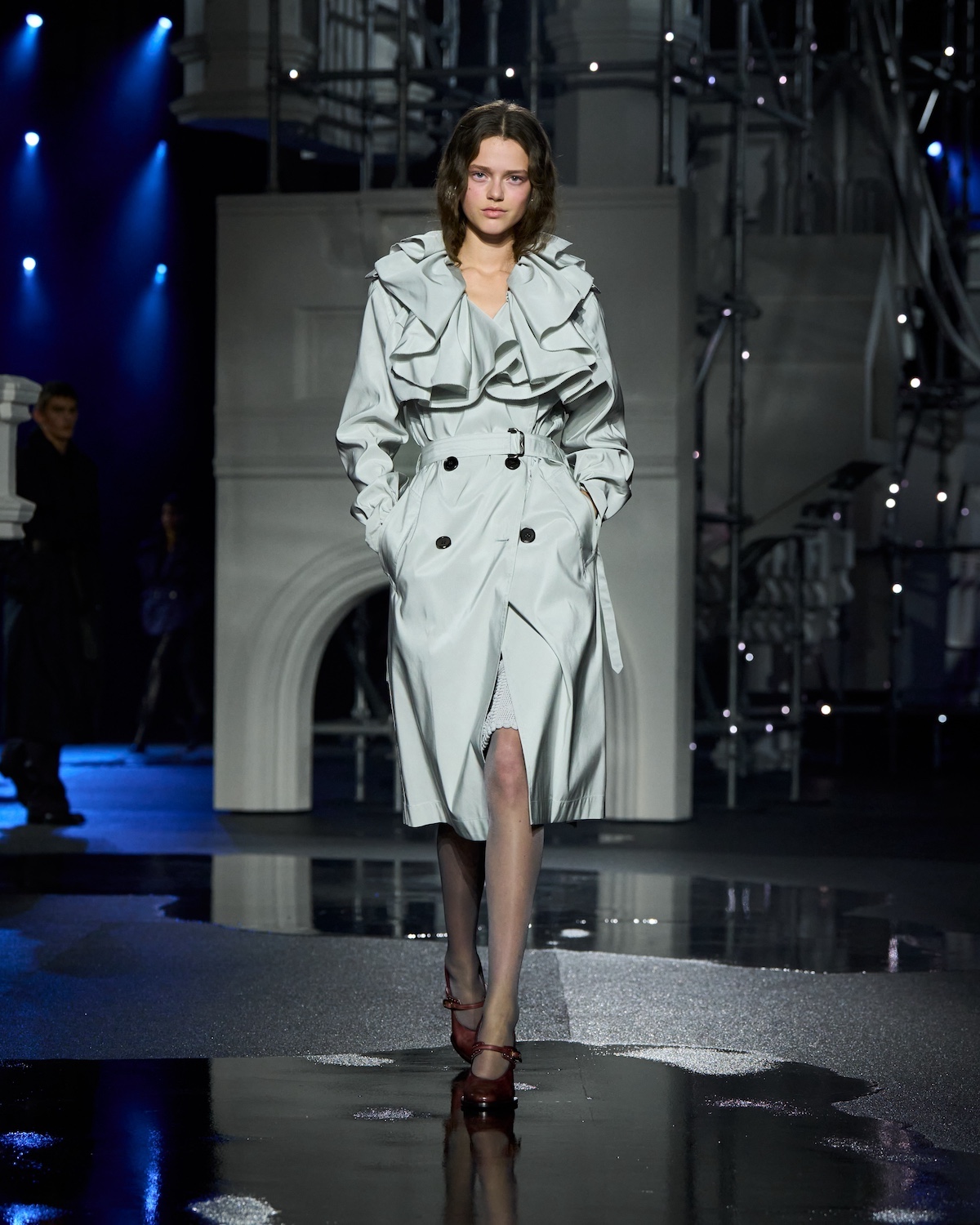
Burberry A/W 2026 at Old Billingsgate, London. Photography courtesy of Wallpaper*
Three years in
Lee's debut at Burberry arrived against considerable scrutiny. His previous work at Bottega Veneta had generated enough critical enthusiasm to position him as one of the most closely watched designers in luxury. Moving to a house with a heritage this specific required a different kind of attention. His first seasons at Burberry traded on the countryside, on weekend coats and open fields. The pivot to London at night signals something else: a settled confidence in the city the brand has always come from.
Burberry cannot ignore London. The heritage is too specific, too anchored in the particular textures of British life for the house to operate as though it exists in the abstract luxury space that most of its peers prefer. What Lee is finding, three years in, is how to make that specificity feel alive. Old Billingsgate was chosen because it is a building mid-transformation: like the city around it, like the house itself. The collection made the case that transformation, handled with this much rigour, is something close to identity.