Daniel Lee walked the Rider down a Burberry runway in September and spent the winter teaching it to behave. In April, it finally arrives in stores — a whipstitched, crepe-soft, stubbornly British argument for what the house’s next handbag should be.
Burberry has spent two decades trying to make an It Bag. The Manor, the Lola, the Knight, the Pocket — each arrived with the expected fanfare and most slipped, eventually, out of the conversation. The trouble was never the craftsmanship. It was that none of them felt quite British enough to justify the house selling them. They were, at their best, handsome leather goods from a London address. Daniel Lee’s Rider is something firmer than that. It is a bag that could only have come from here.
Lee introduced the silhouette on the SS26 runway last September, tucked into a collection that leaned into boho flourishes and music-festival tailoring. The show was polarising. The bag was not. Editors clocked it before the models had cleared the runway and the press release had barely cooled before the waiting lists began to form. Six months later, the finished article is here. It has lost none of its argument in the translation.
What the Rider actually is
The Rider comes in two silhouettes and two sizes. One version hangs with long fringing down each side, the kind that swings when you walk and catches on a coat sleeve if you are not paying attention. The other holds its shape cleanly without the fringe. Both carry a leather top handle and a detachable longer strap, so the object converts from shoulder to hand to crossbody without ceremony.
The hardware carries the house’s equestrian shorthand. Eyelet-studded lips at the opening are set with the Burberry Knight, the brand’s heraldic device revived and reapplied under Lee’s watch. The leather is whipstitched along the seams rather than finished flat. That is a small construction decision with a large aesthetic consequence: whipstitching carries a trace of the hand, even when the bag is made at the scale a luxury house requires.
The palette runs sensibly. Peat brown is the colour the press images keep returning to, but the range extends to soap beige, black, and a python-effect leather treated to catch light without mimicking the real animal. All four are manufactured in Italy. None of them read as tentative.
Why Lee built it this way
Daniel Lee took over Burberry in 2023 and spent his first eighteen months rewiring the accessories workshop. He had come from Bottega Veneta, where he had turned a little-known handbag archive into the house style guide in the space of a season. At Burberry he had the opposite problem. The archive was enormous. The challenge was editing.
His earlier handbag experiments at the house — the Knight, the Shield — were considered and well-finished but read as polite. They had craft. They did not have a thesis. The Rider is the first bag from Lee’s Burberry that feels like a thesis, and the thesis is roughly this: a British handbag should look like it could ride in a Land Rover and still arrive at a Mayfair dinner intact. It should have weather in it. It should not pretend to be French.
You can see the argument in the details. The whipstitching is not the neat hand-finish of Parisian leather goods; it is rougher, more honest, closer to what a saddler would do. The fringe does not sway decoratively the way a Western fringe does. It falls heavier, more clipped, like a riding crop. The eyelets reference boots and belts rather than jewellery. Even the python-style finish has been deliberately softened so it never quite resolves into spectacle.
The Rider is the first bag from Lee’s Burberry that feels like a thesis. A British handbag should have weather in it. It should not pretend to be French.
Camille AshworthThe Britpop line in the sand
There is a phrase circulating in the show notes and the press coverage: “Britpop-ish, rock-and-roll edge.” It sounds like marketing shorthand. It is also, in this case, accurate. Lee’s London references have always pointed backwards through a very particular corridor: Oasis at Knebworth, Pulp at Reading, the tail of the 1990s when British style briefly refused to feel inferior to Paris or Milan. The Rider sits inside that reference. The fringe is Kate Moss at Glastonbury in 2005. The top handle is the same year’s Mulberry Roxanne pulled up short. The whipstitching is the kind of workshop detail a Saturday-afternoon Portobello Road stall would have traded in.
This is not a nostalgia exercise. Lee is too disciplined for that. But he is making a case that Burberry, under his direction, has a specific place in the British leather-goods canon. That place is rougher than Mulberry, more urban than Anya Hindmarch, warmer than Smythson. The Rider stakes out the territory with some confidence.
Where it sits
The Rider launches across Burberry’s flagship stores and its online channels this week, priced in a bracket that puts it in direct conversation with the Chloé Paddington successors, the Loewe Flamenco, and the perennial Chanel 19. That is deliberate. Lee is not positioning Burberry as the cheaper alternative to Paris. He is positioning it as a different answer to the same question.
What the bag needs now is time. The It Bag is a genre Burberry has chased and missed often enough that a good first quarter will not settle anything. The Rider will be judged by what happens in the second and third year — whether it refuses to look dated by SS28, whether the fringe version ages into something cult rather than something embarrassing. The early signs are encouraging. The construction has the kind of density that tends to survive trend cycles.
A bag with somewhere to be
The thing the Rider does best, and the thing Burberry’s previous handbag swings never quite managed, is that it looks like it belongs on a person going somewhere specific. Not a generic luxury customer. A woman with a train to catch, a coat she trusts, a weekend in the country already printed on the back of her mind. That narrow specificity is what makes a handbag work — the sense that it was designed for a life, not a demographic.
Daniel Lee has been playing the long game at Burberry from the start. He has resisted the temptation to overhaul the house every six months. He has narrowed the accessories line rather than sprawled it. He has put real muscle behind a small number of carefully chosen objects. The Rider is the first of those objects to feel like it might actually land, and stay.
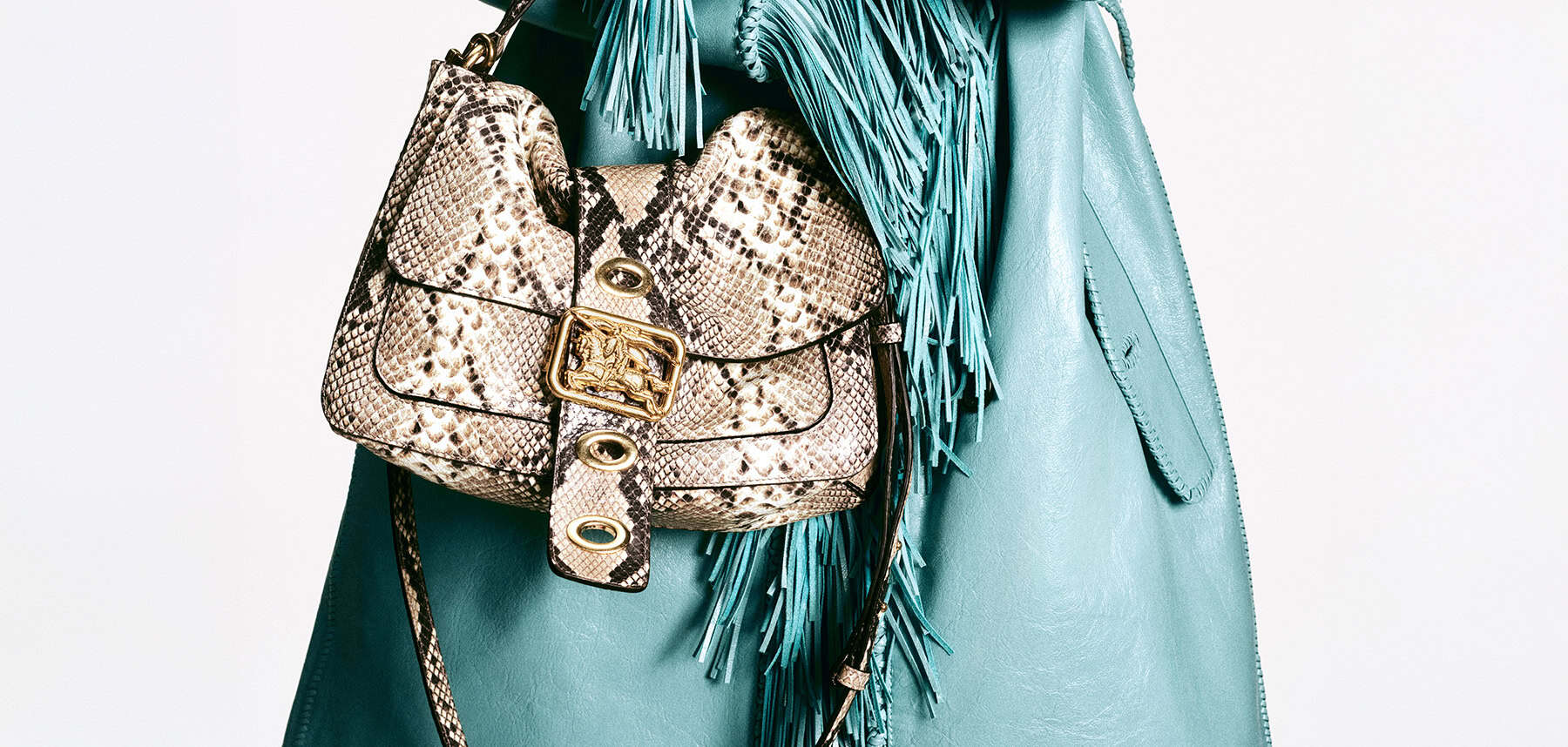
The Burberry Rider, SS26. Photography courtesy of Burberry / 10 Magazine