Burberry turns 170 this year, and the house has marked the occasion in the only way that makes sense: by opening the archive on the trench. Eight coats, four decades, three creative directors. One unchanging proposition — that a single piece of British outerwear can carry the weight of an entire wardrobe, and very nearly an entire century of cinema, weather, and quiet civic pride.
The coat began, as all great British inventions do, in opposition to the climate. Thomas Burberry founded his house in 1856 in Basingstoke, Hampshire, and twenty-three years later he patented the fabric that would change everything. Gabardine was breathable, lightweight, and waterproof in the way that mattered, which is to say it kept the water out without sealing the wearer into a moving sauna. In 1895 he stitched the material into the Tielocken, a belted overcoat with a hook fastening that traveled with British soldiers through the Boer War. The trench coat itself arrived during the First World War, commissioned by the army and quickly refined into the version still recognisable today — double-breasted, buttoned rather than hooked, with epaulettes and a detachable warmer designed for the kind of damp a soldier feels in his bones.
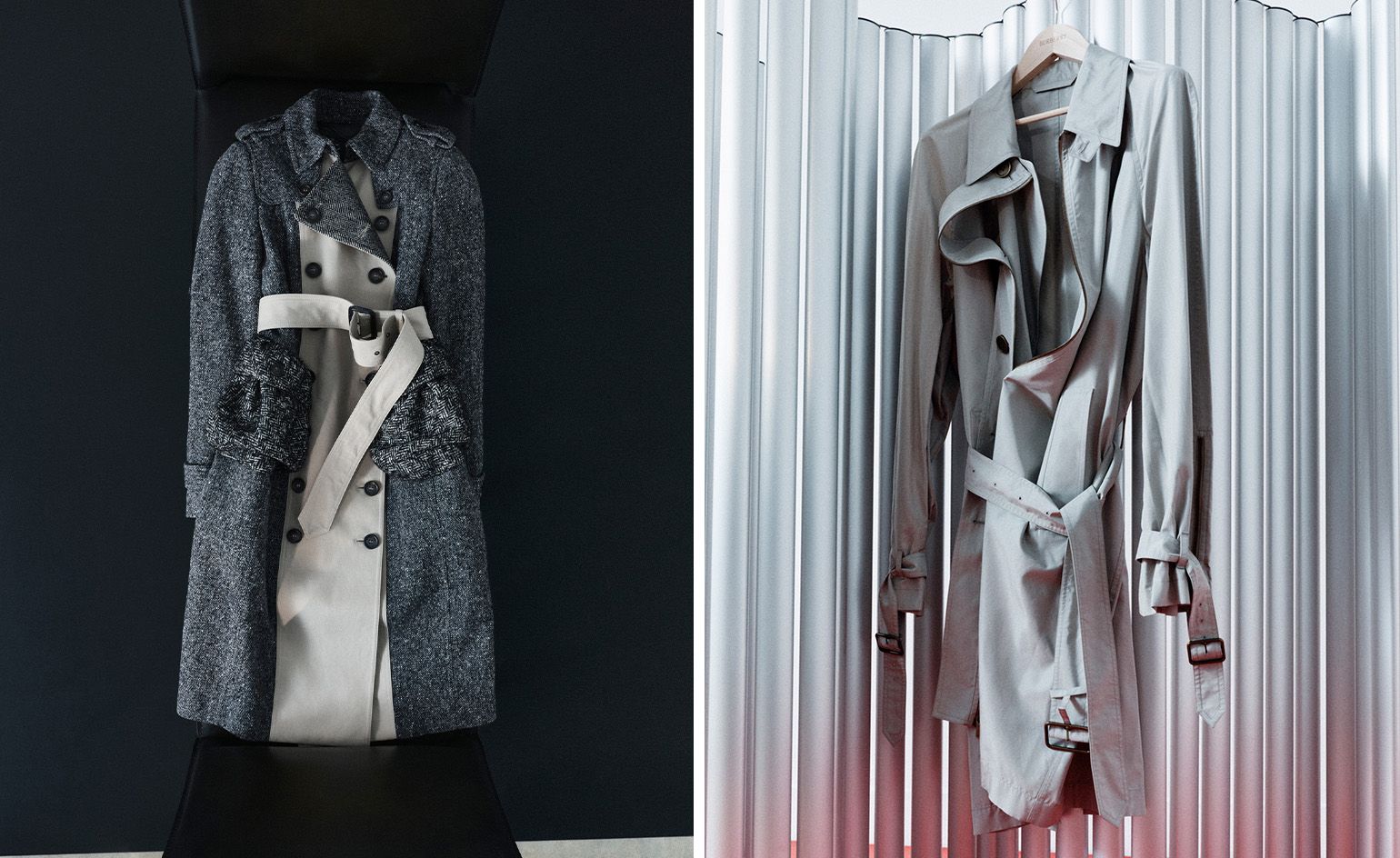
Photography by Trisha Ward
A coat that earned its character
The trench did not become a wardrobe staple by way of fashion. It became one by way of the cinema, which is a different kind of credential entirely. Humphrey Bogart wore it in the rain in Casablanca. Audrey Hepburn ran through Paris in one. Marlene Dietrich, Greta Garbo — the list reads like a syllabus of the twentieth century's most studied silhouettes. There is a reason directors reached for it: a trench coat does the work of half the scene. It tells you the weather is unforgiving, the character is private, and the moment is about to turn. No other piece of clothing has done quite so much heavy lifting on camera.
What this means for the brand is something the marketing department, to its credit, has never had to manufacture. The trench is already encoded with mood. When Burberry shows a new version, it is editing a long conversation rather than starting one. That is a privilege most heritage houses would surrender a flagship to acquire.
The recent directors and what they did with the inheritance
The interesting story of the last twenty-five years at Burberry is not how its creative directors changed the trench, but how each of them found a way to argue with it on its own terms. Christopher Bailey, who ran the house from 2001 to 2018, took the coat at its most cinematic. His Spring/Summer 2013 collection bathed the trench in Quality Street metallics, gold and copper and pewter, a glamour that pretended at irreverence and was in fact deeply reverent — you only dress an icon in tinsel if you trust it to keep its dignity. His Autumn/Winter 2012 show staged a confetti rainstorm with striped umbrellas, an image that has lodged itself permanently in the visual memory of London fashion.
Riccardo Tisci, from 2018 to 2022, pulled the trench in the opposite direction. His most striking archive piece, an Autumn/Winter 2022 trench reimagined as an evening gown, treated the coat as architecture — structure first, fabric second, occasion an afterthought. It was haute couture grammar applied to a Hampshire invention, and it worked because Tisci understood that the trench's formality is not borrowed but native.
Daniel Lee, who took over in 2022, has gone somewhere quieter. His debut Autumn/Winter 2023 trench had the easy authority of something a Londoner pulls off a hook by the door without thinking about it — which is, in its own way, the highest praise a piece of outerwear can receive. In February of this year he showed his Autumn/Winter 2026 collection at Old Billingsgate Market, the floor populated with resin puddles. After more than forty consecutive days of rain in the United Kingdom this winter, the joke was a wet one and entirely earned.
No other garment carries this much cinema, weather, and quiet civic pride in a single set of seams — at 170, the trench still silences every debate about what Burberry is.
Isabelle Rowe, The Splendid EditThe Tim Walker portraits, and why they matter
Accompanying the anniversary is a photographic series by Tim Walker, The Trench, Portraits of an Icon. Twenty-three subjects, including Kate Moss, the musician Little Simz, the actress Teyana Taylor, and the tennis player Jack Draper, are photographed in the coat with the kind of psychological specificity Walker brings to almost everything he points a camera at. The series is the right gesture, because the trench has always been a portrait device first and a fashion item second. It shows the wearer; it does not announce itself.
This is the discreet brilliance of Burberry's anniversary campaign. There is no reinvention, no reissue, no archive-curated drop in collaboration with a sneaker brand. There is simply a house quietly pointing at the thing it has been doing well for a hundred and seventy years and asking, with admirable economy, whether anyone needs further proof.
The case for the investment piece
The coat's longevity is also an argument about how we shop now. After a decade in which fashion has accelerated to a pace no wardrobe can metabolise, the trench remains stubbornly compatible with the way real women actually dress. A Kensington Heritage cut in honey gabardine, the cropped Mayfair in stone, the long Foxfield in oatmeal silk-cotton — these are clothes designed to outlive their season, their decade, possibly their owner. They are, in the most useful sense of the word, conservative. Buy one once. Repair it. Pass it on.
For a brand that has had to argue, periodically, about whether it is luxury or heritage or street or all three, the trench is the silencer of every debate. It is a coat made for the rain in a city that has plenty of it, by a house that has had a hundred and seventy years to perfect the proportions. Anniversaries are usually an excuse to overstate the case. Here the case understates itself, and that, more than anything, is what makes the moment elegant.