Celine has released its Hiver 2026 campaign, and the pictures stay close. Zoë Ghertner photographed Michael Rider's winter collection on the streets of Paris and inside a Parisian flat, with a film by Massimiliano Bomba. The clothes look worn, not staged.
The campaign lands six months after the show. Rider presented Hiver 2026 at the Institut de France on 7 March, his third runway outing for the house. Ghertner has shot Celine before, and the continuity shows. She works in a register that trusts the clothes to hold the frame.
Charles Levai and Kevin Tekinel handled the creative direction. Brian Molloy styled the images, with hair by Duffy and makeup by Lucia Pieroni, and Samuel Ellis Scheinman cast them. The names matter here because the result reads as a group effort rather than a single big idea imposed from above.
Rider arrived at Celine in 2025, after Hedi Slimane’s long run and a stretch of speculation about where the house would go next. His answer has been quieter than a reinvention. He has kept Celine’s appetite for accessories and its habit of building a look from scarves, belts and layered jewellery, then trimmed the proportions and softened the attitude. Hiver 2026 is the clearest reading yet of that project.
Close
Ghertner photographs people at arm's length, without much ceremony. The setting does the same work. A flat with tall windows, a stretch of pavement, light that falls where it falls. The cast reads as a handful of people who might share the apartment: Alaina Rae, Faith Johnson, Frej Larsen, Milo Flaviani.
Her fashion pictures usually favour intimacy over spectacle. Styling, attitude and texture carry the image, and the concept stays out of the way. That instinct suits this version of Celine, where the argument is about how a person puts a look together rather than how a set can be dressed.
The cut
Rider has spent three seasons narrowing the house. Winter continues the move. Coats and suits follow the body, with neat shoulders and fitted torsos. Cropped kick-flare trousers run through the collection, cut to open at the ankle over a boot.
The menswear leans on the French peacoat and a long, narrow overcoat. Leather jackets sit close to the body. Knitwear, shirting and tailoring build a wardrobe organised around proportion. The shapes push back against the oversized silhouettes that have dominated fashion for years.
There is an argument buried in the tailoring. For several seasons the loudest silhouette in fashion has been the largest one, all dropped shoulders and pooling cloth. Rider is betting the other way, on a line that reads the body and asks the wearer to stand inside it. The campaign gives that bet a human scale, showing the coats and trousers in motion rather than pinned flat.
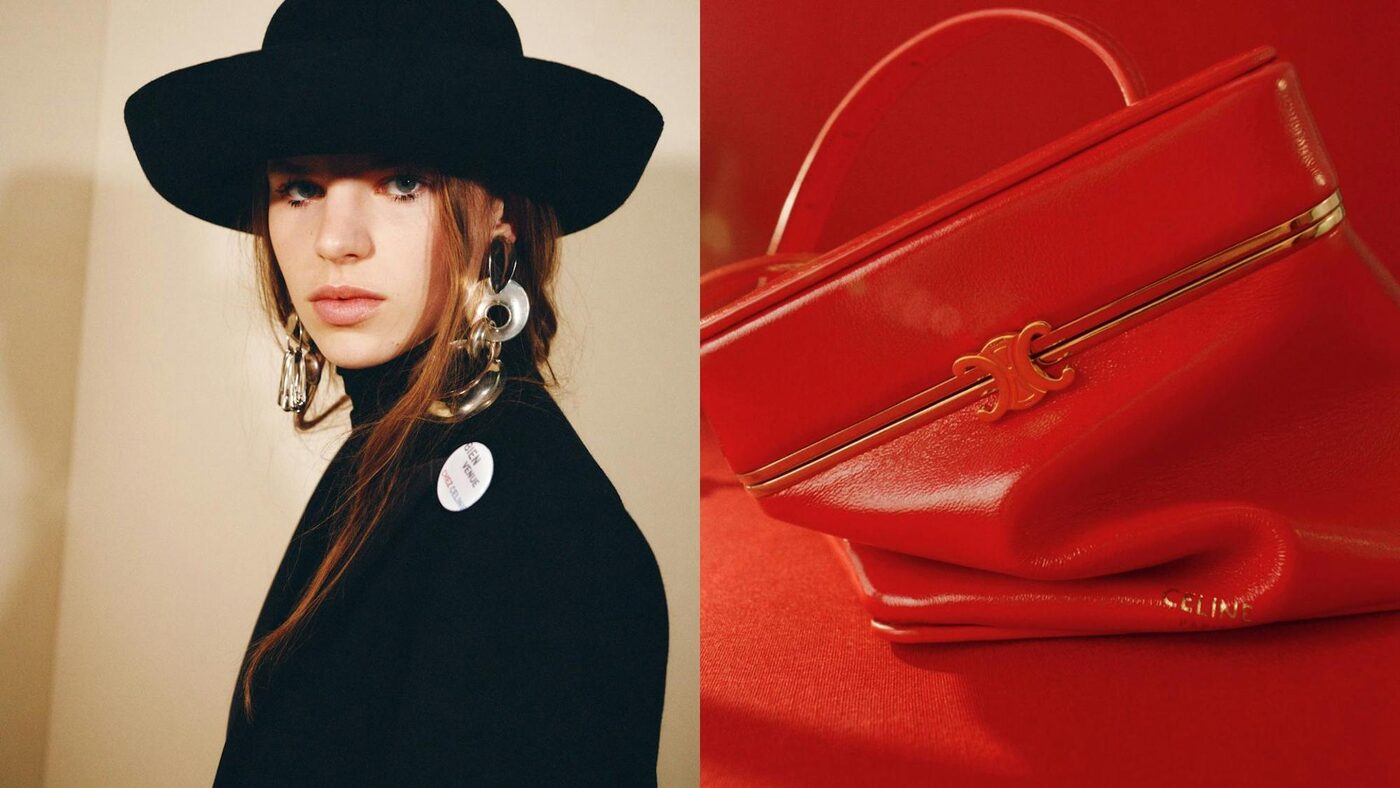
Celine Hiver 2026, photographed by Zoë Ghertner. Courtesy of Celine
Layers
The styling is where the collection loosens. Sweaters knot over suit jackets. Shirt collars stack, one over another. Scarves gather into large knots at the neck and around the face, and headwear arrives as a small provocation worn against the grain of the tailoring.
Black carries most of the collection, then breaks. Animal print, a hot incandescent red, graphic squares of colour. Long floral dresses work as a kind of camouflage, and leather turns soft in trench coats and enveloping jackets. The details pull familiar garments slightly off centre without dulling their use.
The clothes are cut to be lived in, and Ghertner's camera treats them that way.
The Splendid EditCharacter
Around the neck swing necklaces of painted shells, closer to talismans than jewellery. Feathers catch in hair ties. These are the touches Rider uses to place a person behind each look, and they are exactly what the campaign zooms in on.
None of it is loud on the page. The eccentric pieces, the shells and the feathers and the stacked collars, arrive as asides inside otherwise plain looks. That balance is the point. Rider wants clothes that carry a little strangeness without tipping into costume, and Ghertner frames them so the oddness reads as a personal choice rather than a styling instruction.
He has framed the collection as clothes for building a life, made to enter a personal wardrobe rather than sit as isolated runway ideas. In the notes around the show, he described dressing as something that can shift a day, changing the way a person moves and what they feel. The pictures take him at his word.
That is the case the campaign makes without raising its voice. Ghertner's images do not sell a spectacle. They show clothes on people, in rooms and on streets that look like Paris on an ordinary afternoon. For a house rebuilding its vocabulary season by season, that steadiness reads as a position.