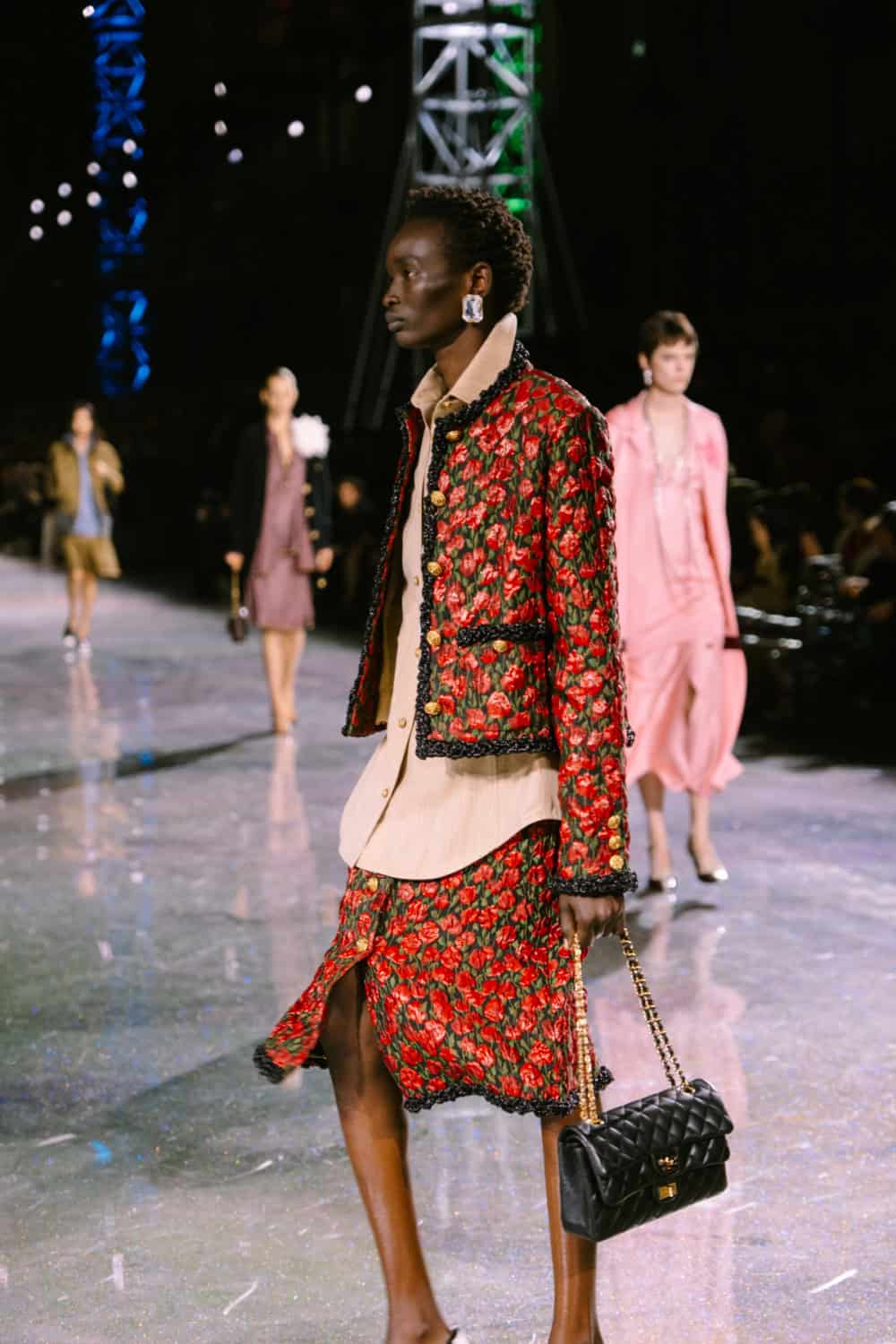
Matthieu Blazy sent a black jersey dress down the Grand Palais runway on March 9th. Unadorned. Cut with intelligence that only the attuned could read. From there, eighty-four looks unfolded as sustained argument about what Chanel means when it contradicts itself. The second season proved the debut was not a single good idea. It was structural.
A second collection tests what the first merely suggests. Matthieu Blazy arrived at the rue Cambon as only the fourth creative director in Chanel's history. His debut last October was warm, but came with an audible reservation: impressive, yes, but could he sustain it. Could an outsider make peace with the house's contradictions without surrendering to them or conducting a renovation the custodians wouldn't sanction. This show answered definitively.
Blazy is not dismantling Chanel. He is showing that its contradictions were always its greatest strength. Rigour and ease coexist. Masculine codes meet feminine expression. Heritage lives alongside invention. The house has always contained these tensions; Blazy trusts them enough to make the contradiction itself the point.
Caterpillar and butterfly
Gabrielle Chanel said it in a 1950s interview: "Fashion is both caterpillar and butterfly. We need dresses that crawl and dresses that fly." Blazy used this as structural logic. Eighty-four looks moved through the argument with consistency. Each piece had its place.
The caterpillar arrived in masculine-coded work shirts cut from bouclé tweed. Blouson jackets. Low-slung skirts borrowing ease from the garçonne silhouette. These pieces had directness that felt almost confrontational. Luxury fashion tends toward complication; Blazy sent pure function down the runway.
Then the butterflies. Dresses in iridescent metal mesh caught Grand Palais light and broke it into colour. Coats threaded with lurex and silicone moved between tailoring and sculpture. A closing gown in black silk with an open back. A single camellia. Both the most Chanel in the room and the most unmistakably Blazy.
Blazy is not dismantling Chanel. He is showing that its contradictions were always its greatest strength, and that no one had simply trusted them enough.
Isabelle RoweThe set as argument
The Grand Palais is one of fashion's most difficult backdrops. Its permanent grandeur overwhelms shows that don't meet it on its own terms. Blazy introduced primary-coloured construction cranes; their lacquered surfaces gleamed against nineteenth-century ironwork. The floor was opalescent, rippling with light that evoked water without naming the reference.
The cranes spoke of transformation. A house being built upon, not torn down. The same argument in three dimensions. Rare in fashion to find a set that does intellectual work. Rarer still for that work to advance the thesis rather than merely illustrate it.
Lady Gaga's "Just Dance" arrived at the moment designed to produce joy. It did. The front row answered with energy. Jennie of BLACKPINK occupied a front-row seat; Chanel's commercial instincts are as sharp as its aesthetic ones.
The bag question
The 2.55. The 11.12. The Boy. At Chanel, these bags are cultural objects, not merely commercial vehicles. Each carries its own history and its devoted constituency. Blazy handled this inheritance with confidence. He has thought about it carefully.
The flap bags returned pristine, original. Last season he sent distressed versions. This season, the message: subversion, once registered, doesn't need repetition. A hybrid bag fused Gabrielle Chanel's 1955 hardware with Karl Lagerfeld's 1983 silhouette. The house's two defining eras. Coexisting, not competing. In quilted black leather, the answer was yes.
Metallic cap-toed heels. Sock-like two-tone boots. The V-vamp pump in mule and ankle-boot iterations. These were the commercially obvious hits; wait-lists formed within hours. They were good.
The case is closed
His debut last October was warm but hedged with questions. Could he sustain it. Could an outsider make peace with rue Cambon's peculiarities without surrendering to them or conducting a renovation the custodians wouldn't sanction. Fall 2026 answers definitively.
Blazy is not dismantling Chanel. He is not hijacking its identity. He is showing that contradictions between rigour and ease, masculine and feminine, heritage and invention were always its greatest strength. No one had trusted them enough to make the contradiction itself the argument.
Gabrielle Chanel built an empire on borrowed vocabulary and revolutionary instinct. She would have found this argument persuasive. The collection sells with the urgency that follows a show the industry has decided matters. The customer agrees.
The standouts
The standouts occupy the middle ground. Neither pure caterpillar nor fully unfurled butterfly, but suspended in transition. The bouclé blouson over a drop-waist silk skirt. The ribbed knit coat with lurex threading, light-catching. The jersey dress that opened the show will become the one designers spend years trying to claim as their own.
The closing image ends up in retrospectives. Black silk. A camellia. An open back. Whether Blazy's tenure becomes the subject of a retrospective will take years to answer. On the basis of what arrived at the Grand Palais, the answer looks very much like yes.
Chanel Fall/Winter 2026 was presented at the Grand Palais, Paris, on 9 March 2026. The collection is available through Chanel boutiques worldwide and at chanel.com.
Photography by Christina Fragkou / 10 Magazine