Chanel's little black dress is one hundred years old. Gabrielle Chanel drew it in 1926, and American Vogue called it a Ford, the car everyone would own. This spring in Biarritz, Matthieu Blazy went back to the year it began.
The dress arrived in 1926 as a short, straight column in black crepe. Vogue printed it and predicted it would become a kind of uniform. Black had belonged to mourning and to servants. Chanel moved it to the center of a woman's wardrobe and left it there.
1926
The line sat low at the waist and stayed plain across the surface. Long sleeves, a hem near the knee, almost nothing added. The Metropolitan Museum keeps a Chanel dress from that year in its Costume Institute and files it as everyday clothing rather than couture spectacle. The cut did the work.
That was the argument. One dress could pass from afternoon to dinner when the gloves and the jewelry changed. The plainness was the point. It gave a hat somewhere to sit and a rope of pearls a reason to exist.
The shape matched the decade. Hems were rising, the corset was going, and women wanted clothes that let them move. Chanel borrowed from menswear, from jersey and from sport, and cut the body some slack. The Met reads that 1926 dress as part of the same shift, a garment built for a life spent upright and in motion.
The Ford
Vogue's line about the Ford has followed the dress for a century. The magazine meant reach, not price. Chanel's crepe cost real money. The comparison pointed at repeatability, a single shape that could belong to everyone and still look considered.
The prediction held. The little black dress became a category, then a reflex. Women reach for it when a dress code is unclear and trust it to answer. That spread is the measure of 1926.
It also changed how a dress could show its value. With little on the surface, the eye goes to line, proportion and finish. A plain black dress has nowhere to hide a weak seam or a cheap cloth. The idea asks for discipline, and it reads as luxury when the discipline is there.
Biarritz
Blazy showed Chanel's Cruise 2026/27 collection in Biarritz on 28 April. He opened with a black dress. Before he drew it he spent time in the Costume Institute at the Met, reading the old garments up close.
The cruise show is where a house speaks to the money, the clothes that sell through the year. Blazy chose to start that commercial collection with a history lesson. It was a signal about how he means to spend the archive.
His version kept the black and the dropped waist and changed the rest. The neckline became a deep V. Geometric stitching ran across the shift in contrast thread. On a surviving 1920s dress he found a large bow at the back. He did not copy it. He turned it into a clutch.
Biarritz is not an accident for Chanel. She opened a house there in 1915, on the Basque coast, dressing women for sport and sea air. Blazy carried the centenary dress back to the town where the label's ease first took shape.
A black dress hides nothing. The cut is the whole confession.
The Splendid EditThe archive
Blazy has spent his first year at Chanel treating the archive as working material. He reads it, questions it, takes it apart. The little black dress is the clearest test of that method. It is famous enough to repeat on reflex and simple enough to ruin.
He avoided both. He held the logic, black, movement, a lowered waist, and rewrote the surface. The bow that became a bag is the tell. He looked for the detail history had smoothed over and built the new piece around it.
Chanel's codes can harden into symbols repeated for recognition alone: the camellia, the chain, the tweed. Blazy is trying to keep them working instead. The centenary dress is a small, exact case of that. He held the thought behind the 1926 design and let the object change.
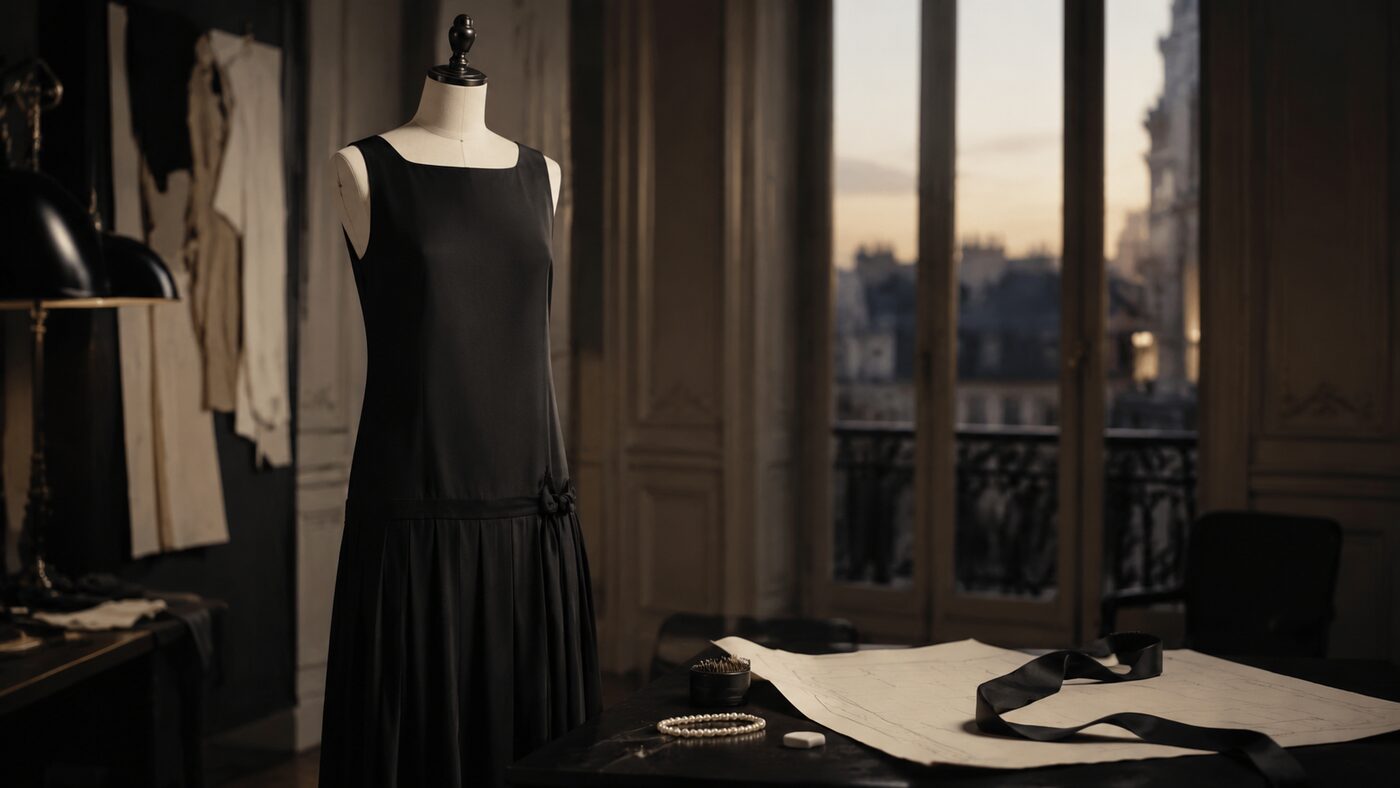
Courtesy of Fashion PR Firm
The stakes
The timing helps. Chanel walks toward Spring/Summer 2027 with a story every shopper already knows. A black dress does not lean on novelty the way a themed runway look does. It sells on cut, cloth, weight and the way it moves.
Vogue placed the original and Blazy's version side by side in an archive feature on 20 August. The comparison flatters the new dress and raises the bar for the collections that follow. A house that claims the little black dress has to keep earning it.
The garment left Chanel long ago. It hangs in every price bracket and every closet, which is both the proof of 1926 and the trap. When everyone owns the little black dress, Chanel has to show why its own still counts. One hundred years on, black stays the hardest thing to make new, and the most worth trying.