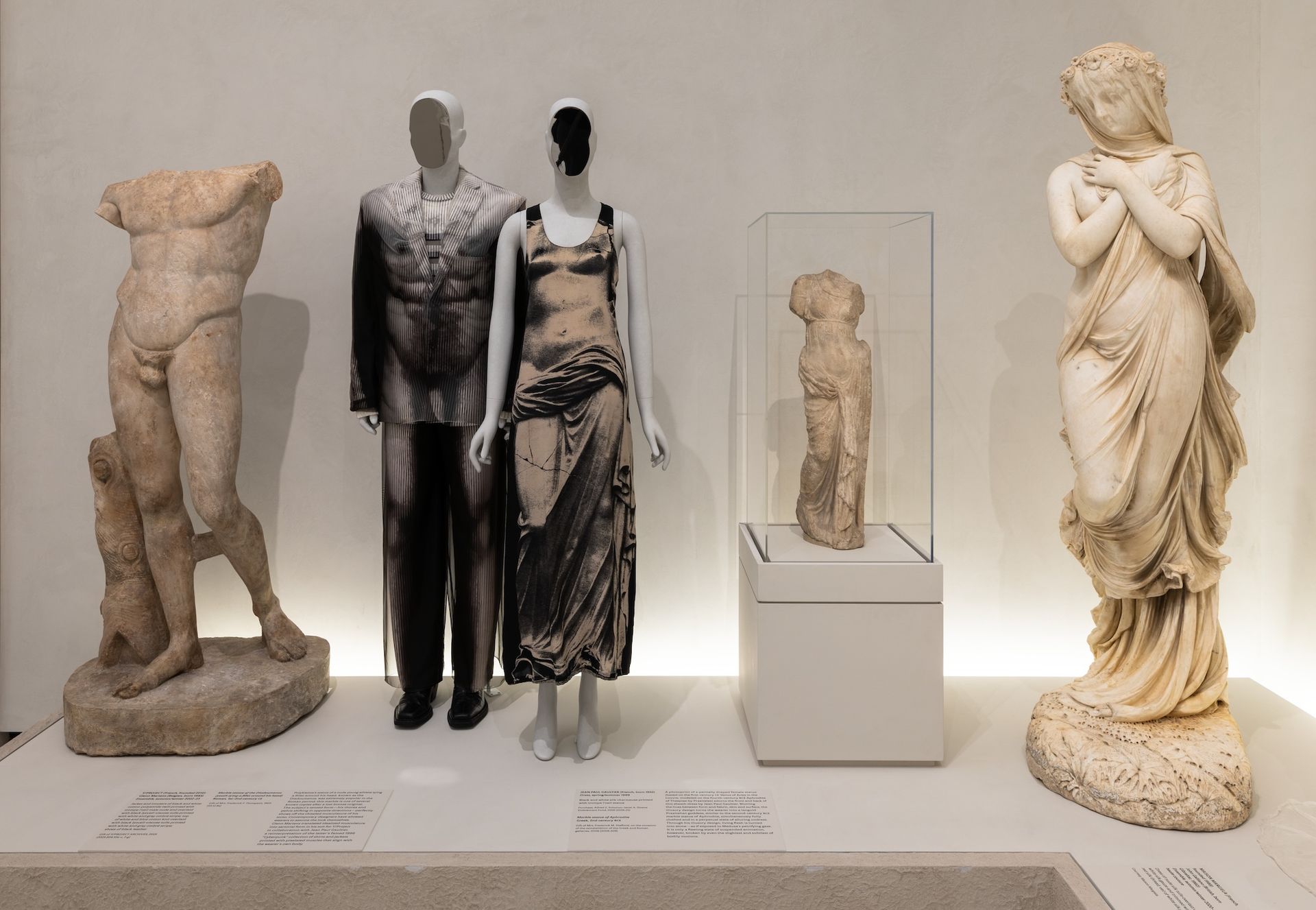
Walk into the Condé M. Nast Galleries on Saturday and a McQueen lace dress will be standing on a body shaped like Michæla Stark’s. The face above it will not be a face. It will be a polished steel mirror, and the reflection in it will be yours.
Costume Art opens to the public on 10 May. The exhibition fills the Condé M. Nast Galleries, the new wing on the Met’s south flank, with roughly four hundred objects pulled from across the museum’s collection. Garments hang beside paintings, sculpture, and antiquities. The thesis, set out by Andrew Bolton, the Costume Institute’s curator in charge, is that fashion has always been art and that the museum’s separations have been administrative, not aesthetic.
The thesis is familiar by now. The mannequins are not.
Fourteen new forms, scanned from living people, sit at the centre of the exhibition. They are short, tall, pregnant, paraplegic, plus, ageing, gender-diverse. Each one was shaped from a 3D body scan taken inside a rig of one hundred and seventy-five cameras, then designed digitally, printed, and finished by hand. Above each torso sits a head by Samar Hejazi, a Canadian-Palestinian artist whose practice with mirrored steel was familiar to Bolton from her gallery work. The heads have no features. They are polished discs.
The bodies, named
The Met has been quietly explicit about whose bodies these are. Michæla Stark, the Australian artist whose self-portraits bind and reshape her own flesh, sat for one of the scans. Antwan Tolliver, a model who became paraplegic after being shot, sat for another. Sinéad Burke, the Irish writer and accessibility advocate born with achondroplasia, sat for a third. Each of them stood, or sat, in front of the cameras in close to nothing while a hundred and seventy-five lenses fired at once. The scan that came out of the rig is the form on which a Charles James gown, a McQueen tailcoat, an Issey Miyake folded silk, will now be shown.
The point is in the specificity. A mannequin shaped from no one in particular reads as a generic ideal. A mannequin shaped from a person you can name reads as that person, holding the dress up. The garment is no longer floating above an absence. It is fitted to a presence.
After the show closes in January 2027, the fourteen forms enter the museum’s permanent collection. The next Costume Institute exhibition, and the one after that, will be installed on bodies that were not invented to make the clothes look easy.
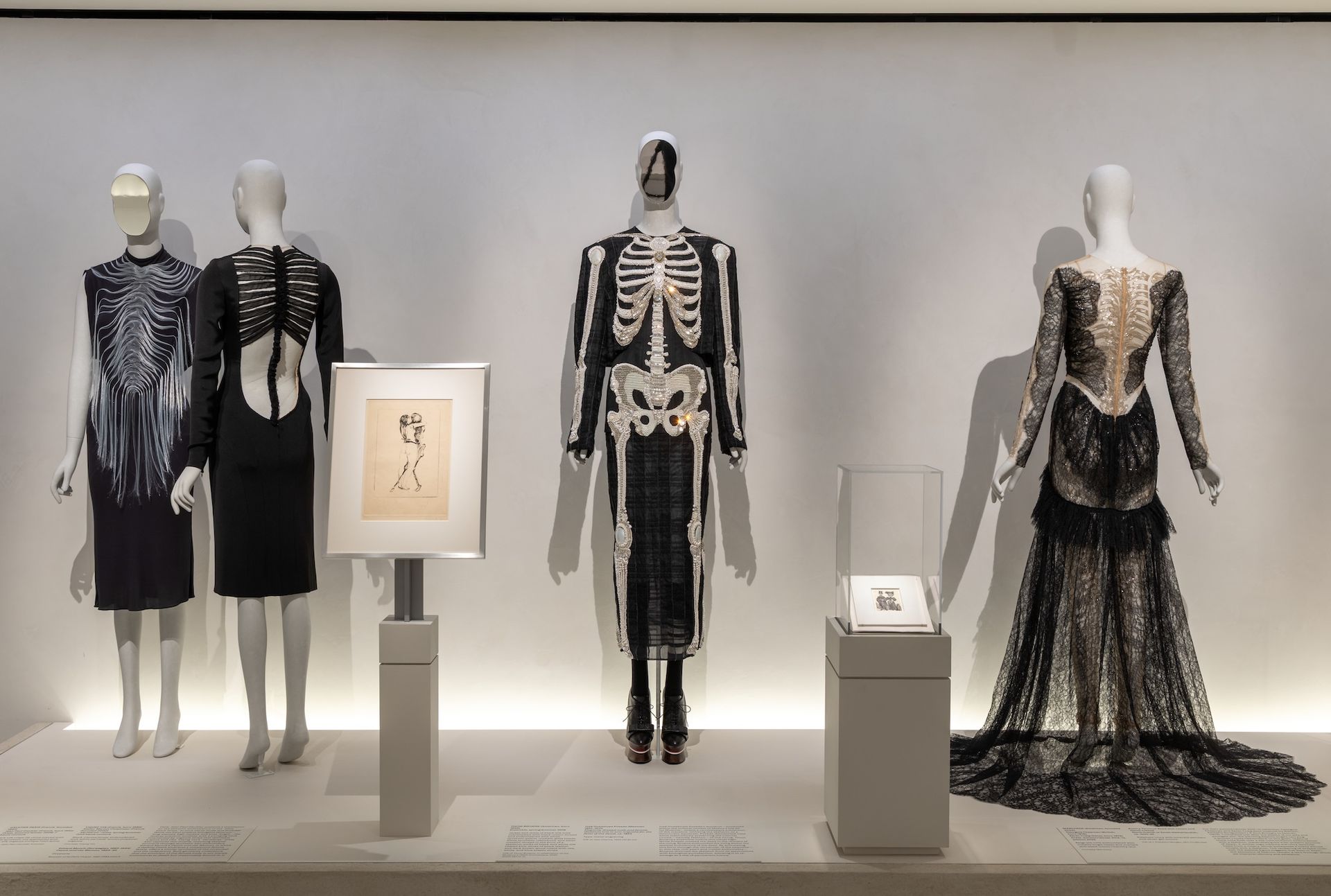
A bespoke mannequin in the Condé M. Nast Galleries with Samar Hejazi’s mirrored head. Photography by Anna-Marie Kellen, courtesy of Wallpaper*.
Why the mirror
Hejazi has been making mirror works for years. Steel, polished to optical clarity, set into shapes that catch a viewer mid-stride and return them to themselves. Bolton commissioned her on the strength of that practice. The brief was simple. Replace the face on the Met’s mannequins with something that closes the loop between viewer and garment.
The result, walked through last week ahead of opening, does what museum heads almost never do. It refuses to do the period-portrait work, the wig and the contoured cheek, the arched neck. It hands that work back to the visitor. Stand in front of a Worth ball gown and the head wearing it has your face. Lean closer and the proportions shift. The dress is on a body that is not yours, with a mirror that is.
Fashion exhibitions have spent twenty years cultivating the visitor as voyeur, kept at distance behind cordon and glass. Costume Art reverses the angle. The garment looks back.
The dress is on a body that is not yours, with a mirror that is.
Isabelle RoweThe new wing
Costume Art is the first show to open inside the Condé M. Nast Galleries, the dedicated Costume Institute spaces named for the late publisher and funded out of Anna Wintour’s long campaign for the wing. The galleries are larger, taller, and more flexible than the basement rooms the Costume Institute used for forty years. The lighting brief reads closer to a contemporary art space than a fashion vault. The mannequins, in this room, sit as sculpture rather than dressmaker’s forms.
That is the institutional argument the show is making. Garments belong on plinths. Plinths require plinth-quality bodies. The Met has built fourteen of them, by name, from people who walked in for a scan.
The dress code, in retrospect
Monday’s gala read the show as a costume party, which is what galas do. The carpet’s Costume Art looks were costume, not art. The exhibition itself is the inverse. Walk past the Madonna Carrington tableau in the gift-shop window, climb to the second floor, and the argument is being made in the quiet register the gallery affords. Body, garment, mirror. The visitor enters the cabinet.
The exhibition runs in the Condé M. Nast Galleries from 10 May 2026 through 10 January 2027. Tickets are timed. The mannequins, after that, stay.