Nicolas Di Felice steps down as artistic director of Courrèges after five years. His final collection studied a Parisian woman’s day from first light to the last Metro home. It arrived as manifesto and love letter in equal measure.
He leaves at the sharpest point of his vocabulary. Five years at the same frequency, collections finding their register, audiences learning to read them. Di Felice departs not because the project exhausted itself but because five years is enough.
When he arrived in 2021, Courrèges carried more history than momentum. André Courrèges invented something radical in the 1960s: geometric silhouettes, white vinyl, a vision of the future both utopian and precise. The label spent decades unable to locate contemporary relevance in that inheritance. Di Felice, Belgian, trained under Raf Simons, years at Louis Vuitton, understood the problem was never the archive. It was courage to use it differently.
The final collection
Titled 24 Hours in the Life of a Courrèges Woman. Structured like a film. Guests found a clock instead of the usual invitation card. The set replicated a Paris street: narrow, functional, scored with manholes and pavement markings. The soundtrack moved through textures of an ordinary day; coffee percolating into silence, half-heard radio news, the particular quality of late-afternoon light. Di Felice channelling the Belgian filmmaker Chantal Akerman, whose work tracks the drama inside the quotidian.
The clothes matched that ambition. Slim coats with funnel collars in glossy vinyls, proportions precise as a ruled line. Pleated skirts moving with slick mechanical rhythm. Evening dresses assembled from organza printed with Paris Metro tickets and cloakroom stubs. A new bag, the Shadow, appeared to mold to its contents, defined not by its own shape but by what it held.
The problem was never the archive. It was courage to use it differently.
Léa FontaineFor the finale, every look reappeared in white. An open canvas. A gesture toward whatever the house might become next. A generous exit from a designer who leaves without pulling the building down around him.
Five years
He found a way to make the Space Age idiom speak to the present without translating it into nostalgia. The vinyl stayed; it arrived in cuts that felt contemporary. The geometric rigour remained; it was offset by a clubby sensibility entirely his own, a willingness to let the clothes exist at night as comfortably as by day.
The vinyl jacket became the label’s most recognisable object under his watch. The bags accumulated a devoted following among women who had never previously thought of Courrèges as a house they needed. He made the brand relevant to a generation with no investment in its history.
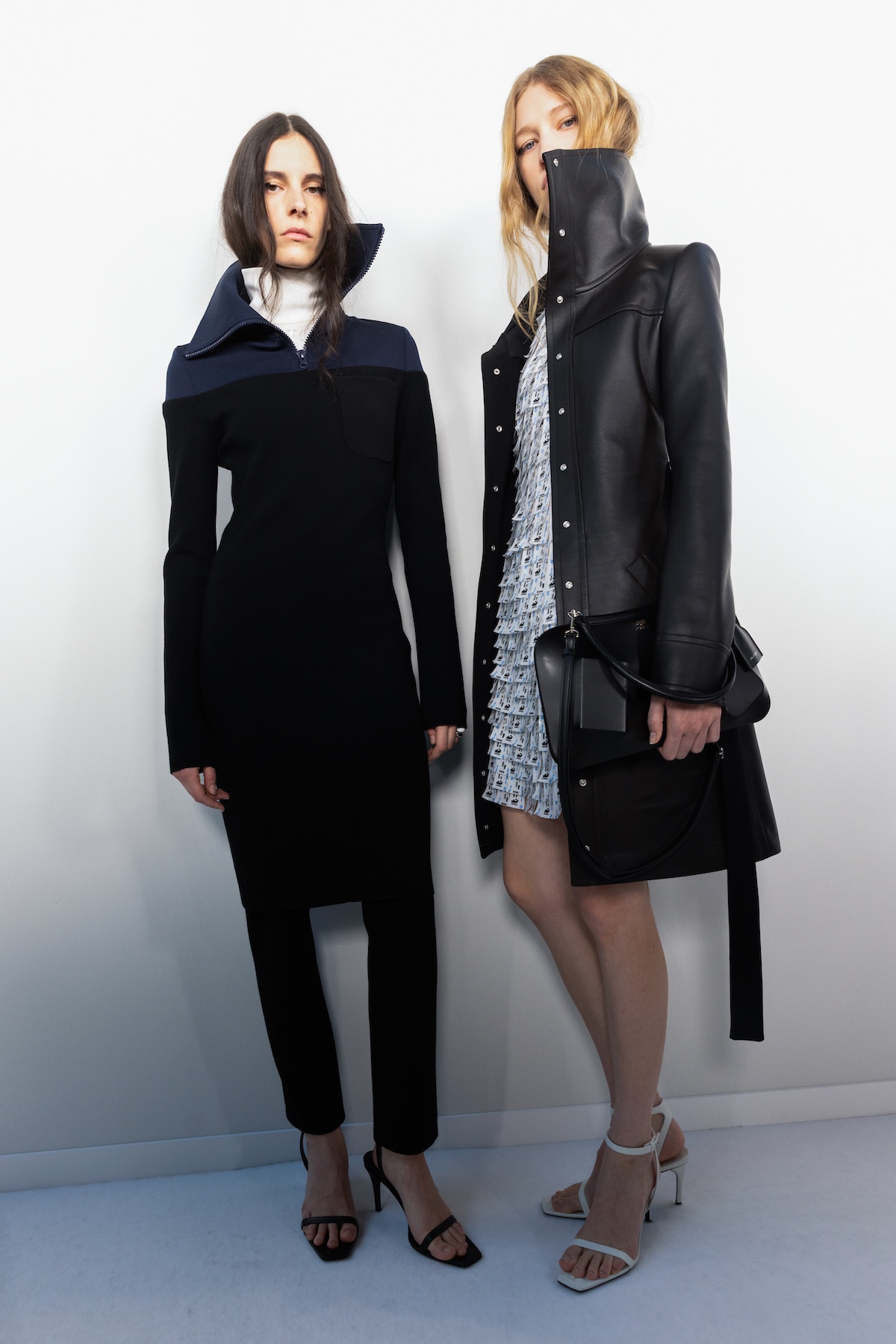
Backstage, A/W 2026. Photography by Delphine Achard
What comes next
Courrèges is owned by Artemis, the Pinault family’s holding company. A successor will be announced imminently. The list of names in circulation is long. The list of designers who could continue what Di Felice built is shorter.
Di Felice appears next as guest designer at Jean Paul Gaultier’s haute couture presentation. Speculation about permanent appointments has already begun. Alaïa and Rabanne mentioned in conversations that may or may not be grounded in anything more than wishful thinking.
He arrived with a point of view, maintained it against institutional pressure to dilute it, and leaves with that point of view intact. The Space Age, in his hands, never became a costume. It became a living argument.