The invitation arrived as a miniature green park chair. The show took place around a pond in the Tuileries, on a runway that cut through lily pads and water lilies, elevated above the surface of the garden itself. Jonathan Anderson had staged a walk in the park as a form of theatre. The circular path. The crowd arranged in tiers. The collection moving through green space as an act of seeing and being seen.
This is Anderson's second ready-to-wear collection for Dior, and his sophomore statement carries the confidence of someone who has already made his point. In January, his couture debut referenced the sculptural forms of Dame Magdalene Odundo's ceramics and a small posy of cyclamen that John Galliano left behind. That show was about inheritance and debt. This one is about freedom.
A garden of movement
The silhouettes arrive lean and contemporary. Narrow shoulders. Waists that sit at the natural anatomical point. Trousers in fluid fabrics that move away from the body rather than cling to it. A series of striped knits in the house codes of navy and white, worn with elongated skirts that brush the ankle. Simple dressing with no artifice.
What reads as simplicity contains extraordinary attention to the way fabric moves in air. Capes lined with contrasting silk. A dress of raw linen that shifts in tone as light passes across its weave. Coats cut from oversized checks that break down into smaller and smaller patterns as they approach the hem. A tonal palette of greens and greys and whites, punctuated by moments of deep red.
The show began at dusk. Models walked in near-silence across the circular runway, the only sound the gentle movement of fabric, the occasional splash of water, the ambient murmur of the garden itself. Each piece announced itself through proportion and material rather than ornamentation. No logos. No heavy branding. The clothes trusted themselves.
Dior's future form
Anderson designed this collection in under a month. He works with prolific intensity, the same speed that defined his tenure at Loewe refined now through the vocabulary of Dior. The house codes still read in the proportions of the jackets and the cut of certain silhouettes, but Anderson has loosened his grip on the past.
Between the couture debut, this ready-to-wear, and a forthcoming menswear collection, Anderson has produced an remarkable volume of work in rapid succession. Each piece feels considered rather than rushed. The vision coheres not through repetition but through clarity of intent.
Dior has this giant past, and I had to start there. Now I feel free to release it from that.
Sienna CaldwellThe meaning of the walk
Anderson chose the Tuileries deliberately. The Grand Allée stretches from the palace gardens toward the Seine. The walk itself has a certain formality, a ceremonial quality. To stage a fashion show as a walk through those gardens was to acknowledge the relationship between fashion and performance, between the person wearing the clothes and the person watching them move through space.
The collection spoke to that directly. Clothes designed for movement, for the angle of light at a particular hour, for the specific way a body inhabits public space. No pretense. Just presence. The clothes got out of the way and let the women in them be the subject.
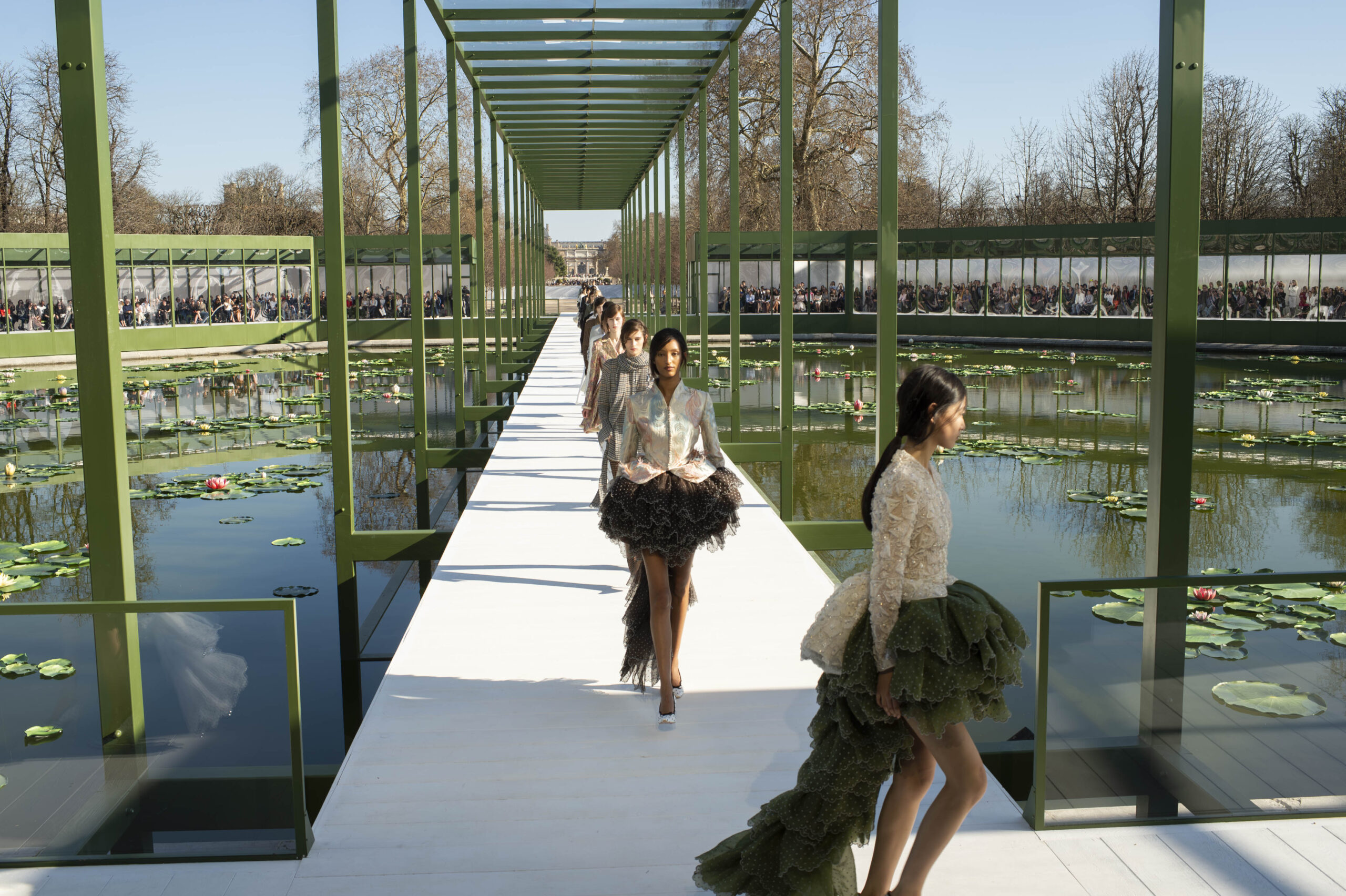
Dior A/W 2026, Tuileries Gardens. Wallpaper*
For a moment, in a garden in Paris, fashion became about the most ordinary and profound thing: a person walking, being seen, moving through light and air. Anderson's Dior stands in the light of that ordinary moment.