Six days after Nicolas Di Felice stepped away from Courrèges, the house named his successor. Drew Henry, senior design director at Burberry, will assume the role of artistic director in May and present his first runway collection at Paris Fashion Week in September.
The announcement came on March 30. Henry is 35, South African-born, raised in Mpumalanga. He trained at LISOF in Johannesburg before completing his MA under Louise Wilson at Central Saint Martins, where his peers included Lee Alexander McQueen and Kim Jones. He has since worked at Céline, JW Anderson, and most recently Burberry, where he has been senior design director since 2023.
The lineage
Henry is the latest designer to emerge from Phoebe Philo's professional orbit and land at the helm of a major Paris house. Di Felice followed a parallel route, working under Nicolas Ghesquière before arriving at Courrèges in 2020. The pattern is not accidental. Philo's studio produced a generation of designers who understand precision, material integrity, and the quiet power of proportion. Henry carries all three.
His years at JW Anderson added something else: an ease with conceptual thinking that never loses sight of the wearer. Jonathan Anderson runs a studio where the idea and the garment must resolve themselves in the same gesture. Henry absorbed that discipline for several years before moving to Burberry, where he worked alongside Daniel Lee on some of the house's most formally ambitious collections.
What Courrèges needs
Di Felice rebuilt the house with considerable skill. He reintroduced vinyl, repositioned the archive of white and silver and primary colour, and brought a generation of younger customers to a brand that had drifted. His six-year tenure gave the house its commercial footing and its cultural moment. The AW26 collection, shown in Paris in March, closed that chapter with rigour.
Henry steps into a house with strong foundations and a clearly defined visual identity. The challenge ahead is one of evolution. Courrèges belongs to a particular moment in French fashion history, 1960s futurism made physical, and every creative director must decide how far to carry that inheritance forward and how much weight to give it.
André Courrèges believed in clothes that make sense for how people live. That matters to me.
Drew Henry, quoted by Camille AshworthHenry's own words point toward a practical sensibility. "André Courrèges believed in clothes that make sense for how people live. That matters to me." The statement does not foreground spectacle. Courrèges in the 1960s was radical because it was functional. Short hems. Flat shoes. Clothes designed for women who moved. Henry seems to understand that the radicalism was always grounded in purpose.
September
François-Henri Pinault, whose Kering group has owned Courrèges since 2018 alongside a roster that includes Gucci, Balenciaga, Saint Laurent, and Bottega Veneta, described Henry as someone with "a clear point of view" who is "well placed to lead the next phase." The language is measured. Pinault has overseen enough creative transitions to know that the point of view rarely declares itself in the announcement.
It declares itself in September, at the show. Paris Fashion Week will be watching closely.
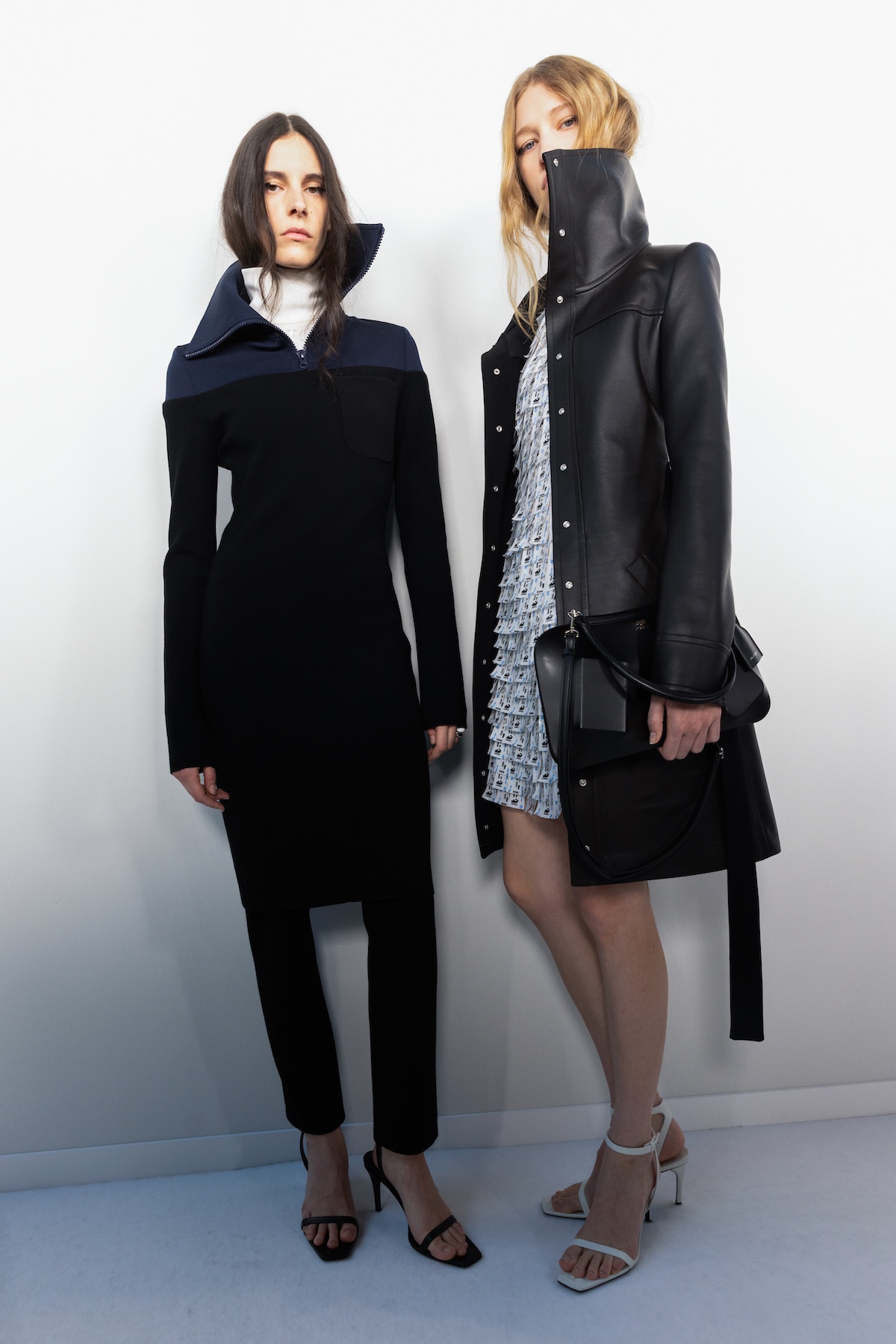
Courrèges A/W 2026, Paris. Photography courtesy of 10 Magazine
Henry begins in May. Between now and September he will have four months with the Courrèges archive, its ateliers, its teams, and the accumulated intelligence of a house that has survived several reinventions. The question he carries into that time is the same one every incoming creative director faces: what does this house know that the world does not yet need, but soon will?