Ferrari Style has opened its first standalone flagship outside Italy, at the corner of Old Bond Street and Piccadilly. The building is a 1905 Queen Anne block; the interior, 850 square metres of hand-brushed stainless steel and Maranello red, makes the argument that a car company can hold its own among the Parisian leather houses next door.
Number Forty-five Old Bond Street was, until recently, the London home of De Beers. When the diamond house left, the block sat for months with brown paper on the windows. The Officina that now occupies it is the sort of tenant Mayfair has been quietly waiting for: Italian, technical, spending heavily on the things you cannot see.
Ferrari Style, the ready-to-wear and accessories division that Rocco Iannone has led since 2021, has spent four years building its case slowly. A boutique in Milan, an atelier in Maranello, a growing footprint in department stores on two continents. London is the first address where the house has tried, seriously, to stand on its own. The neighbours are instructive. Cartier sits a few doors down. Prada is closer still. Tiffany keeps shop on the opposite pavement. The block has a vocabulary and Ferrari has chosen to speak it.
The building, and what is inside
The flagship spans three floors of the 1905 facade, preserved almost exactly as the previous tenant left it. The exterior is a quiet Queen Anne pile in Portland stone, repointed recently but not cleaned too aggressively. Someone on the design team understood that a facade in this part of London is not a thing to be restored so much as inherited.
Inside, the gesture shifts. The ground floor has been opened to the street through floor-to-ceiling windows, with a gallery-style arrangement of aluminium and glass vitrines. Hand-brushed stainless steel runs along the perimeter, catching light the way a tooling bench in a workshop does. The flooring is concrete, polished but not lacquered. Ferrari red appears sparingly: on the spines of the vitrines, a thread running through display shelving, a single leather-clad column near the stair.
Upstairs, the Tailor Made Atelier sits behind leather curtains rather than walls, so the fitting room reads as a workshop. Clients can order suits, coats, driving jackets and accessories across the full range of house leathers and wools. The space is built around a tailor’s table rather than a showroom sofa. Below ground is the Caveau, a private chamber for rare Ferrari components and collectibles. It is, in practice, a Mayfair reliquary: a room you are invited into rather than shown, where the line between fashion and automotive heritage becomes deliberately porous.
The team, and the language of workshops
Iannone assembled an unusual pair for the project. Formafantasma, the Milan studio run by Andrea Trimarchi and Simone Farresin, took charge of the interior objects and fixtures. Gonzalez Haase AAS, a Berlin architecture practice whose past clients include Balenciaga and Andreas Murkudis, handled the spatial plan. Both studios work in a register that might be called curatorial minimalism: nothing decorative, nothing unnecessary, every surface chosen with the seriousness that another designer might reserve for a chair.
The choice is telling. Mayfair retail has, for a decade, been dominated by two languages. One is the French maison vernacular: boiserie, bronze, travertine, the dim lighting of a private drawing room. The other is the Italian heritage vernacular: terrazzo, brass, marble archways, the mood of a palazzo. Ferrari has rejected both and chosen a third. The shop reads as a working space that has been kept polite for clients, closer in spirit to an engineering studio, or the cleaner end of a Formula One paddock, than to any of the boutiques on the same block.
The shop reads as a working space that has been kept polite for clients. It is closer in spirit to an engineering studio than to any of the boutiques on the same block.
Juliette MarchandWhat Ferrari Style is trying to be
A question sits underneath every car-brand fashion line and has to be addressed directly. Can an automotive house credibly make clothes that people will wear when they are not thinking about cars? Most attempts so far suggest not. Lamborghini’s line is a merchandise shelf by any honest reading. Porsche Design has survived by narrowing itself to accessories and eyewear. Aston Martin made a run at tailoring and retreated. Ferrari, under Iannone, is trying something different, and the London flagship is the clearest statement of that difference yet.
Iannone came to the house from Dolce & Gabbana, where he had spent most of his career, and from Pal Zileri before that. His work at Ferrari has moved the line away from the logo-forward streetwear the brand sold for two decades, toward a sober Italian ready-to-wear with a technical edge. The tailoring is cleaner than the Milanese standard. The leathers are heavier. The sportswear borrows from racing uniform without the costume. It is a coherent wardrobe that could be worn by a person who does not own a car, which is the only honest test.
Why London, why now
The timing is unsurprising if you read the Mayfair retail ledger. Old Bond Street has had a remarkable two years. Celine opened a three-floor flagship further up the street. Bottega Veneta took the space opposite Cartier. Rents have held their ground through a difficult broader market because the tenants at this end do not depend on foot traffic. They depend on appointments, on the customer who has been to the atelier in Paris and wants the same service closer to Grosvenor Square.
Ferrari Style is betting that the same customer, who owns a 296 or an SF90 or is on the waiting list for a Daytona, will come in for a wool overcoat on a Tuesday afternoon. It is not an obvious bet. The Mayfair Ferrari owner has, historically, been served by tailors in Savile Row and boot-makers in St James’s. The brand has finally decided to compete directly for the wardrobe rather than licensing someone else to do it.
A workshop, with a postcode
The flagship will not answer the question of whether Ferrari Style can become a credible fashion house on its own terms. That answer arrives slowly, in the shape of what sells and what does not, and in whether clients who walk in for a watch strap come back for the suit. What the shop does do is put the house in a room where it has to compete on the grounds of fashion rather than automotive legacy. The Cartier client across the street is not buying a Ferrari. The Prada client next door is not buying a Ferrari. Ferrari Style is on that pavement now as a fashion brand, measured the way the others are measured. That is already more than most of its predecessors in the automotive-fashion genre ever managed.
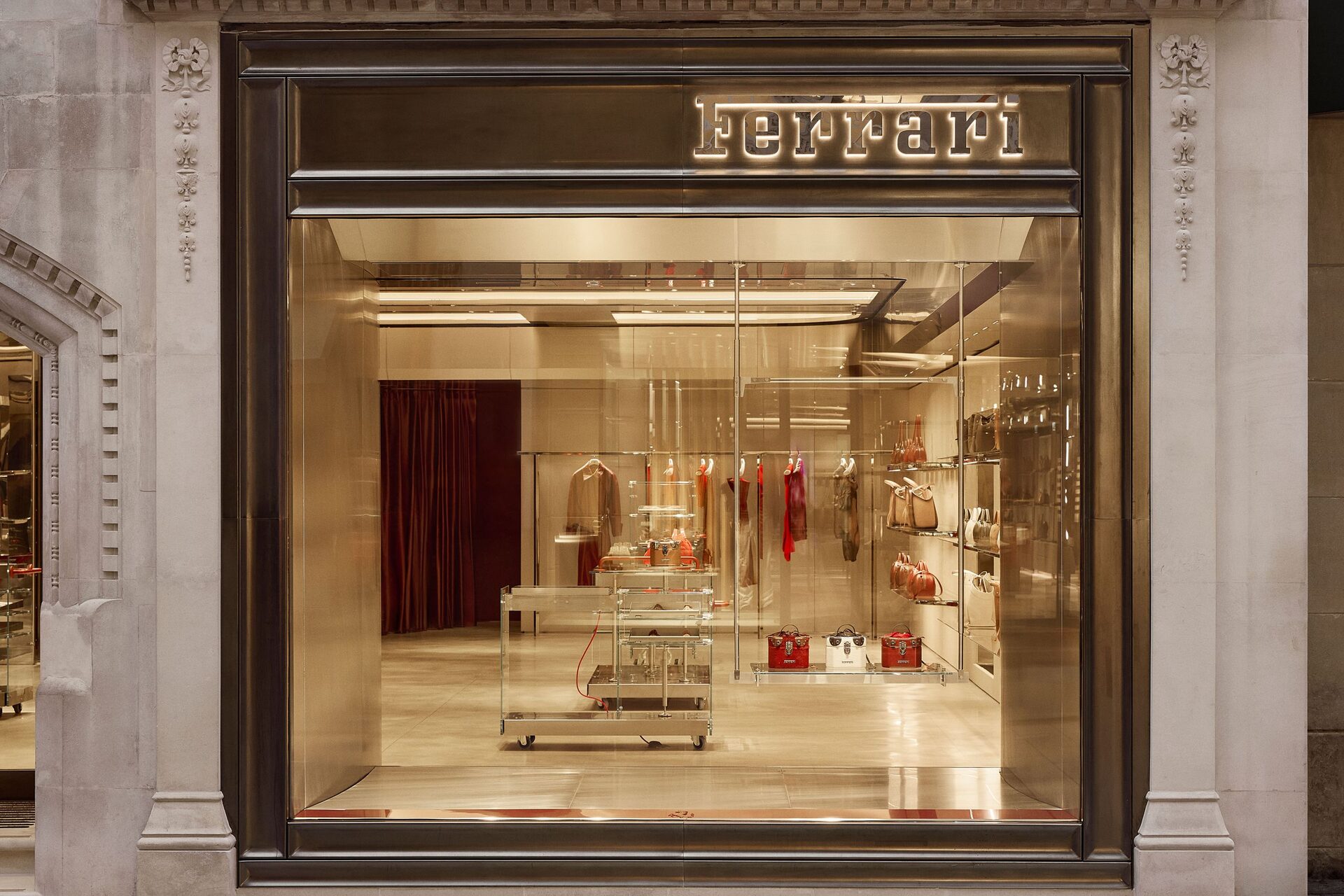
Ferrari Style, 45 Old Bond Street, London. Photography by Ed Reeve / Wallpaper*