Demna goes into the archive and comes back with ten silk scarves, each one a direct conversation between the house’s past and his own unfolding vision for Gucci.
The Art of Silk is a collection of ten scarves, each produced from a print drawn directly from the Gucci archive. Demna selected the prints himself. The range moves across floral, botanical, nautical, animal, and equestrian motifs, pulling from decades of house production without privileging any single era. The effect is an edited survey rather than a retrospective. Where another designer might have recontextualised these images through irony or distortion, Demna presents them cleanly, allowing the craft to carry the argument.
Each scarf is produced in 100% mulberry silk, cut to a format that works across the body. The campaign shows them worn as headbands knotted at the nape, as tops wrapped and tied at the waist, as belts threaded through trouser loops. The house demonstrates here that the scarf is not a decorative afterthought. Worn in the hands of people who understand proportion, it becomes a garment in its own right.
Flora
Two scarves in the collection are dedicated to the Flora print, produced exclusively for LACMA and the opening of the Peter Zumthor-designed David Geffen Galleries. The print has a precise origin. In 1966, the Gucci house commissioned illustrator Vittorio Accornero to create a botanical composition for Grace Kelly, then Princess of Monaco. Accornero looked to Botticelli’s Primavera for his source material. The result was a densely layered garden of flowers, butterflies, insects, and foliage, rendered with the patience of a miniaturist and the confidence of someone who understood that abundance, handled correctly, reads as refinement.
The Flora print became one of the house’s most enduring images. The two LACMA editions place it in a new institutional context, linking the archive to the reopening of one of California’s most significant art spaces. Zumthor’s David Geffen Galleries represent a decades-long ambition for the museum, and the choice to mark that occasion with a textile rooted in Botticelli’s garden carries a logic that extends beyond marketing. Both the painting and the scarf are concerned with beauty as a form of argument.
The supply chain
The Art of Silk collection is produced in collaboration with Nido di Seta, a Calabrian agricultural collective, and Ongetta, a specialist silk manufacturer. Together they have revived a domestic silk supply chain that had largely been abandoned. Mulberry cultivation returns to once-fallow land in Calabria, powered by renewable energy. The silkworm farming and reeling processes are restored using traditional methods. Nido di Seta and Ongetta have spent years demonstrating that Italian silk production is viable again at commercial scale; Gucci provides the platform to prove that it can reach the market.
The significance of this extends beyond the scarves themselves. Italian fashion has long relied on French silk, principally from Lyon, for its finest fabrications. The ambition here is to build a credible alternative, rooted in the same peninsula as the houses that use it. If the supply chain holds, the Art of Silk collection will be remembered not only for its prints but for what it set in motion further down the production line.
The archive is not a museum. It is a working material, and silk is among the most honest ways to use it.
Sienna CaldwellDemna’s Gucci
Demna’s debut Gucci show in February set a clear framework. The set was marble-clad, populated by classical statuary, a direct nod to the Uffizi Gallery in Florence. The clothes worked in conversation with that environment: precise, historically literate, resistant to the kind of provocation that announces itself. The Art of Silk collection follows the same logic. These are not archive prints worn ironically. They are archive prints worn because they are good, and because the house that created them deserves to use them again.
The scarves are priced at £525 each. That figure places them within reach of the fashion customer who buys considered accessories rather than seasonal impulse pieces. A scarf at this level is not a small purchase. It is a decision, and the Art of Silk collection has been assembled with enough range, in terms of motif and mood, to justify a considered one. Ten prints, a revived supply chain, a Flora designed for a princess and now offered to a museum audience in Los Angeles. The archive, in Demna’s reading, is neither nostalgia nor heritage tourism. It is simply where the work already is.
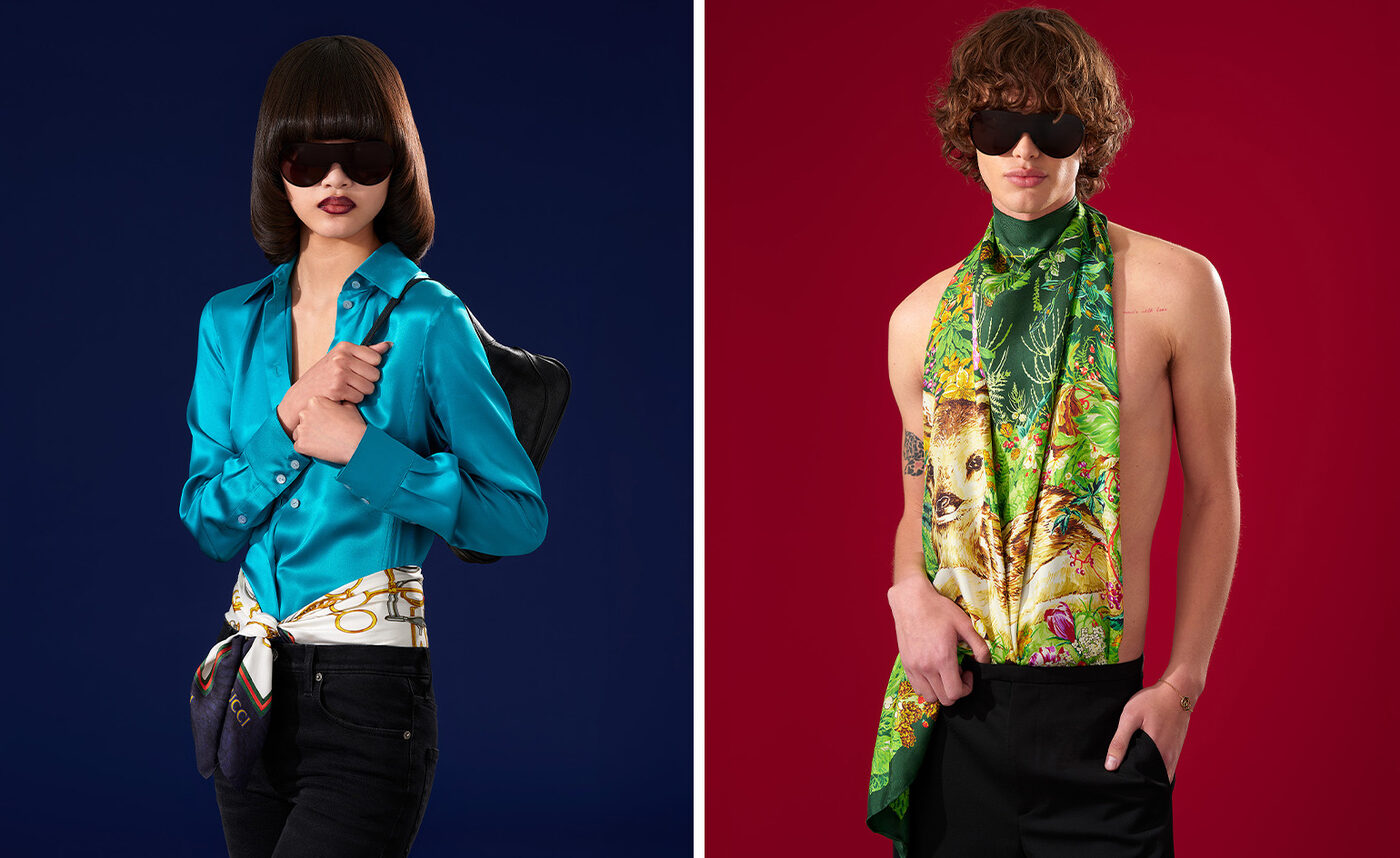
The Art of Silk campaign, Gucci — Photography courtesy of Gucci
Gucci Art of Silk scarves are available now. Priced at £525 each. gucci.com
Photography courtesy of Gucci