The house left Tribeca after twenty-four winters and walked uptown to a Beaux-Arts corner at Madison and 26th. Thirteen thousand square feet, a glass staircase that holds the centre, and a small back room called MADO. The largest Issey Miyake store anywhere in the world opened on Friday the eighth of May. It does not look like a store.
For almost two and a half decades the Hudson Street boutique was a quiet pleasure of downtown shopping, a low-lit cube where Pleats Please hung in vertical rows and the staff knew which dress folded into the size of a paperback. The lease ended. The next chapter, the brand decided, would not be a like-for-like move. It would be a building.
Cass Gilbert designed the New York Life Building in 1928. The gilded pyramid roof above is the postcard. What sits at the base is the new flagship, and the work of getting it there fell to Florian Idenburg, Jing Liu and Ilias Papageorgiou of Solid Objectives, the firm New Yorkers call SO–IL. Their plan was less to install a shop than to expose a room.
The staircase
The first decision was vertical. A structural glass staircase runs through the centre of the space, transparent as the Pleats Please pieces it shares the floor with. It connects the two levels without insisting on itself. The eye travels up. The original columns of the Beaux-Arts shell stay visible. The new aluminium and stainless steel fixtures stand a polite distance from the masonry, never quite touching it.
The architects describe the language as a dialogue between heritage and the present. The phrase is overused. The space earns it. Walk from the menswear wall on the ground floor to the second-level platform and you can read both centuries in the same breath. The result feels closer to a small civic building than a flagship boutique. A pavilion you happen to be able to buy a shirt inside.
What sits on the rails
The full house is here. Men’s and women’s runway collections in the centre. HaaT, the textile-driven line out of Kyoto, on one wall. me ISSEY MIYAKE in its bright knots and folded shapes. Pleats Please and Goods Goods near the front. A-POC Able, the experimental line of one-piece garments cut from a single tube of fabric, has its own corner. Few flagships outside Tokyo carry this much of the family at once.
Two objects in the space refuse to be merchandise. A titanium panel above the cash desk reads as architecture, but it is a quiet tribute to Frank Gehry, who built a long friendship with the late Issey Miyake and once designed the brand’s Tribeca pavilion. The glass wall panels from that old Hudson Street store have been cut and laid down as tables, holding accessories and folded shirts. Nothing on a wall plaque says any of this. It is set out for those who know.
A pavilion you happen to be able to buy a shirt inside.
Elena VossMADO
At the back, separated from the retail floor by a slim threshold, is MADO. The word translates from Japanese as window. It is the first dedicated Issey Miyake gallery outside Asia, a room of about a hundred square metres given over to rotating projects. The first show is a tight selection of work from the brand’s textile research arm, the same lab that has been pleating polyester since 1988. Future MADO programmes will lean on collaborations: artists, makers, architects, the wider creative circle the house has cultivated since Tokyo in the seventies.
Calling the back of a store a gallery is a familiar trick. Calling it MADO and meaning it is not. The lighting is museum-standard, the labels are written in a curator’s voice, and the door to the retail floor stays open. The line between commerce and curation is treated as a soft edge, not a wall. The house has always written that way.
The exclusives
To mark the opening, three pieces have been kept inside Madison Avenue only. The FOLDING COAT, hand-pressed with a Rakkan seal stamped at the inner lining, opens out from a flat parcel into a long coat with the sculptural collapse of a kimono. The UNBOUND HAT is woven from abaca, a fibre stripped from a Philippine banana plant, and sits on the head like a piece of architecture rather than a hat. The SHADE AND SHADED_NY pleated series is the most elegant of the three: a small group of sheer separates and dresses cut in light shadow tones, sold only to those who walk through the doors at 45 Madison.
None of the exclusives will travel. None will appear on the website. They are tied to the building. The thinking is old-fashioned in the best sense, an argument for the shop as a place rather than a node in a distribution network.
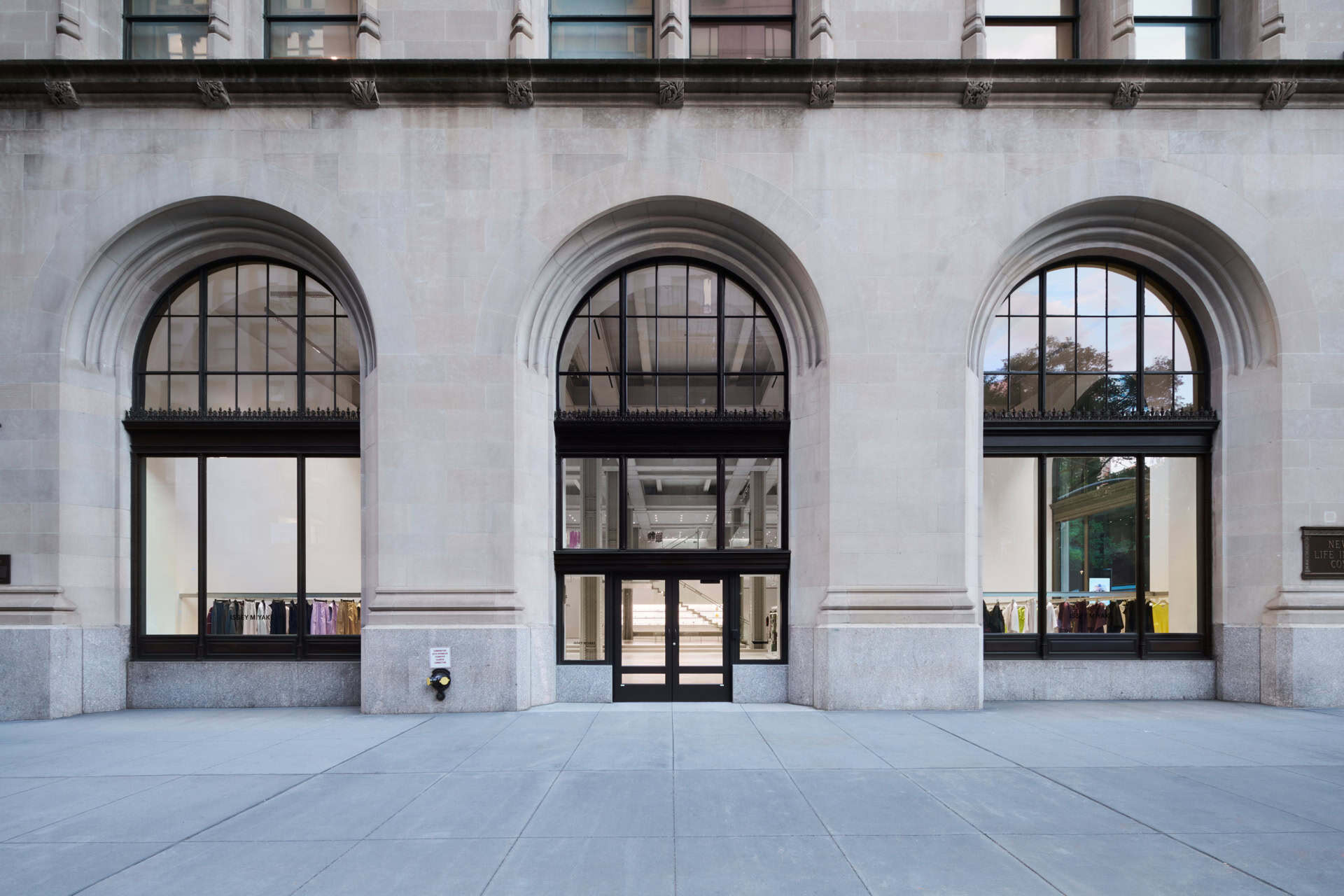
Photography courtesy of Issey Miyake / 10 Magazine
What it says
A retailer with a long memory and a smaller real-estate footprint than its rivals has chosen to commit to a single, generous room rather than a network of smaller outposts. The bet is on the visit, not the scroll. It is also a bet on Madison Avenue, a stretch of street that has spent the last five years quietly becoming the most architecturally interesting shopping spine in the city. Lanvin in a Bernard Dubois interior a few blocks south. Fendi a little further uptown. Now SO–IL holding the centre.
Issey Miyake never built a brand on the cult of the designer. The house values the studio over the signature, the textile over the silhouette, the room over the rail. The new flagship reads as another statement in that long sentence. Walk in for a folded coat and leave thinking about a glass staircase, a friendship with Frank Gehry, and a piece of unwoven banana fibre that somebody decided to call a hat. New York will be the better for it.
Photography courtesy of Issey Miyake / 10 Magazine.