In a week loud with inflatables and tapestries and influencer-friendly espresso bars, Simone Bellotti's first Salone outing for Jil Sander has been the loudest thing in the city — precisely because it is silent. Sixty books, sixty lecterns, a pair of white gloves at the door, and an instruction to slow down.
The address itself is a confession. Via Luca Beltrami 5 is a quiet, slightly sober side street in the rough orbit of Brera, the kind of corner Milan reserves for businesses that prefer not to advertise. To find Reference Library you walk past the early dinner queues spilling out of the more famous Salone activations, climb a staircase that smells of old plaster, and enter what looks at first like a small chapel for the printed page. There are sixty chrome lecterns laid out in a quiet grid, each one holding a single book, each one lit from above by a warm reading lamp. A mirrored back wall doubles the room without doubling the noise. A staff member offers you a clean pair of white cotton gloves and asks, with what feels like genuine interest, how long you have.
That last detail is the one that gives the project away. Reference Library, on through Friday at the Jil Sander headquarters and produced in collaboration with the Spanish-Italian magazine Apartamento, is staged as an installation but operated as an invitation. Bellotti, the Milanese designer who arrived at Jil Sander last year from a stretch at Bally and a longer Gucci apprenticeship, did not come to Salone with a furniture collection or a perfume launch. He came with a reading list.
Sixty books, sixty readers
The premise is artless and a touch romantic, which is what gives it its grip. Bellotti and the Apartamento team asked sixty figures whose taste they trust — designers, writers, artists, architects, musicians, filmmakers — to nominate a single title that has shaped the way they think. The choices were then assembled, copy by copy, into a portable canon. There is no theme. There are no curatorial linkages between the volumes. The point of the exercise is the cumulative oddness of the list, the friction created by Sofia Coppola's selection sitting next to Hans Ulrich Obrist's, with Lykke Li's choice somewhere in the next aisle.
The roll call is a useful diagram of how the new Jil Sander wants to be understood. Ronan Bouroullec is in. So are Jasper Morrison and Faye Toogood, all three of them designers whose work has been quoted, sometimes too directly, by fashion's interiors-curious wing. The art world has Rirkrit Tiravanija, who has chosen Masanobu Fukuoka's The One Straw Revolution, a 1975 manifesto on natural farming whose presence in a fashion installation is funnier the longer you stand with it. Celine Song, whose film Past Lives turned the cinema of small silences into a small industry, has chosen Patrick Suskind's Perfume. The musician Lykke Li is here. So is the painter Walton Ford, in a reading that is somehow more straightforward than his pictures.
The point of asking sixty people for their books rather than fifteen is that you cannot bluff sixty. Fifteen names is a press release. Sixty is a community. The room hums quietly with the sense that these are the people Bellotti calls when he wants advice, or the people he wishes would call him, and that the line between those two categories has been left, helpfully, unresolved.
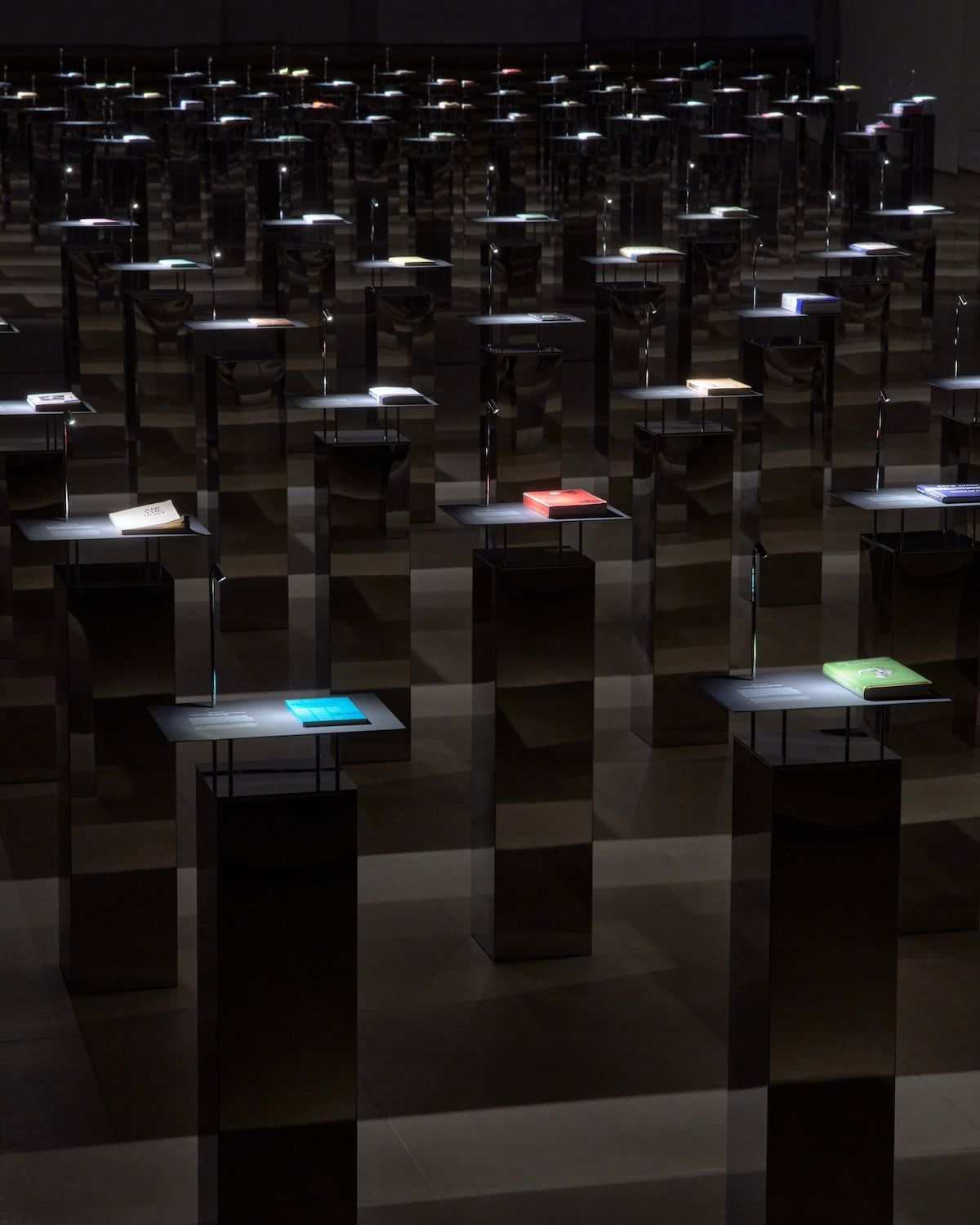
Reference Library at the Jil Sander headquarters, Milan Design Week 2026. Photography courtesy of Jil Sander, via Wallpaper*.
The case for the physical page
Reference Library belongs to a small, growing genre of fashion installations that are willing to slow a visitor down. Loewe has been building a version of this argument for years, with its craft prizes and its book imprint. Bottega has done a softer version with its Quotidiano programme. What Bellotti has added is a piece of furniture and a procedure. The chrome lectern is not, on its face, a Jil Sander object. It is colder, more institutional, more nineties Milanese architecture office than the warm minimalism the brand is selling on the racks. But it works because it forces the right posture. You stand to read. You do not sit and scroll. You touch the page through cotton because the page deserves it.
Studioutte, the local architecture practice that designed the installation, understands this register exactly. The lecterns are precise in the way a Donald Judd shelf is precise — an object whose entire personality is held in the dimensions of its top edge. They are placed close enough together that two readers will brush past one another, far enough apart that nobody is reading over a shoulder. The mirrored wall, which could have been a vanity move, instead does the quiet work of multiplying the books into something that looks like the inside of a brain.
Bellotti has not arrived at Jil Sander with a redesign. He has arrived with a syllabus — and a Salone is the right week, in the right city, to hand it out.
Elena VossWhat this means for Bellotti's Jil Sander
The natural reading of Reference Library is to take it as a soft prologue to a wardrobe Bellotti has not yet shown in full. He took the creative directorship in early 2025 and his first real ready-to-wear outing is still to come, with the September womenswear show in Milan flagged as the pivotal date. In the meantime he has been giving interviews about restoring what he calls the moral seriousness of the house, a phrase that should make a publicist nervous and that, in Bellotti's mouth, somehow does not.
The library is the first concrete evidence of what that phrase means. It is a Jil Sander that wants to be photographed, but not for the camera roll. It is a Jil Sander that talks about ideas before it talks about silhouettes. It is also, less abstractly, a Jil Sander that recognises the brand has spent the last decade being thought of as a beautiful empty room, and is now very politely furnishing it with arguments. Several editors I bumped into in the cloister-like main gallery used the same word for the experience — relief.
Some of that is fashion's tonal recoil from a Salone that has otherwise been cheerfully maximalist. Down the road, Louis Vuitton is doing trunks shaped like sea creatures, Valextra is filling its windows with inflatables, Gucci is hanging Botticellian tapestries in a fifteenth-century cloister. Reference Library is the only fashion house in Milan this week proposing that you be quiet for an hour. That is a position, and Bellotti has staked it.
The luxury of not knowing
The most surprising thing about the room is the willingness to leave you alone. The labels next to each book carry only the title, the author, and the chooser. There is no curatorial caption explaining why this volume mattered. The visitor is asked to draw their own line between, say, Yukio Mishima and a 1972 monograph on Donald Judd. The result is something close to an old-fashioned bookshop on a long Saturday, with the Apartamento editors in the role of well-read shop manager, and Bellotti in the role of the slightly absent owner who keeps placing the strangest titles face out.
You leave with the white gloves, the take-home of the project. They sit in your hotel room for the rest of Salone like a small reproach to your phone. Whether Bellotti's Jil Sander, when its clothes finally appear, will live up to the seriousness of this opening gesture is a question that cannot be answered until September. What the library does establish, with a confidence the Milan calendar has otherwise lacked this week, is that the new house has a reading list, a sense of history that is not nostalgic, and a willingness to ask the visitor to do some of the work. In a season of one-line collaborations, that already feels like a long sentence.
Reference Library runs through 24 April at Via Luca Beltrami 5, Milan. By appointment, free.