On a bright-yellow runway inside the grounds of a fourteenth-century fortress, Jack McCollough and Lazaro Hernandez presented their second collection for Loewe — and made a persuasive argument that joy is not the opposite of seriousness, but its most demanding expression. The Château de Vincennes has endured centuries of siege and ceremony; on March 6, it held something stranger and more alive.
The story of McCollough and Hernandez arriving at Loewe is, by now, familiar: two Americans who spent nearly two decades building Proenza Schouler from a graduate thesis into one of New York's most admired independent labels, then stepped away, took time, and re-emerged inside one of Europe's oldest leather houses. Their debut, shown in Paris last October, was precise, colourful, and carefully argued. This second one, shown in the Château's grounds with Cologne artist Cosima von Bonin's giant plush animals — lobsters, dogs, whales, octopuses — scattered across the gingham-lined space, was something altogether more committed. It was the sound of two designers deciding, definitively, who they want to be.
A castle, a yellow runway, and a colony of plush creatures
The choice of venue mattered. The Château de Vincennes is not the Louvre pyramid, not a converted railway shed, not the perfumed salons that populate the arrondissements most favoured by fashion week. It sits at the eastern edge of Paris, heavy-walled and medieval, the kind of place that suggests history as weight. McCollough and Hernandez chose it and then proceeded to cover its interior setting in gingham and fill it with soft, oversized animals in vivid wool. The contradiction was the point. Play does not require permission from decorum.
Von Bonin's creatures — commissioned specifically for the show — are not decorative afterthoughts. Her practice, rooted in a decades-long interrogation of labour, leisure, and the politics of the handmade, made her an ideal interlocutor for what the designers were reaching toward. "Her work mirrors many of the ideas we were seeking to articulate," they noted in their show statement. An octopus the size of a small car reclined near the exit. A dog rendered in navy wool sat attentive at the runway's edge. The collection moved past them and, somehow, the conversation between the two felt entirely coherent.
The clothes: levity as technical achievement
Loewe built its reputation on leather — the Spanish house's craft ateliers in Madrid produce some of the most refined leatherwork in the industry. McCollough and Hernandez understand this, and they have used it not as a ceiling but as a foundation. For autumn/winter, leather arrived in forms that required genuine ingenuity to produce: bouclé coats constructed from loops of lacquered leather that moved like fabric; snap-on jackets in burnished orange and brown that latched and unlatched along their front seams; a series of slip dresses cut from red latex with the precision of eveningwear.
Elsewhere, the collection played with inflation — literally. Parkas that could be expanded, scarves that puffed outward from within, anoraks in primary colours that suggested both ski resort and the kind of pool float that costs more than a business-class ticket. A thick-knitted mini skirt trailed a floor-sweeping train in ombré wool. A tartan shift dress seemed to have been constructed, affectionately, from the kind of laundry bag that travels between weekends in the country. Climbing rope appeared as garment trim and, on one look, as the structural logic of the whole silhouette. All of it was executed with the kind of finish that signals a house working at genuine altitude.
The act of making is an expression of joy — an intellectual, process-driven pursuit charged with playfulness.
Jack McCollough & Lazaro Hernandez, Loewe A/W 2026 show notesMenswear arrives — and integrates
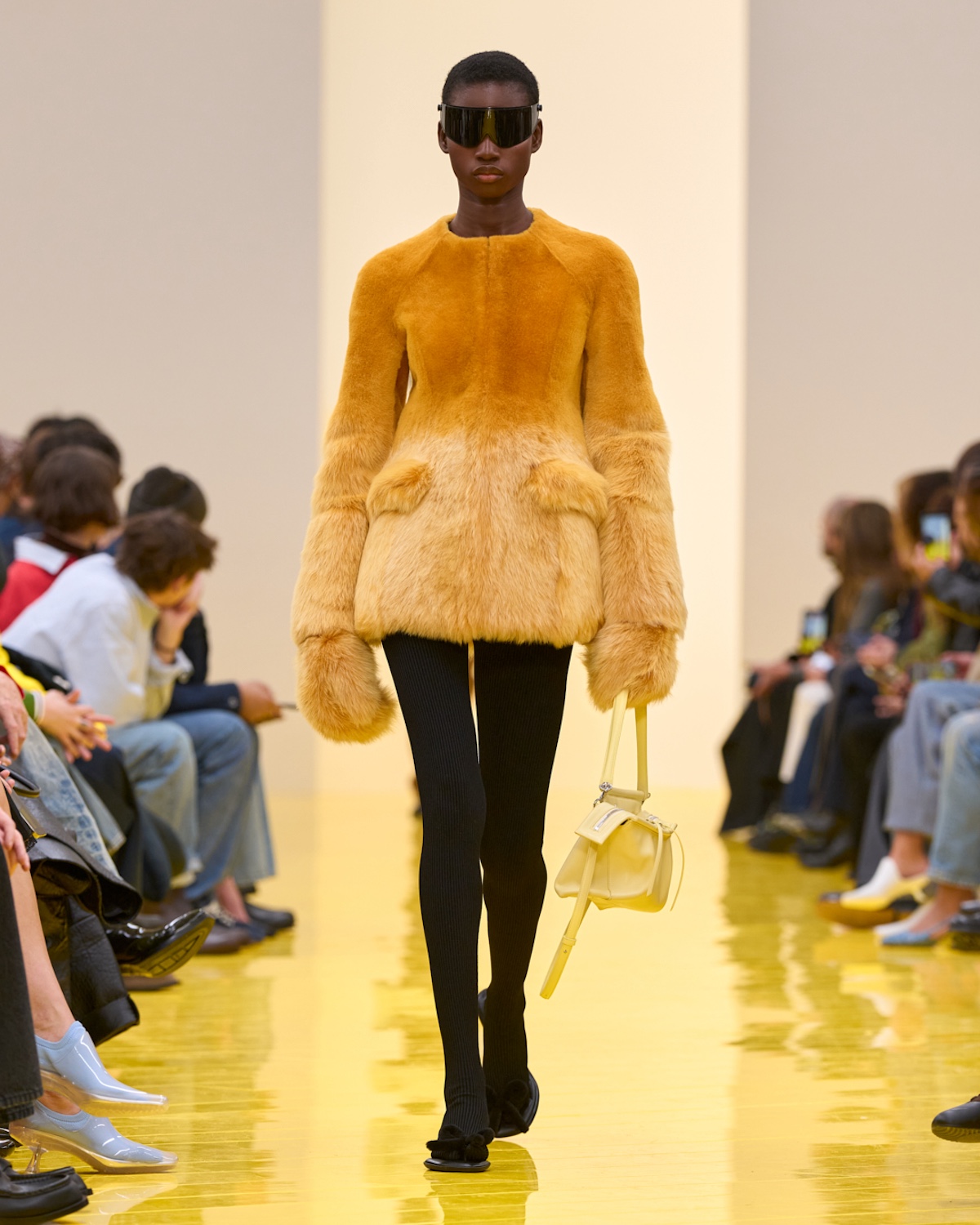
This was the first Loewe collection under McCollough and Hernandez to include menswear on the runway, and its arrival felt neither tentative nor tokenistic. The men's pieces shared the same material logic and tonal exuberance as the women's — dégradé shearling parkas in curved silhouettes, face-shielding sunglasses that referenced both skiing and science fiction, chunky half-zip pullovers that riffed on sportswear archetypes through Loewe's artisanal lens. The co-ed format suited the collection's spirit. A show about play does not need to segregate its players.
The colour story moved from primaries to pastels with an ease that belied the difficulty of keeping a palette coherent across such range. Gradient shearling appeared in two directions — from cream to caramel on one coat, from sky blue to pale grey on another. The ombré technique, which the designers referenced as akin to the art of poodle grooming, was deployed with a light touch that made even the most elaborate pieces feel wearable, even wearable in the sense of wanting to wear them immediately.
What kind of house is Loewe becoming?
Jonathan Anderson's decade at Loewe produced some of the most discussed fashion of its era — cerebral, art-adjacent, occasionally confrontational, always deeply considered. His departure left a specific kind of absence: a house accustomed to operating at the edge of its own ideas. McCollough and Hernandez are not filling that shape. They are drawing a different one.
Their Loewe feels warm where Anderson's could feel cool, capacious where his was precise, generous with colour and volume and the pleasure of the object where his was more likely to withhold. Neither approach is superior; they are simply different theories about what fashion can do and who it can address. The American designers appear, across two collections, to be building a house that believes in the customer's intelligence and also in their desire for beauty that does not demand justification.
Photography courtesy of Wallpaper*
There is a particular kind of collection — rare enough to be worth naming when it arrives — that makes you feel the clothes want to exist. Not as arguments, not as concepts, not as correctives to some prior season's excess, but simply as objects that carry pleasure in their construction and ask to be worn by actual people in the actual world. The Loewe A/W 2026 show, staged in a medieval fortress decorated with gingham and populated by giant plush animals, was precisely that kind of collection. Joy, it turns out, is very hard to do well. McCollough and Hernandez are getting very good at it.