Loewe turned 180 this year, and it looks nothing like it did a season ago. Jack McCollough and Lazaro Hernandez took the house from Jonathan Anderson and painted it yellow and red. The change reads on the street as much as the runway.
The two men built Proenza Schouler in New York across more than twenty years. They sold their stake, stepped back from the label they founded, and moved to the oldest house in Madrid. Their first Loewe collection showed in Paris last October. Their second followed at the Château de Vincennes.
Anderson had run Loewe since 2013 before leaving for Dior. He made the house strange and prized, all trompe l'oeil and off proportion, and turned a quiet leather maison into one of the most watched names in Paris. The pair inherited a signature that belonged entirely to one man. They kept the craft and changed the mood.
The move came in a year when nearly every large house changed hands at once. Anderson went to Dior, Demna left Balenciaga for Gucci, Matthieu Blazy took Chanel. Loewe answered by hiring the pair behind one of New York's most respected labels and handing them a house with almost two centuries of leather behind it.
The debut
For the first collection they hung the show on a painting. Ellsworth Kelly's Yellow Panel with Red Curve, from 1989, set the terms. Yellow and red ran through the knitwear, the dresses and the shoes. A sweater was knotted straight over bare skin.
Colour did the arguing. Block panels cascaded down long striped dresses and carried on into two-tone tights, then softened to pastel before snapping back. Parkas, anoraks and tank tops brought sport into a house known for its hides. The debut campaign, shot by Talia Chetrit, put actors before models, Eva Victor and Erin Kellyman among them, and framed the clothes as things worn rather than presented.
The palette
The reference was Spanish and personal. Loewe was founded in Madrid in 1846, and the pair pulled the collection toward the country's light and its craft rather than its clichés. Sculptural jackets hid their seams. The tailoring reshaped the body from the inside, which is the sort of trick Loewe has always paid its workshop to do.
The second collection, for autumn, brought in the German artist Cosima von Bonin and a broader streak of humour. Slip dresses trimmed with lace and bows returned as 3D-printed latex, moulded to the body and shining. Parkas and scarves inflated. The joke never crowded out the cut, and the American sportswear the pair carried from New York kept the whole thing grounded.
The bag
Loewe still sells leather first. The Amazona, drawn in 1975, is the house's oldest working icon, and the pair reissued it as the Amazona 180 to mark the anniversary. It reads looser than before, less structured, made to be carried without ceremony. A house this dependent on its bags cannot afford a weak one, and this one holds.
Anderson made Loewe strange. The new pair made it bright.
The Splendid EditThe leather goods carry the business, and the anniversary gives the pair cover to touch the icons early. Reworking the Amazona in their first year is a statement of intent. It tells the client the house is not waiting a decent interval before it moves.
The rooms
The reset reached the shops. Loewe opened a Casa on Avenue Montaigne in November, then a second in Paris on Rue Saint-Honoré in March. The Saint-Honoré space runs to 405 square metres over two floors and hangs its clothes among art, from seventeenth-century Dutch and Anglo-Flemish portraits to contemporary work by Mary Stephenson and Paul Thek.
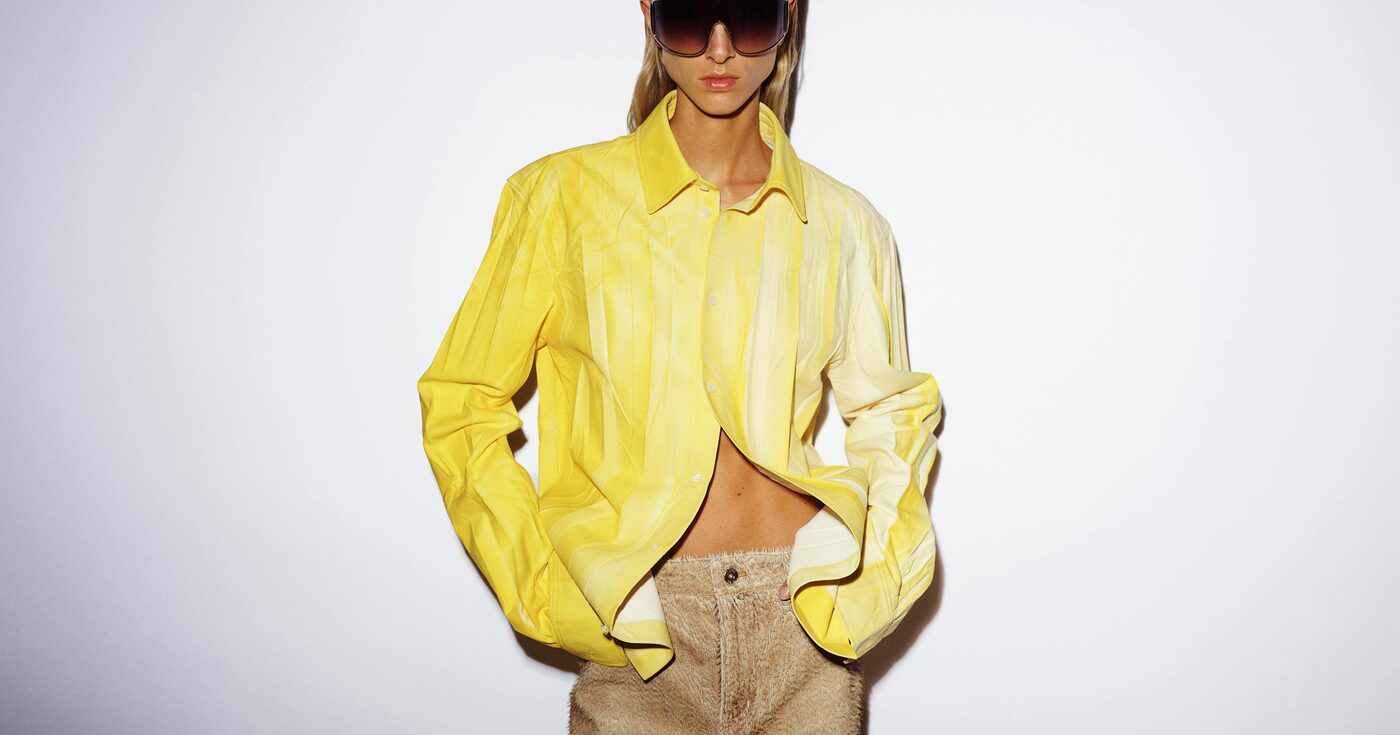
Loewe's first collection under Jack McCollough and Lazaro Hernandez, built on Ellsworth Kelly's yellow and red. Courtesy of Loewe
The Casa idea is Anderson's, kept and extended. Loewe has long treated its stores as galleries and its foundation as a serious patron, from the annual Craft Prize to the works it lends and buys. The new pair have not dismantled any of that. They have moved into it.
The measure
One year in, the numbers matter as much as the mood. Loewe grew fast under Anderson and became one of the clearest creative wins in the LVMH stable. A change at the top of a house like that carries risk, and the group moved two outsiders into a seat shaped by a singular predecessor.
Continuity carried the rest. The workshops in Spain did not change, the Craft Prize ran on schedule, and the leather goods kept selling straight through the handover. What the pair had to supply was a point of view, and colour turned out to be theirs.
The early read is confident. The clothes are legible, the colour is loud, and the leather still carries the label without argument. The next test is the spring collection, and the one after that. For now, Loewe looks awake.
The Splendid Edit on Loewe's first year under Jack McCollough and Lazaro Hernandez. Collection details from Loewe and LVMH.
Photography courtesy of Loewe