Nicolas Ghesquiere turned the Cour Carree of the Louvre into a landscape. Louis Vuitton's Fall-Winter 2026 collection walked through it like a pastoral painting from a science-fiction fable. The clothes took their shape from the weather.
The show ran on 10 March, inside the Louvre's oldest courtyard. Jeremy Hindle built the set. He is a production designer known for the series Severance, and he shaped the Cour Carree into an abstraction of nature, lush and geometric at once. Models moved through it like figures painted into the ground.
Ghesquiere has led Louis Vuitton womenswear since 2013, and he tends to open a season with a set that reworks a room rather than fills it. Here the courtyard of straight lines and old stone became overgrown. The contrast did the work.
The Louvre
The setting did more than decorate. Ghesquiere framed the collection as an architectural wardrobe for the twenty-first century, defined by the natural world. The Louvre gave that idea a spine, stone and symmetry set against invented flora.
Nature here was engineered. It was drawn with a ruler, then left to overgrow. The landscape read as a place a person might actually have to dress for, cold, exposed and a little strange.
The elements
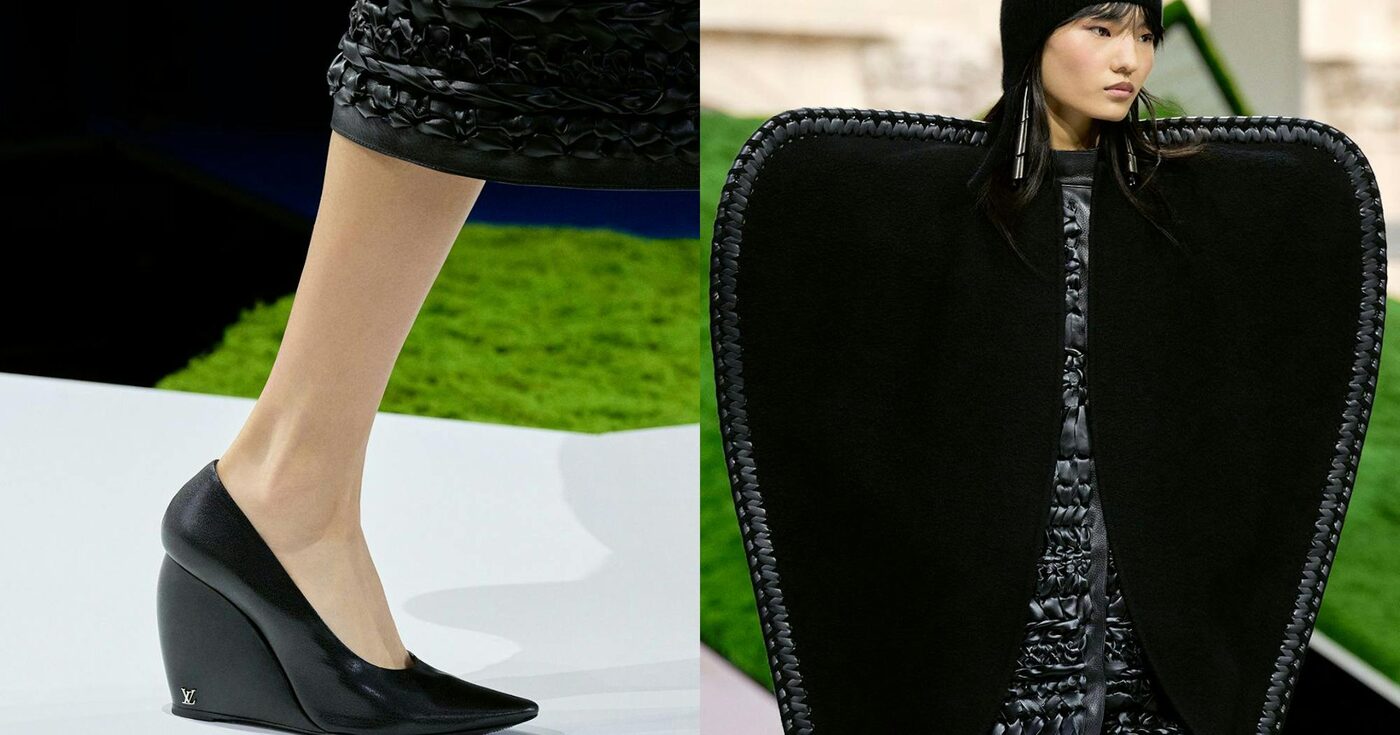
The clothes were formed by the elements. Wind, rain, snow and sun each left a mark on the cut. Coats carried monumental shoulders. Headgear reached toward the sky, built up rather than pinned down.
Flora and fauna pressed into the garments. Animalier patterns were woven into canvas and denim and took on a new scale. Invented flowers, shaped in leather, worked as decoration and as protection at the same time.
The premise was clothing for a body that lives inside weather rather than sheltering from it. The volumes made sense on that reading. A large shoulder is armor. A raised collar is a roof.
Color stayed grounded in earth and weather. Surfaces carried the argument, from woven animalier to leather pressed like petals. The eye moved across texture before it settled on any single garment.
The making
Craft carried the concept. Louis Vuitton leaned on its leather and its ateliers, then pushed both toward the surreal. Leather was grained, grooved and tanned to mirror wood, with a suppleness real wood never has.
Details did the storytelling. Buttons appeared like minerals. Heels resembled antlers. Vegetal furs invented new texture, and technology sat beside handwork instead of replacing it.
This is the register Ghesquiere has held at the house for more than a decade. He treats a collection as a world with its own physics. The Fall-Winter looks obeyed the rules of the landscape he built for them.
None of it looked accidental. Louis Vuitton runs one of the deepest leather workshops in fashion, and the collection put that depth on display. The surreal finishes only land when the base craft is this exact.
A monumental shoulder is armor. A raised collar is a roof. Ghesquiere dressed the body for weather it could not escape.
The Splendid EditThe jewels
The jewelry reached back into art history. Parures reinterpreted dreamlike creations by Man Ray, the Surrealist who worked in Paris a century ago. Studded with the nail-heads of a Louis Vuitton trunk, they carried the house's own hardware into the pieces.
Bags held the travel thread the maison never drops. The Noe returned, the bucket bag first made to carry champagne, here reworked to shift through time. The collection framed nature and travel as one instinct, moving freely like nomadic peoples.
The Noe carries its own history. Gaston-Louis Vuitton designed it in 1932 to hold five bottles of champagne upright, and the house has kept it in rotation ever since. Sending it back out in a nature collection tied the newest idea to one of the oldest shapes in the archive.
Courtesy of Louis Vuitton
The house
Louis Vuitton is the largest fashion house in the world, and its runway carries weight beyond the clothes. A Ghesquiere show sets a direction that filters through the industry within months. Super Nature pointed toward volume, surface and a harder read of the natural world.
The Louvre setting made its own claim. Showing inside the museum places the house beside the culture it borrows from, Man Ray on one side and the palace on the other. Louis Vuitton has the resources to build a landscape for one evening and take it down the next.
Paris gives the house its largest stage of the year, and it tends to take a closing slot. Super Nature will read into the shops as texture, large outerwear and hardware pulled from the trunk. The set comes down. The ideas travel.
The collection asked what a person wears when nature is the only architecture left. Ghesquiere answered with shoulders like cliffs and leather cut to look like bark. It was a wardrobe for a world that has grown over, styled by a house that can afford to imagine one.