A ship has landed on Nanjing West Road. Nearly 100ft tall, clad in metallic monogram panelling and shaped like the prow of a transoceanic liner, Louis Vuitton's The Louis sits at the centre of Shanghai's busiest commercial corridor. It is the house's largest cultural statement in China, and possibly anywhere.
The structure, designed by OMA under the direction of Shohei Shigematsu, occupies a prominent position at HKRI Taikoo Hui, No. 789 West Nanjing Road. Its hull and stacked upper levels recall the elegant proportions of 19th-century steamer trunks. The reference is deliberate. Louis Vuitton began as a malletier, a trunk maker, and the building treats that origin as architectural grammar.
Shanghai's own history as the Gateway to the East gives the ship motif a second reading. The city's port defined its cosmopolitan character. Luxury goods, ideas, people: everything arrived by sea. The Louis is built on that axis of exchange.
The exhibition
The first two floors combine retail and exhibition space. The centrepiece is "Louis Vuitton Visionary Journeys," an immersive display designed by Shigematsu that traces the house from its workshop in Asnieres to the present day. The scenography moves through themed zones dedicated to fragrance, literature, sport and craftsmanship. Each section treats the house's codes as cultural artefacts rather than commercial touchpoints.
One signature installation, Trunkscape, suspends floating Monogram trunks in a long corridor. The effect is a hall of mirrors turned solid. Shigematsu first presented the concept at LV The Place in Bangkok and the Nakanoshima Museum of Art in Osaka. In Shanghai, it anchors the visitor's journey through the building.
The retail concept occupies the same floors. Leather goods can be customised with ship motifs or the Shanghai skyline. Limited-edition pieces are available exclusively at this location. The integration of shopping and cultural display is seamless. There is no threshold between looking and buying, between understanding the house and wearing it.
The building does not explain itself. It simply arrives, enormous and inevitable, a vessel carrying 170 years of French craft into the centre of Chinese commerce.
Léa FontaineLe Café
The third floor houses Le Café Louis Vuitton, an open-air dining terrace designed to evoke a seaside deck. Chefs Leonardo Zambrino and Zoe Zhou trained under Arnaud Donckele and Maxime Frédéric in Paris and Saint-Tropez. Their menu negotiates Eastern and Western influences with a specificity that avoids novelty.
Monogram Ravioli are styled after traditional jiaozi. The Cesar Salad Eclipse comes with yuja dressing. Peach Charlotte arrives with jasmine tea. Each dish holds its ground on flavour rather than concept alone.
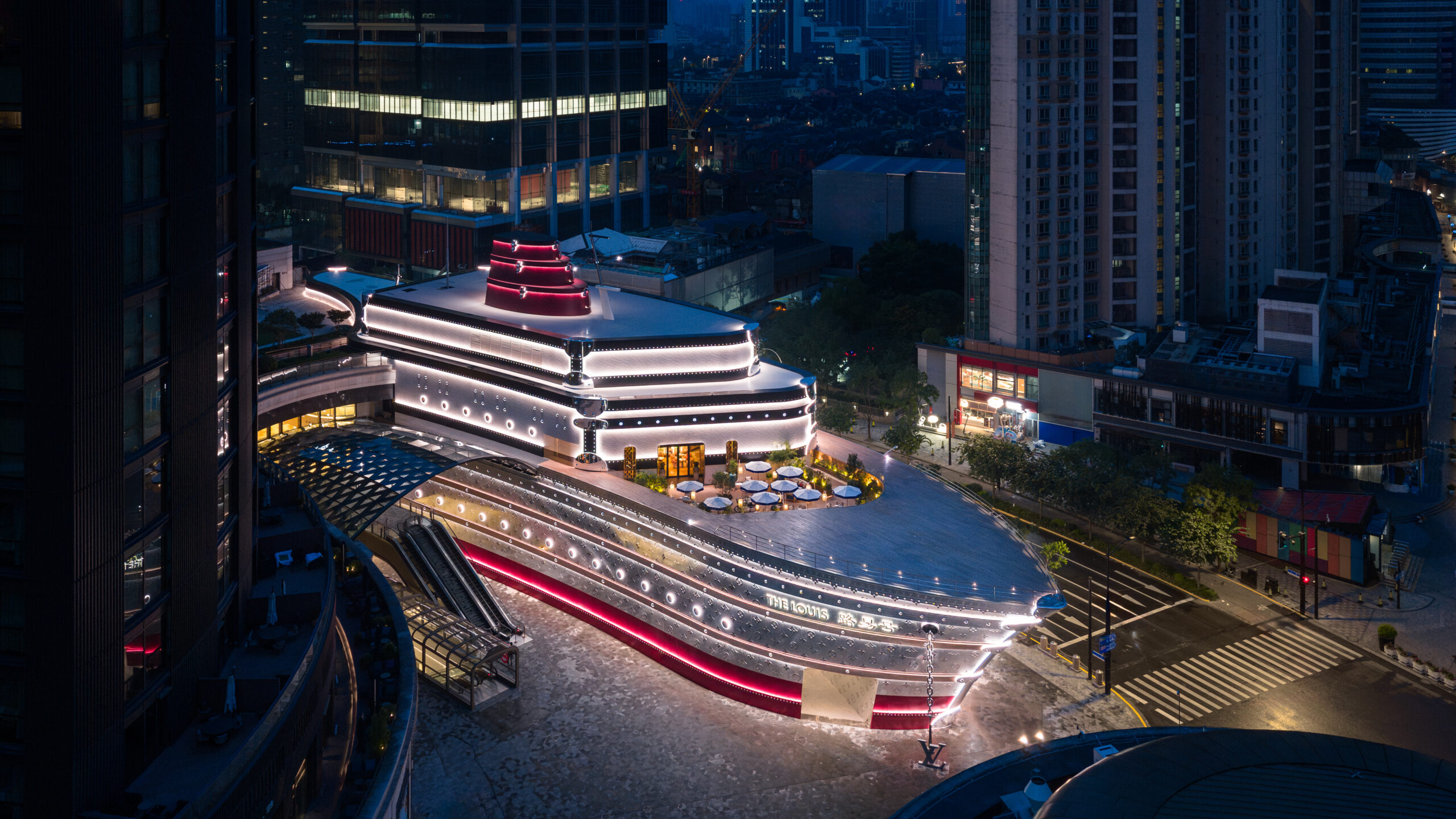
The Louis, Shanghai. Photography courtesy of Louis Vuitton
Scale and intent
The building is open daily from 10am to 10pm. Entry is free, with reservations available through the My LV WeChat mini program. That detail matters. The Louis positions itself as public architecture, not a private clubhouse. It belongs to the city the way a museum or a concert hall does.
For Louis Vuitton, The Louis represents something more than a flagship. It is a statement about where luxury is heading: toward permanence, toward cultural investment, toward buildings that outlast the seasonal cycle. The trunk, after all, was designed for journeys that took months. The building that honours it is built to stay.
Shanghai has long been the proving ground for European luxury houses testing their ambitions in Asia. The Louis suggests that Louis Vuitton is no longer testing. It has arrived.