Creativity has always been the part of fashion that resists explanation. LVMH and the Institut Francais de la Mode want to study it anyway. This week the two announced the Sciences and Creation Chair, a research post built to ask how a new idea actually forms.
The Chair sits at the Institut Francais de la Mode in Paris, the school that trains much of the industry's design and management talent. Its brief is broad. It draws on fashion and luxury, the humanities, cognitive science and the newer tools of artificial intelligence, and it treats the act of making as something that can be examined rather than only admired.
LVMH has funded academic chairs before, at business schools and engineering institutions, on subjects from sustainability to data. This one turns the lens on the work itself. The Group frames it as a way to understand creative processes, feed what IFM teaches, and keep a live channel open between researchers and the ateliers of its houses.
The question
A designer will tell you a collection began with a colour, a photograph, a walk. The account is honest and incomplete. What happens between the reference and the finished garment stays private, even to the person who made it. The Chair proposes to map that middle ground.
Cognitive science has spent decades on attention, memory and pattern. Fashion has spent centuries on instinct. Bringing the two into one room is the wager here. The research is meant to describe how ideas move from a first impulse to a resolved object, and to do it in language a studio can use.
Sidney Toledano, president of the Institut Francais de la Mode, tied the effort to the future of the creative professions. He described the point as preparing those industries for science, new technology and artificial intelligence while holding on to what makes them singular, namely culture, craft and the people who carry it. He spoke of readiness rather than reinvention.
A house can teach the hand. What it cannot teach is the moment the hand decides. That decision is what the Chair wants to see clearly.
The Splendid EditWhy now
The timing is not neutral. Artificial intelligence can now generate a plausible print, a mood board, a first sketch in seconds. The industry has spent two years arguing about what that means for the people who used to do that work. A research post on how human creativity operates reads, in part, as an answer to the machine.
Material science is moving at the same speed. Houses are testing lab-grown leathers, recycled technical yarns and fabrics engineered for weight and wear. Louis Vuitton spent this month rolling out a silk and nylon hybrid built for strength. The distance between the atelier and the laboratory has been closing for a while. A chair that studies both is a way of naming that.
There is also a supply question underneath. Fashion needs designers who can think across disciplines, who read a spreadsheet and a swatch with equal ease. IFM already positions itself at that junction. The Chair extends the pitch, promising graduates who understand the mechanics of their own ideas.
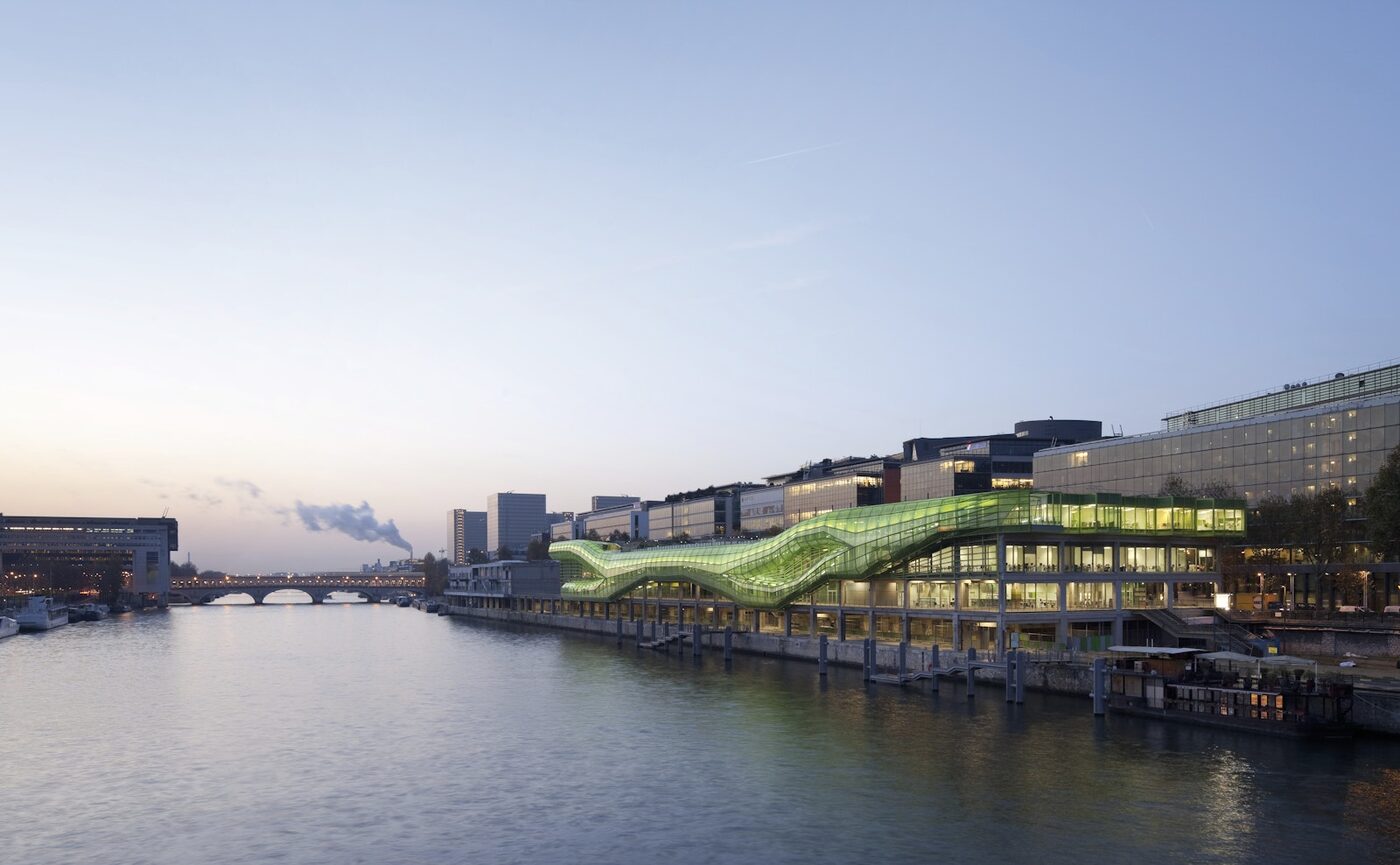
The Institut Francais de la Mode on the Seine, Paris. Courtesy of LVMH.
The precedent
LVMH is not new to the campus. The Group runs scholarships, judges student work and hires from IFM's studios, and in January it held a portfolio day at the school where its houses met the graduating class. The Chair formalises a relationship that already ran on handshakes and hiring.
IFM itself was built by merger, folding a business school and a couture-trained atelier into one institution on the Quai d'Austerlitz. The green glass building on the Seine reads as the argument: commerce and craft under one roof. A research post on how creation works belongs in a place assembled from both.
What it changes
The near-term work is quiet. Papers, seminars, a place in the IFM curriculum, exchanges between the Chair and the design and product teams inside the Group. None of it will show on a runway next season. The value, if it arrives, is slower and structural.
Still, the gesture matters. A conglomerate that owns Dior, Louis Vuitton, Loewe and Celine has decided that creativity is worth studying as a system. For a company whose product is desire, that is a shift in posture. It suggests the houses want to protect the source of the work, the part that sits upstream of the product.
Paris is the right address for it. The city built the school, the ateliers and the calendar that the rest of fashion follows. Adding a research post to that map reads as a bet that the next advantage is knowledge, held close and taught well. The Chair opens now. Its findings will take longer, and they may be the more lasting thing.