The final of the LVMH Prize ran at the Fondation Louis Vuitton on 4 September. Twelve creative directors sat on the jury, from Jonathan Anderson to Phoebe Philo. Three young designers left the building with money and a year inside the group.
This was the thirteenth edition. The competition began in 2014 and has become the clearest annual signal of who the industry expects to matter next. The roll call of past winners runs through Marine Serre, Thebe Magugu, Wales Bonner and S.S. Daley. A place on that list follows a designer for years.
The top award went to Julie Kegels. The Belgian designer is 27 and runs a womenswear label under her own name. The jury read her work as a contemporary wardrobe built around the individual who wears it. She takes home 400,000 euros and a year of mentorship from a team of LVMH specialists.
Jennifer Lawrence, dressed in Dior, handed Kegels the prize. Priyanka Chopra Jonas presented one of the other awards, and the Thai actress Urassaya Sperbund joined the jury as a special guest. The trio tells you how the group frames the evening. The money is real, and so is the theatre built around it.
Two more names
The Karl Lagerfeld Prize went to Zane Li, a 25-year-old Chinese designer whose brand, Lii, covers both womenswear and menswear. His clothes fold sportswear into couture cutting. The award carries 200,000 euros and a year of mentorship from the group.
The Savoir-Faire Prize went to Anil Padia, a 35-year-old Kenyan designer behind the label Yoshita 1967. His project leans on handwork and the communities that make it. Alongside the 200,000 euros, he gains a collaboration with Maison Vermont, the embroidery house, which will supply 50,000 euros of embellishment for his next collection.
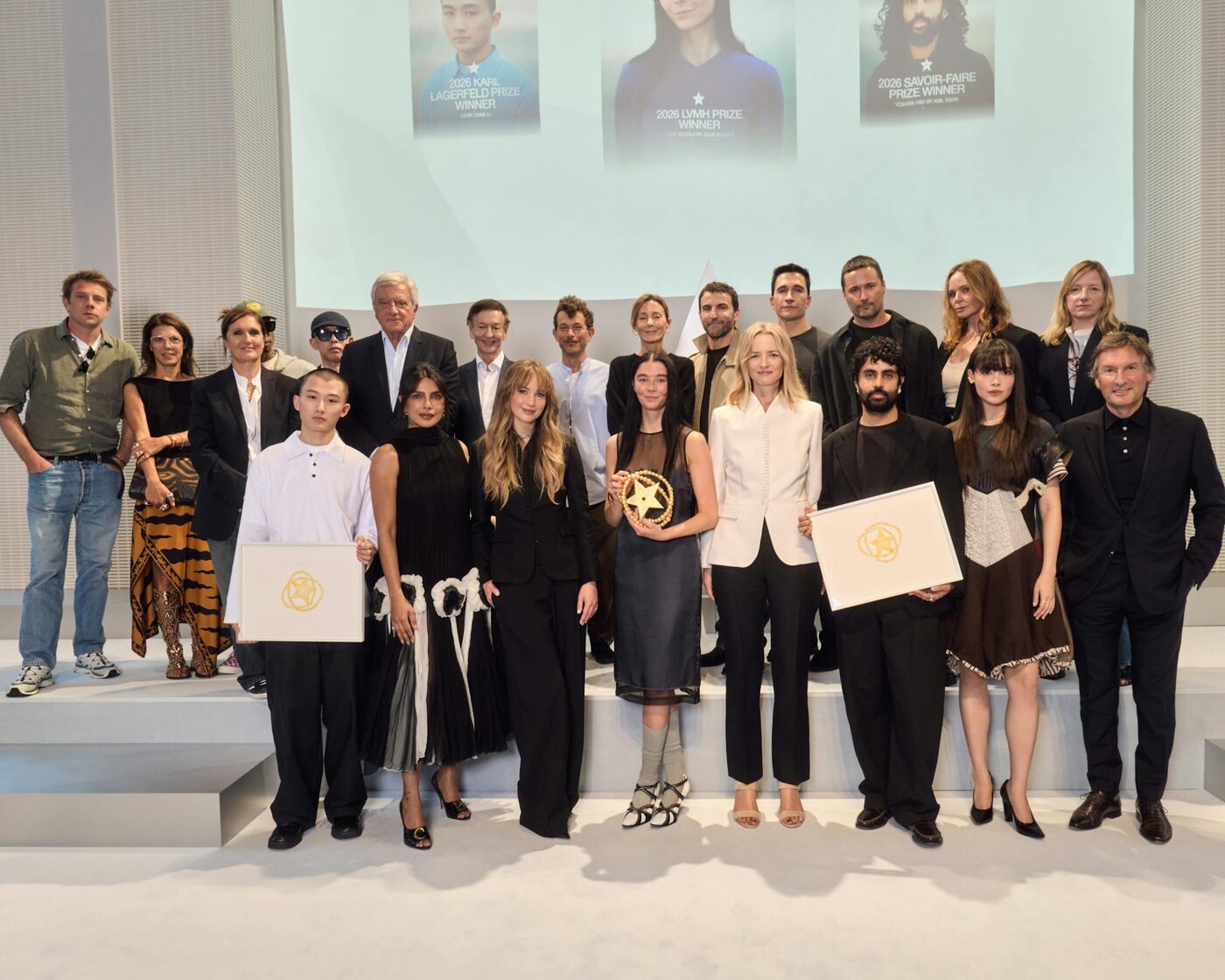
The 2026 LVMH Prize for Young Fashion Designers, staged at the Fondation Louis Vuitton in Paris. Courtesy of LVMH
A prize like this does two things at once. It hands a young label a year of runway, and a year of scrutiny.
The Splendid EditShared support
Each winner also draws on Nona Source, the platform that resells deadstock fabric from the group's fashion and leather houses. The main winner receives a 20,000-euro allowance there. The other two receive 10,000 euros each. The figure is small against the endowments, and it points at a larger habit the group is trying to build around unused cloth.
The mentorships matter more than the cheques. A year inside LVMH means access to production, sourcing and legal teams that most young labels cannot afford. For a designer running a studio on their own, that support tends to decide whether the next collection ships on time.
The jury
The jury read like a map of the group's creative leadership in 2026. Anderson now sits at Dior. Sarah Burton runs Givenchy. Maria Grazia Chiuri has moved to Fendi. Michael Rider leads Celine, Nigo holds Kenzo, and Nicolas Ghesquiere stays at Louis Vuitton womenswear. Jack McCollough and Lazaro Hernandez came as the pair now steering Loewe.
Delphine Arnault chairs the prize and hosts it each year at the Fondation. She thanked the jury for backing emerging designers and singled out each winner for a specific strength. Around her sat Pietro Beccari and other senior figures. The room holds both the talent and the people with the power to hire it.
The graduates
A second prize ran alongside the main one. Three fashion graduates were named, each with a 10,000-euro grant shared with their school. Maria Albores from the Royal Academy of Fine Arts in Antwerp joins Dior womenswear. Candice Morin from IFM in Paris joins Celine menswear. Louis Presencer from Central Saint Martins in London joins Louis Vuitton men's accessories.
That last detail is the quiet engine of the night. The prize is the headline, and the graduate placements are a hiring pipeline. A student walks out of the Fondation with a studio job at one of the largest houses in the world.
The LVMH Prize works because it does not pretend to be neutral. It picks, it pays, and it puts its own creative directors in the room to judge. This year it chose a Belgian, a Chinese designer and a Kenyan, three labels with little in common beyond the jury's attention. That attention has a way of outlasting the cheque.