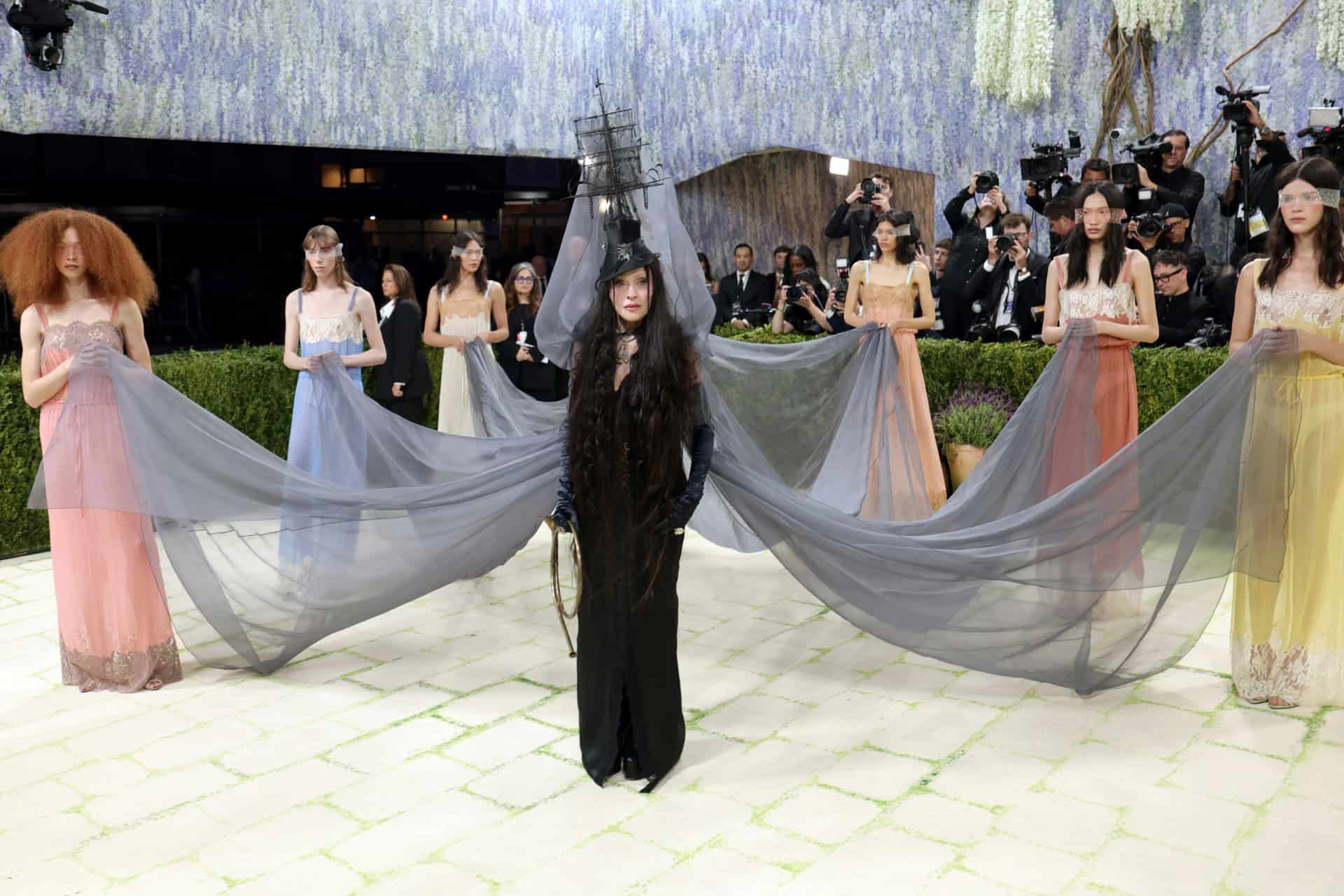
A Surrealist painting from 1945 walked up the steps of the Metropolitan Museum on Monday night, in lace, in opera gloves, in platform booties, with a small fleet of attendants holding her veil. Costume Art was the dress code. Madonna read the assignment, found a Leonora Carrington, and had Anthony Vaccarello build the painting around her body.
The Met Gala asked the room to make an argument for fashion as art. The 2026 Costume Institute exhibition stages clothing alongside paintings, sculpture, and antiquities pulled from across the museum’s collection. The thesis is that the line between a Sargent and a Charles James gown is institutional habit. The carpet’s job, briefly, was to demonstrate this. Most attendees responded with a literal painting reference. One or two arrived with frames embroidered on their sleeves. Madonna arrived with a fully realised oil painting in three dimensions and a sense of theatre that made the others look like cocktail attire.
The reference, since confirmed by Anthony Vaccarello, was Carrington’s ‘The Temptation of St. Anthony,’ the British-Mexican painter’s 1945 entry into Pictures and Sculpture from Sixteen American Cities. Carrington’s saint is wrapped in fabric like a tent, surrounded by tiny attendants and creatures, with what looks like a galleon balanced over the figure. To turn that picture into a single look on a body climbing stairs is the kind of literalism the Met Gala usually botches. Saint Laurent did not.
The look, piece by piece
The dress was a long, lacy, gothic black gown, which is the simple part of the answer. The complicated part lived in the styling. Long black satin opera gloves. Platform booties under the hem. A pendant at the throat, dark and weighted, the kind of object that Carrington might have placed at the centre of the canvas. The hair, courtesy of Eugene Souleiman with wig work by Merria Dearman, abandoned the platinum signature for inky, witchy length, looped and braided like a votive offering.
Above all of this sat the hat. A miniature haunted ship, perched on the head, sails and hull and rigging in dark detail. From the top of the ship fell a long cornflower chiffon veil that covered the carpet steps and trailed behind the figure like sail-cloth pulled into wind. The veil was held aloft, as the procession moved, by seven women dressed in colourful lace slips and white veils across their eyes. They moved as a single unit. The look became a tableau. There was no other word for it.
Some looks at a Met Gala perform the theme. A handful of looks are the theme. This was the second category, and the rarest one in the room.
A painting can hang on a wall. It can also walk up a flight of stairs in a black lace gown and a ship.
Camille AshworthWhy Carrington
Choosing Leonora Carrington as the source is its own argument. Carrington has been having a long, posthumous reassessment, particularly after the Tate Modern show that made the case for her as a central figure in twentieth-century Surrealism rather than a footnote to Max Ernst. The Met itself acquired her work for the new wing. Her aesthetic, dense with ritual, animals, alchemical symbol, and women presiding over their own rooms, sits comfortably inside the Costume Art thesis. She painted clothing as costume, costume as ritual, ritual as art.
Madonna has been dressing inside this register since the early 1990s, often without a Surrealist reference visible in the credits. The Erotica film. The Marie Antoinette MTV moment. The Madame X tour. The Carrington choice felt less like a celebrity-stylist provocation and more like a long-running interior preoccupation getting a proper exterior at last.
Vaccarello, quietly
Saint Laurent has had a quieter season than its rivals. The Cruise calendar has been crowded by debut narratives at Chanel, Dior, and Gucci, and Anthony Vaccarello has, in a sense, sat out the noise. The Met Gala result is a useful reminder of what the house produces when it operates on its own register. The look on Madonna was a couture object dressed up as a piece of art history, but the underlying garment, the lace gown beneath the styling, was pure Saint Laurent grammar. Severe shoulder. Disciplined waist. Blackness as the primary colour. Vaccarello has been making the same dress for ten years. Here, finally, it was given a frame proportionate to the work.
The relationship between Vaccarello and Madonna has been quietly accumulating moments like this for several seasons. He dressed her for the Madame X tour. He dressed her for several private occasions where the carpet was technically a stage. The fluency between designer and subject was visible on Monday in a way that very few celebrity-house pairings can achieve. The cut of a gown sits differently when the maker has dressed the body before. There were no nervous tucks. There was no obvious tailor’s last-minute panic. The picture was complete.
What the rest of the carpet missed
The most common failure mode for a Met Gala dress code is the literalism trap. A theme like Costume Art produces, predictably, dresses with picture frames embroidered around the bodice, dresses that quote a single famous canvas, dresses with a literal museum label sewn somewhere visible. These are charming for half a minute and then, on the second look, embarrassing. They mistake quotation for argument.
The Madonna look made a different choice. It did not quote Carrington. It became one of her paintings. The carpet steps became canvas. The seven women became Carrington’s small attendants. The ship became the ship. The body inside the gown became the saint, the temptation, the tableau. This is the difference between fashion as costume and fashion as art, and it is the argument the Costume Institute is making in the galleries upstairs. Most of the carpet read the wall text. Madonna walked into the picture.
What follows is a useful question. The Met Gala has, in recent years, drifted toward a costume-party register that has nothing to do with the exhibition it is meant to celebrate. Monday’s carpet had its share of pleasant references and competent embroidery. It also had a single guest who took the brief seriously enough to commission a Surrealist tableau and walk it up the stairs.
The image will sit in the Met archive eventually. It will hang next to the Carrington it cited, and the relationship will be obvious. That is, after all, the whole point.