Glenn Martens brought Maison Margiela to Shanghai and surrounded it with shipping containers — industrial, anonymous, unmistakably freighted with meaning. What emerged from those corridors of corrugated steel was not a ready-to-wear collection in any ordinary sense. It was an excavation, a procession, a deliberate act of unsettling.
The Margiela house has always trafficked in dislocation — in the beauty found in things half-finished, re-formed, or resurrected from somewhere else entirely. Martin Margiela established that grammar decades ago, and every designer who has occupied the role since has been measured against it. Glenn Martens, who took the creative directorship after John Galliano's departure, does not attempt to erase that inheritance. He builds within it, and at times, he builds on top of it with considerable force.
The Shanghai setting was not incidental. The city has become the site of fashion's most charged ambitions — a place where the global luxury industry stages its most elaborate gestures of outreach and reinvention. Martens chose to arrive there with a show that refused easy legibility, dressing the city's appetite for spectacle with something genuinely unsettling to look at.
Porcelain and ruin
The materials told the story before the silhouettes did. Layered organza, handled until it mimicked the brittleness of fine porcelain. Actual fragments of shattered porcelain — fixed, impossibly, onto the surface of gowns. Surfaces that appeared wax-hardened, excavated, as though extracted from some sealed archive. The effect was that of objects recovered from a house that had been closed for a very long time, then dressed for a party that may never have taken place.
Fabric face coverings appeared throughout — painted with exaggerated makeup, slightly warped, referencing the house's foundational interest in anonymity. The Margiela tradition of obscured identity, of fashion as costume rather than social presentation, ran through these pieces with unexpected freshness. In an era of relentless personal brand construction, a covered face carries more charge than it used to.
Leather met tweed with no attempt to broker a soft landing between them. Raw edges were left raw. Seams exposed their construction. Wet-look draping pooled alongside rigid architectural tailoring — a conversation between softness and severity that the house has been having, in different registers, for thirty years.
Martens is working with Margiela's original grammar and pushing it toward something genuinely his own — darker, more visceral, less ironic.
Sienna CaldwellThe colour of unease
Sand-toned nudes anchored the palette — the colour of bare plaster, of something stripped back to its foundation. Against these, Martens introduced moments of startling intensity: a full gold look that caught the container yard's industrial light like armour; a metallic pink gown with the sheen of something ceremonial; acid green velvet with oversized duchess sleeves that read as theatrical, deliberately so. Bird skeleton prints appeared on silk kaftans, adding a note of gothic naturalism to proceedings.
This is not a colour story built for the street, nor for the conventional commerce of a ready-to-wear season. It is a mood board for a very specific sensibility — one that finds pleasure in discomfort, that understands beauty as something that can include dread. The customer for this collection knows exactly who they are.
What Martens is doing at Margiela
The question worth asking, as Martens moves further into his tenure at the house, is not whether he respects the Margiela tradition — the work makes that obvious — but whether he is capable of moving it somewhere new. The Shanghai collection suggests the answer is yes, though the direction is not entirely comfortable to sit with.
Where Galliano's Artisanal collections at Margiela tended toward baroque emotional excess — couture as psychodrama, runway as operatic memoir — Martens is working with colder material. There is austerity in his approach even when the garments themselves are extreme. The shattered porcelain is not expressive. It is evidence. The wax-stiffened surfaces do not perform suffering; they simply refuse comfort. The difference matters.
The show's musical accompaniment leaned into this register — dark, ceremonial, designed to make the familiar feel slightly wrong. The shipping containers did the same. Martens understands that atmosphere is not decoration; it is argument. The environment made a claim about what these clothes are and who they are for, and the clothes confirmed it.
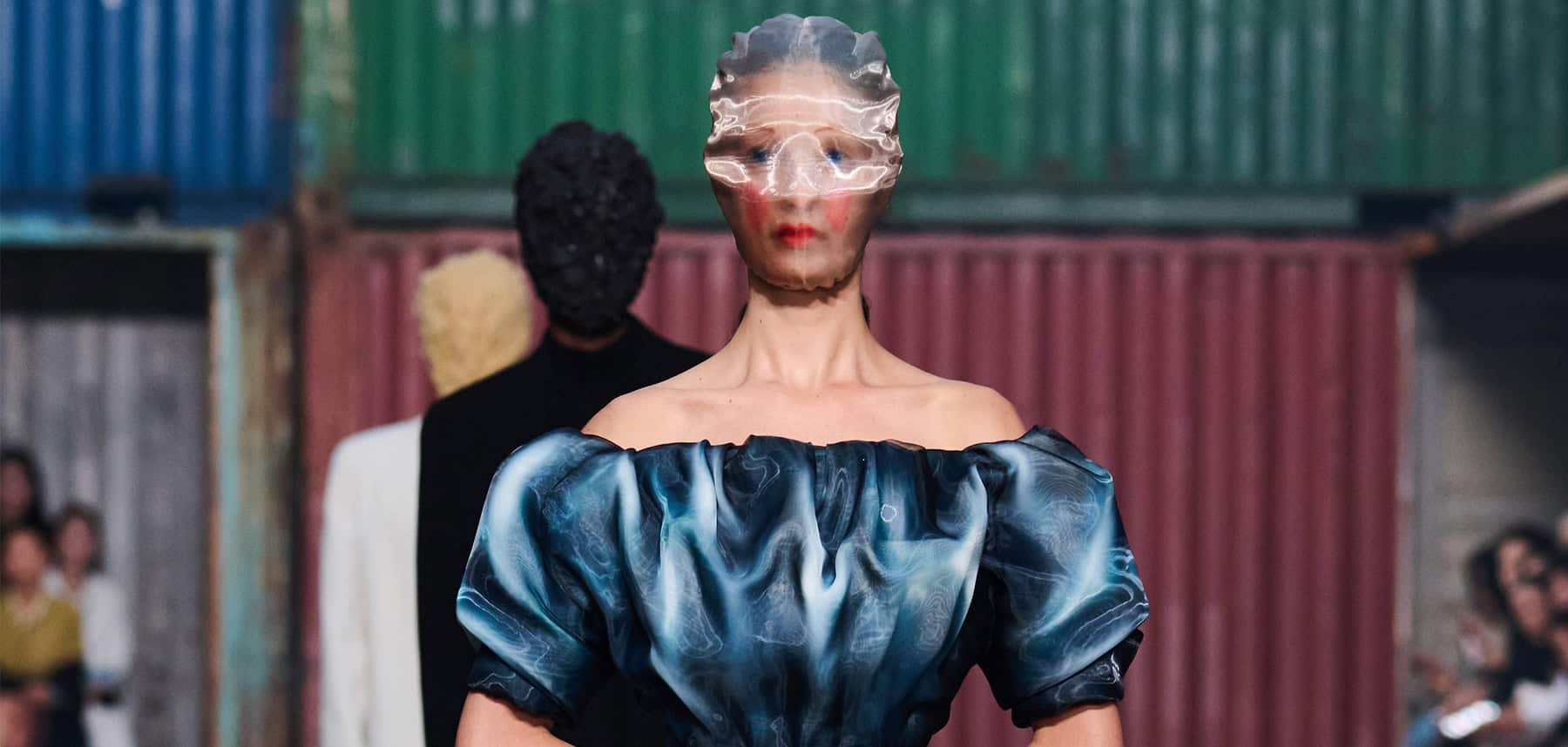
Photography courtesy of 10 Magazine / Maison Margiela
The point of it all
One could reasonably ask what the function of a collection this severe is, in a season when much of fashion is reaching for lightness and approachability. The answer, if Martens is to be taken seriously, is that not every house is required to reach for the same thing. Maison Margiela has never been in the business of reassurance. Its founding purpose was to question fashion's assumptions about desirability, about finish, about the relationship between garment and body.
Martens is working within that lineage and pushing it toward something genuinely his own — darker in its material references, more visceral in its relationship to the body, less ironic than earlier chapters of the house's history. The irony was always a protective layer. Martens seems less interested in protection.
What landed in Shanghai was a collection that demands to be looked at carefully and does not reward a glance. That is, by the house's own standards, exactly the point. The aristocratic ghosts making their way between the containers were dressed for an occasion fashion rarely asks of itself: the confrontation with its own strangeness.