Marks & Spencer had never shown at London Fashion Week. On Thursday it did, at the Design Museum, one hundred years after it first sold a jumper. The clothes went on sale before the room had emptied.
The show started at noon on 18 September. Fifty-seven looks, forty-one womenswear and sixteen menswear, moved through the Design Museum in Kensington. M&S designed all of it in-house. No guest designer, no borrowed name above the door. The retailer put its own team on the official schedule beside McQueen and Mulberry, and let the work stand there on its own.
There is history in the timing. M&S sold its first clothes in 1926, moving out of drapery and haberdashery into ready-made pullovers, petticoats and underwear. It sold them to people who had been sewing their own or paying for made-to-measure. A century later the pitch has barely shifted. Wearable, priced to move, made to a standard. The catwalk is new. The thinking under it is not.
For most of the twentieth century M&S was where Britain bought its basics. St Michael, the old in-house label, dressed the country in school jumpers, work shirts and Sunday coats. It was rarely where Britain went for fashion. The gap between quality and desire is the one the brand has spent recent years closing, and the runway is the flag planted on the far side of it.
Archive
The collection began in Leeds. M&S keeps its archive on the University of Leeds campus, more than seventy-two thousand items logged across the decades. Designers worked through silhouettes, prints, fabrics and styling notes, then built forward instead of reproducing. A tan leather borg jacket traces to an old St Michael design. A black tuxedo and a crisp white shirt echo the ones Christy Turlington modelled for the brand in the nineties. A dry-wax car coat, Japanese selvedge denim, heritage check and velvet tailoring cut to an eighties line fill out the menswear.
Three pieces sit closer to the source. A Per Una shearling jacket, and a skirt and dress carrying a bespoke floral built from two prints held in the archive. The brand's centenary exhibition, The Archive Edit, has spent this year showing a hundred pieces that had never been on public display. The runway is the commercial end of the same dig.
A hundred years of selling the reasonable thing, staged as though it were the daring one.
The Splendid EditBuy now
Everything on the runway was for sale by the evening. That is the part that sets the show apart from the rest of the week. M&S ran it see-now-buy-now. The collection went live on M&S.com and into ten flagship stores across the UK and Ireland, from Marble Arch and Pantheon through Manchester, Liverpool One, Leeds Briggate, Glasgow and Dublin. Half of it is priced under fifty pounds. The show streamed on M&S.com at six in the evening, and on Zalando's Live Hub across France, Germany, the Netherlands and Poland an hour after.
The European stream is the strategy showing through. M&S wants to double its online sales, and it is borrowing Zalando's reach to reach shoppers it does not yet have. The looks were stock, not samples. The set was a storefront. For a business that spent decades treating fashion week as someone else's party, that is a pointed way to arrive.
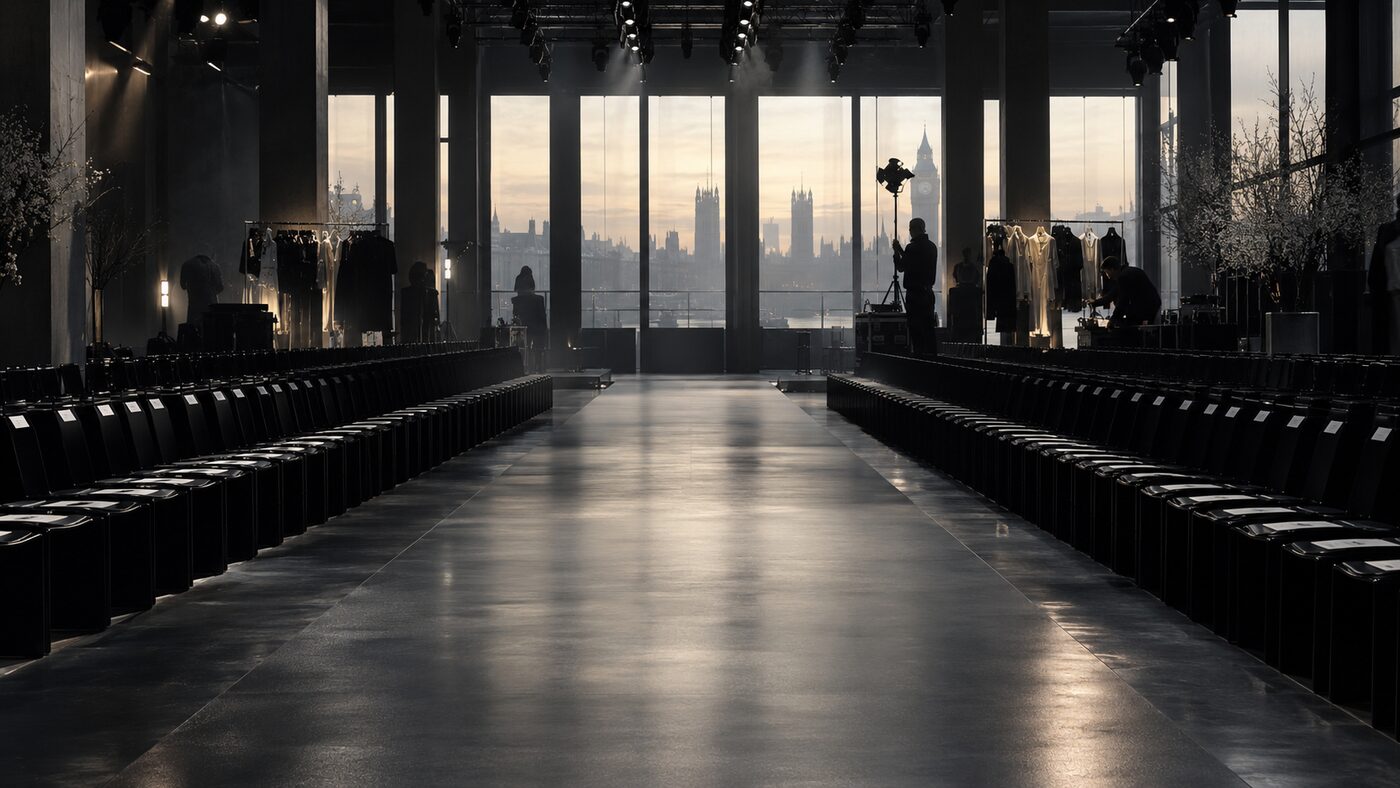
Courtesy of Fashion PR Firm
The schedule is making room for this. M&S follows a run of high-street names treated as fashion stories rather than afterthoughts, from designer partnerships at Zara to H&M staging a show with a photographer and a soundtrack. The line between the runway and the shop floor has thinned for years. M&S, of all houses, walked straight through it.
The bet
M&S holds around a tenth of the British clothing market and has spent a few years rebuilding how people see its clothes. Style scores are up, it leads on quality and value across age groups, and the number of under-thirty-fives shopping the brand has climbed by a sixth in a year. Behind the runway sits an unglamorous machine: a hundred and sixteen in-house designers, thousands of hours of fit sessions, a supply chain being rewired store by store. The show is the visible tip of that work.
It is also a gamble. The London schedule rewards ideas and is unkind to the ordinary, and M&S built a century on the ordinary done properly. The company framed the move as protecting what has worked and modernising the rest, a sensible line for a sensible business. The runway asked the harder question. Whether sensible can hold a room that came to see McQueen.
M&S did not try to pass as a fashion house for an afternoon. It carried its shop onto the runway and dared the week to find that dull. The answer, as ever with M&S, lands at the till. A hundred years in, the nerve is the story.