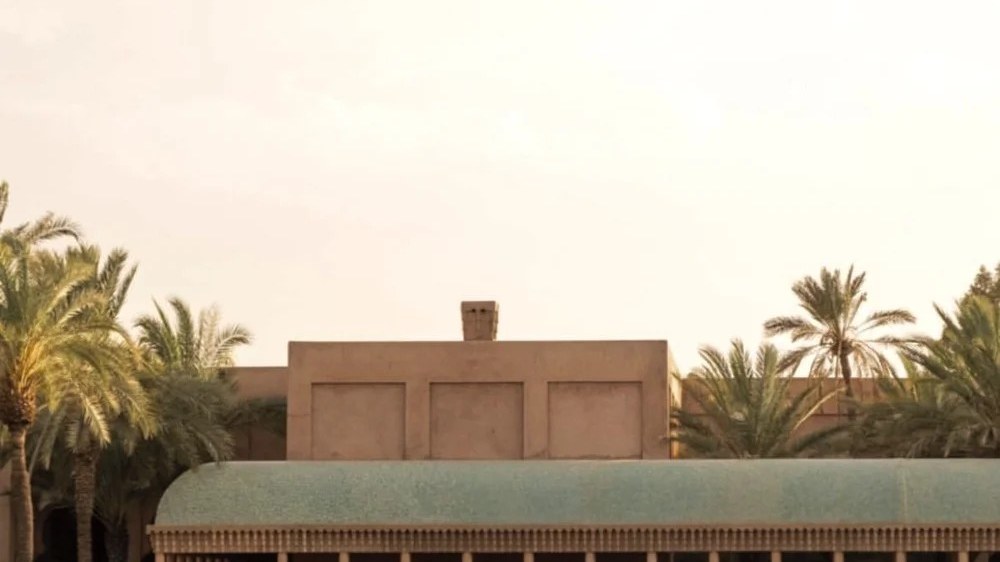
April is when Marrakech finally exhales. The crowds of high season have not yet arrived, the light sits lower in the afternoon sky, and the city — volatile, ancient, eternally pink — becomes something close to perfect for those who know when to show up.
There is a version of Marrakech that belongs to the Instagram reel and the five-night package tour: the frantic Djemaa el-Fna at midnight, the riad that looks exactly like every other riad. This is not that Marrakech. The city that greets you in early April has shed that skin. The souks still hum, the light still bleaches the stone walls to a colour between terracotta and rose, but there is space now — physical and psychological — to actually look at it.
I arrived on a Tuesday. By Wednesday morning I had forgotten what city I normally lived in. That is not something Marrakech does immediately, or gently. It takes the first twenty-four hours to stop flinching and start listening.
The Address Question
Where you stay in Marrakech is not a minor decision. The city cleaves hard between medina and ville nouvelle, between the ancient walled quarters and the wide boulevards of the newer city. Most people who come for the first time stay in the medina, which is correct — but staying in the medina well requires some navigation of a very wide range of options.
The boutique end of the medina is anchored by properties like Riad Sakkan in the Mouassine quarter, which does the riad format properly: twelve rooms built around a central courtyard, surfaces of hand-painted zellige tilework, the sound of water underscoring everything. From €150 per night it occupies the serious-but-not-stratospheric bracket, and its location — deep enough into the medina to feel genuinely hidden, but knowably placed — is right.
The other end of the spectrum is Amanjena, which sits twelve kilometres from the medina walls on the Route de Ouarzazate, surrounded by olive and palm groves. Thirty-four pavilions and maisons arranged around a central reflecting pool the colour of a still lagoon. Moorish architecture executed with the kind of precision that makes the building feel timeless rather than theatrical. At €800 and up per night, it addresses a different traveller entirely — one for whom proximity to the souks is less important than proximity to silence.
Marrakech is a city that rewards the traveller who understands that absorption is not the same as activity.
Léa FontaineThe Medina on Foot
The Mouassine quarter in the early morning is worth building a visit around. The light comes in at an angle through the narrow streets that turns ordinary plaster walls into something paint-ready. The great mosque of Mouassine anchors the neighbourhood; around it, the lanes tighten and loosen in ways that feel deliberate even when they are not. You will get lost. This is both unavoidable and instructive.
Bacha Coffee, housed in a 1910 palace just inside the Bab Doukkala gate, operates at a remove from the chaos outside. The room is all dark wood and mosaic floor, with over two hundred single-origin coffees on the menu. It is the kind of place that could only exist in a city where grandeur has been allowed to accumulate across centuries rather than constructed all at once.
Le Jardin — a restaurant in the medina built around a fig and banana garden — handles the midday problem with some grace. Order the pastilla, which in Marrakech still means something. Avoid the tourist-facing menus that have migrated toward tagine-for-every-occasion uniformity. The kitchen at Le Jardin has not committed that particular error.
The Gardens, Which Are Not Optional
Yves Saint Laurent understood Marrakech before most of the fashion world arrived. His Villa Oasis, hidden behind the walls of Jardin Majorelle — the cobalt-and-yellow garden the designer purchased in 1980 — is now partly accessible via the adjacent Musée Yves Saint Laurent Marrakech, which opened in 2017 and handles the archive with an intelligence that matches the clothes themselves.
The Majorelle garden proper, though, is the point. A collection of botanical specimens from across Africa and beyond, anchored by the building's famous cobalt walls, it remains the single most photogenic quarter-hour in Marrakech and the one place in the city where the crowds do not diminish the experience. The design is strong enough to absorb them.
Outside the city, forty minutes south into the Agafay Desert — where the landscape flattens to pale stone and a silence that has genuine mass — the camps and lodges that have taken root in recent years offer the one thing the medina cannot: absolute stillness. The drive there through the Atlas foothills is not negligible. Neither is the return, which tends to make the pink walls of Marrakech look different on the way back.
The Right Moment to Leave
Marrakech is a city that rewards the traveller who understands that absorption is not the same as activity. Four days is correct. Five begins to tip into something else — a familiarity that the city, with its layers and its noise and its refusal to fully disclose itself, does not quite permit. You leave when you are still wanting slightly more. This is the discipline.
April closes the window neatly. By May, the heat has arrived in earnest. By summer, only the most committed visitors endure it willingly. April sits between — the city at the precise temperature where walking is still a pleasure, the light still cooperative, the accommodation market still rational. It is the version of Marrakech that does not require suffering to access.
The Splendid Edit visited Marrakech in April 2026. Best travel window: March through mid-May, and October through November. Fly direct from London, Paris, or Madrid. The medina is navigated on foot; download maps offline before you arrive.
Photography courtesy of worldofsplendid.com / Splendid Magazine