The De Manta bag was born in 2010 beneath a fictional ocean floor, in the season that changed what fashion thought it could say. Sixteen years later, McQueen has sent it back underwater — and asked Tim Walker to bear witness.
There is a particular weight that attaches to certain objects within a fashion house. Not the weight of popularity or of commercial success, though those things may follow, but something more difficult to name: the sense that a design carries the house's argument within it. The De Manta bag, first introduced in Alexander McQueen's Spring/Summer 2010 collection, Plato's Atlantis, is that kind of object. It does not merely accompany the wearer. It states something.
The bag's form mirrors the manta ray — angular, wide-winged, built through sharp geometric folds rather than soft, accommodating curves. Lee Alexander McQueen designed it as part of a collection that imagined the sea reclaiming the land and human bodies evolving in response. It was a collection about extinction and transformation. The bag was not an accessory to that idea. It was an expression of it.
Plato's Atlantis and the weight of origin
To understand the De Manta campaign is to understand what Plato's Atlantis meant. That show — broadcast live online, a first for the industry — took as its premise the retreat of civilisation back into water. The clothes were scaled, alien, unsettling in the most precise sense: they disturbed something in the viewer. The models moved as if already mid-evolution, their bodies lengthened by the famous armadillo shoes, the prints generated from deep-sea photography.
It was the last collection McQueen completed before his death the following February. That fact has shaped how everything from those months is read. But the objects carry their own resonance independent of biography. The De Manta bag is angular where most luxury bags seek softness. It refuses to look settled. It is, in this way, a genuinely demanding object — one that asks the person carrying it to hold their ground against it.
That Seán McGirr has chosen to centre the bag now, to dedicate a full campaign to it for the first time, is a decision that reads as neither nostalgia nor nervous homage. It reads as a claim. This is what McQueen means. Start here.
Walker's underwater theatre
The campaign was shot by Tim Walker — and few choices could have been more considered. Walker is the photographer fashion turns to when it needs images that resist the literal: his work has always operated at the edge between documentary and reverie, between a thing seen and a thing dreamt. His sets for McQueen's previous campaigns have occupied this territory with great precision.
Here, Walker shoots model Vivien Solari submerged. Her strawberry-toned hair spreads through the water in slow arcs. The De Manta bag moves with her — held, gripped, carried through the current. Gary Card designed the set as an otherworldly waterscape, a light-dappled expanse that sits somewhere between a swimming pool and the deep ocean, between studio construction and genuine immersion. The art direction, by SJ Todd, keeps the palette saturated and cool: all blues and the bag's own forms pressing through the surface tension.
The result is a campaign that takes the bag's origin seriously. The manta ray was a creature of the deep before it was a bag. Walker's images remember this. They do not strip the object of its history to make it more accessible. They restore that history and ask the viewer to sit with it.
We wanted to bring the silhouette to life, exploring McQueen's relationship with nature. Working with Tim Walker captures an energy at McQueen's heart — between calm and chaos.
Seán McGirr, Creative Director, McQueenThe house and the natural world
McQueen's relationship with nature has never been decorative. Other houses borrow the language of flora and fauna for surface pattern. McQueen has always gone further, treating natural forms as structural and philosophical sources: the spine, the skull, the wing, the scaled hide. This was true of Lee McQueen's own collections and it has remained a constant through the house's subsequent chapters.
The De Manta embodies this approach in concentrated form. Its angular geometry does not merely resemble the manta ray; it thinks through the creature's form — the way the ray moves through water by flexing its entire body, generating lift through shape rather than force. The bag's folds are load-bearing ideas, not ornamental ones.
The current campaign makes this argument visible in a way that standard product photography cannot. Submerging the bag in Walker's underwater theatre places it in the environment that gave it meaning. It is a form of contextualisation that most luxury campaigns avoid, preferring the abstraction of white space and clean light. Here, the context is the point.
McGirr's inheritance
Seán McGirr has now been at McQueen for over two years, and his tenure has been characterised by a willingness to look the house's most formidable history in the eye. His runway work has not softened what McQueen does. The De Manta campaign extends this approach into the accessories category, where the temptation to play it safe is greatest — where a bag can be reduced to its availability in three colourways (smooth black, red, gunmetal) and its various charm attachments (pearl, crystal, chandelier chain), and presented as simply that: a product.
McGirr and Walker have refused this. The campaign presents the De Manta as an object with a claim on the viewer — with an origin story that demands acknowledgment, a form that resists easy handling, and a visual context that makes its natural source undeniable. That it is also available to buy is almost beside the point. The point is the argument the bag makes.
Fashion campaigns are rarely this confident. They usually seek to remove friction, to make desire as legible and uncomplicated as possible. This campaign introduces friction. It places a demanding object in a demanding environment and trusts that the audience will meet it there. If the history of McQueen is any guide, some of them will.
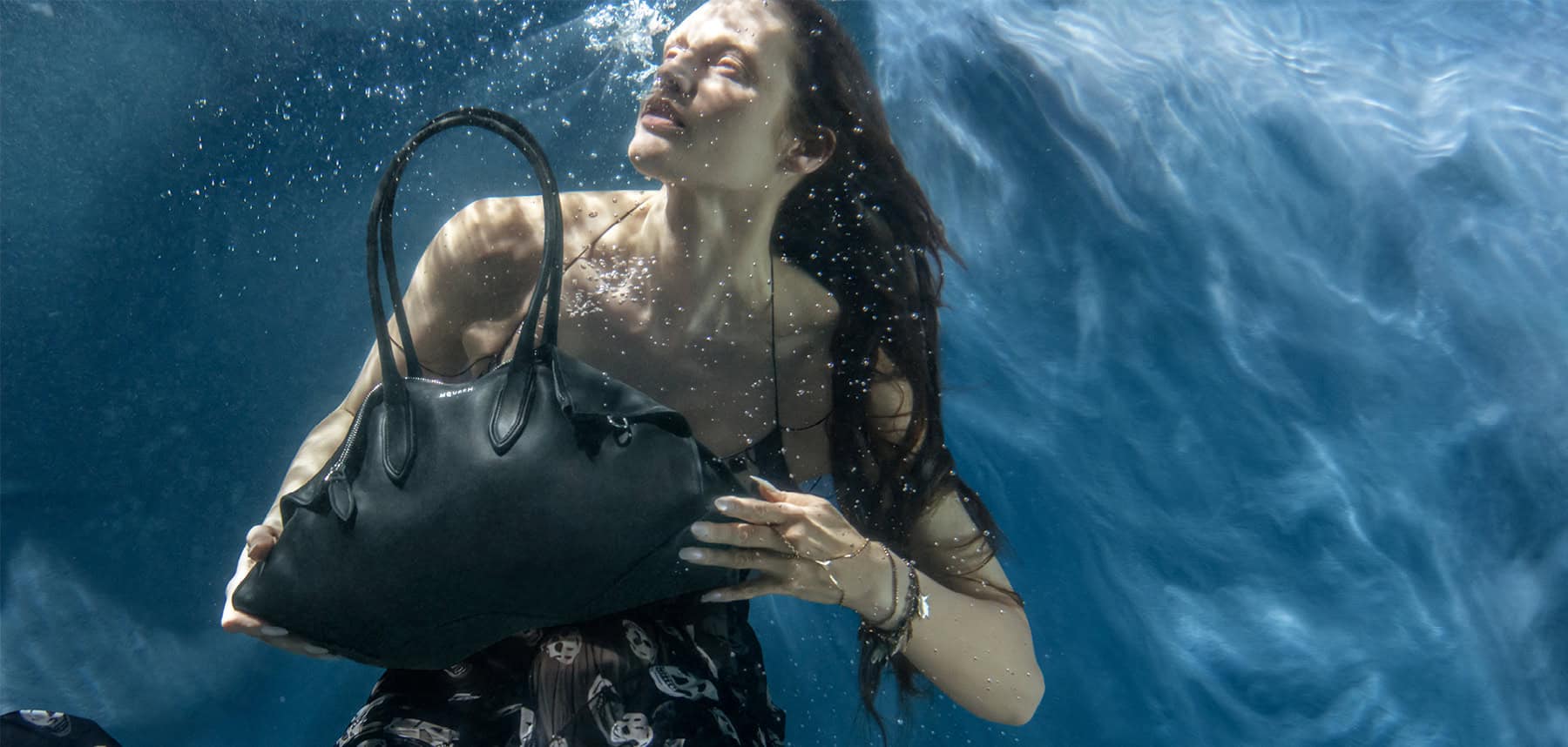
Photography by Tim Walker / 10 Magazine — McQueen De Manta bag campaign, S/S 2026
There is something clarifying about a house returning to one of its own monuments. It says: this is where the thinking started. The De Manta is not a revival or a reissue. It has been in the line continuously. But dedicating a full campaign to it — placing it under Walker's lens, in water, in motion — is an act of editorial will. It says this object matters, and it says so without apology.
McQueen has always done this or tried to: insisted on meaning, on the presence of an idea behind every object. The De Manta campaign is that insistence made visible again. Plato imagined a civilisation consumed by the sea. Walker has returned one of fashion's most indelible objects to the water and asked what it looks like still alive. The answer, apparently, is this: exactly as it always did. Angular, deep, unwilling to be easily held.