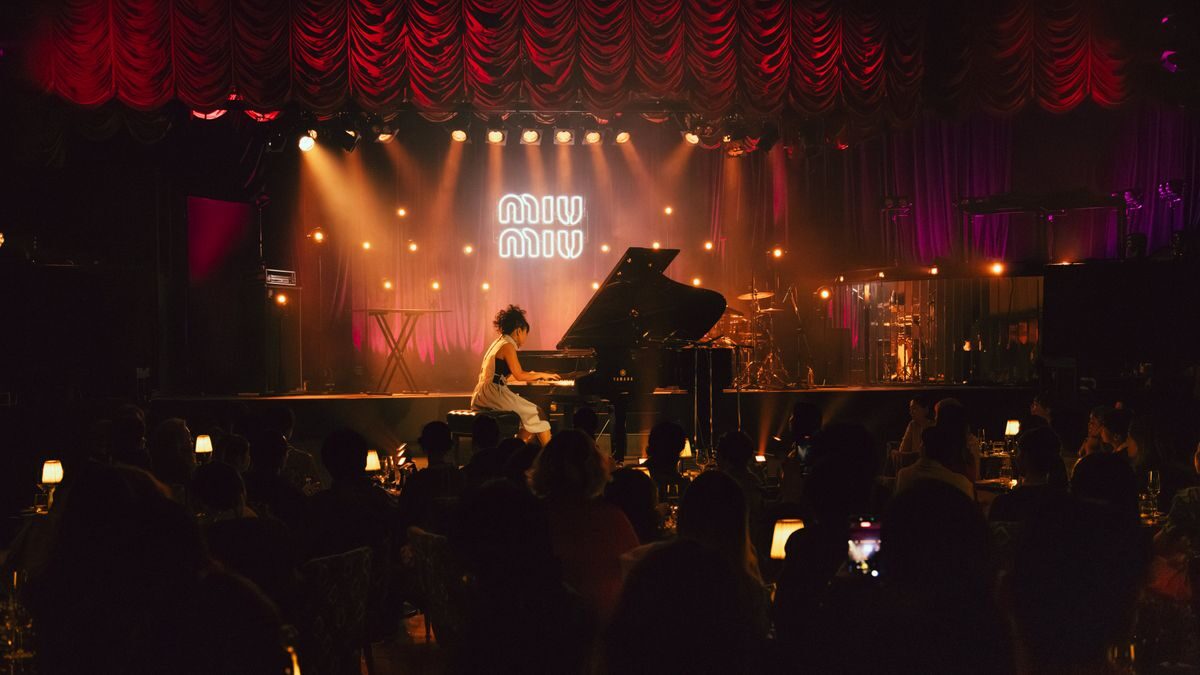
On 13 May 2026, Miu Miu reopened its Ginza flagship and celebrated by turning Tokyo's last surviving dance hall into a jazz club for one night only. Grammy-winning pianist Hiromi Uehara headlined. The clothes stayed in the store. The music carried the message.
Dance Hall Shinseiki opened in 1948, three years after the war ended. It sits near Ueno, the neighbourhood that houses Japan's first public art museum and its oldest art university. The interior has barely changed in eight decades. Velvet stage curtains hang in folds that have softened with age. Victoriana-style damask covers the walls. The floor is sprung for dancing, not for standing and watching. Miu Miu took the space as it found it.
The evening was the latest in a pattern that Miuccia Prada has established over recent seasons. The Miu Miu Literary Club ran in Milan during Salone del Mobile. A music event at Koko in Camden marked the London store reopening in late 2025. Each activation selects a cultural form native to the host city and builds an evening around it. In Tokyo, the form was jazz.
A century of swing
Jazz arrived in Japan in the 1920s, brought across the Pacific by travellers who had spent time in American cities. Dance halls followed almost immediately. The genre settled into Japanese culture with a permanence that it never quite achieved in most European capitals. The jazz kissa, a listening cafe built around a serious hi-fi system and a deep record collection, became a fixture of Tokyo street life. Many still operate today, their owners cataloguing decades of vinyl in rooms the size of a living room.
Miu Miu understood this context. The evening was not an import of Western jazz culture into a Japanese setting. It was an acknowledgement that Japan's relationship with the music is older, deeper, and more particular than most outsiders assume. The choice of venue reinforced the point. Dance Hall Shinseiki is a relic of the period when jazz first took root in Tokyo. To stage the evening there was to honour a lineage.
Hiromi plays
Hiromi Uehara performed solo. She is a pianist whose technique is so physically expressive that watching her play resembles watching a dancer. Her body rises and dips with the phrases. Her left hand crosses her right. She plays Latin passages, classical runs, and rock power chords within the same piece, and the transitions are so fluid that genre becomes irrelevant. She has won a Grammy and performed at festivals across five continents. At seventeen, the late Chick Corea invited her onstage.
In the intimate dimensions of Dance Hall Shinseiki, with smoky stage lighting and an audience seated close enough to hear the mechanism of the keys, the performance felt private and enormous at the same time. Uehara played as though she were conducting a quartet, but every voice came from her own instrument. The younger members of the audience, many of them Miu Miu's core demographic, sat motionless. Several had never attended a live jazz performance before.
The most sophisticated thing a fashion house can do in a foreign city is listen to what that city already knows.
Juliette MarchandThe new Ginza store
The reopened flagship in Ginza now includes Miu Miu's first VIP salon in Japan. The space is designed around the Japanese principle of intimate hospitality, offering private appointments in rooms furnished with a warmth that feels residential rather than commercial. The store's renovation coincides with a broader moment for the brand in the Japanese market, where Miu Miu's popularity among younger consumers has accelerated sharply since the viral success of its low-rise skirt silhouettes.
Ginza itself is a neighbourhood defined by careful curation. The major fashion houses maintain their flagships here, each one competing not on square footage but on the quality of the experience offered inside. For Miu Miu, that experience is now framed by music, literature, and conversation, as much as by the garments on the rails.
Trumpeter Reiya Terakubo
The evening's second performer was Reiya Terakubo, a young Japanese trumpeter whose sound carries the warmth of hard bop and the restraint of something more contemporary. His set provided a counterpoint to Uehara's virtuosity: where she was kinetic and expansive, he was measured and cool. The two performances together described the range of Japanese jazz in 2026, from explosive innovation to quiet precision.
The audience moved between the performances and a drinks reception that ran through the evening. No runway. No lookbook. No product placement beyond the clothes that guests chose to wear. The brand's presence was expressed entirely through its curatorial taste, its willingness to let the evening belong to the musicians rather than to itself.
The pattern emerges
Miu Miu under Miuccia Prada has always resisted the obvious. The brand does not sponsor concerts or attach its name to existing festivals. It builds temporary institutions: a reading room, a film series, a jazz club. Each one lasts a single evening or a few days, and each one communicates something about the house's values that a billboard cannot. The message is consistent across cities and formats. Women's creativity matters. Cultural forms deserve to be taken seriously. Fashion is richer when it sits inside a larger conversation about art and ideas.
In Ginza, that conversation happened through the medium of improvised music, in a room where people have been dancing since 1948. The velvet curtains stayed. The damask stayed. Miu Miu added nothing to the room except an audience and two extraordinary musicians. Sometimes that is enough.