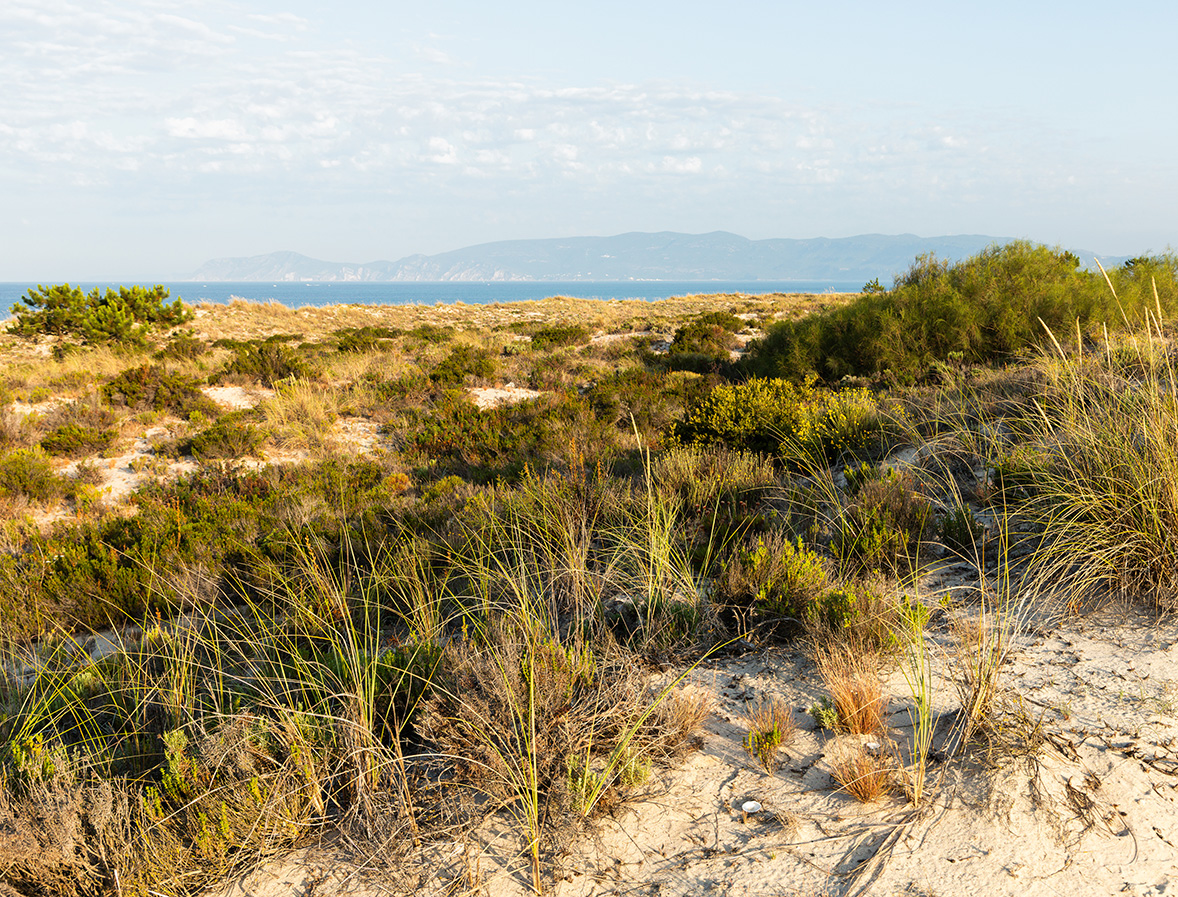
Fifteen years on a peninsula an hour south of Lisbon. A hundred and thirteen keys on three hundred and forty hectares of preserved dune, sitting quietly between the Atlantic and the estuary.
Cars stop at the edge of the site. Electric buggies take over from there, moving on a single sand track through the pine. Juniper thickens at the shoulders. The dunes settle in. Four minutes later the building comes into view, low against the horizon, already half swallowed by the land it sits on. Na Praia opens this month. It has taken most of a decade and a half to do so.
José António Uva bought the peninsula in 2011. The plans were approved for a site four times the size of what stands now. Eighty per cent of that footprint was returned to the dunes before construction began. The hotel that opens this spring is the residue of that decision.
The site
The peninsula lies between the Atlantic and the Sado Estuary Nature Reserve. Three hundred and forty hectares of pine, sand and scrub. Two kilometres of white beach with no other building on it. The Sado's mouth carries migrating storks in autumn; in summer, the water holds the pale green of the estuary grass. Dolphins run the channel most mornings, visible from the pier at Carrasqueira if the tide is right.
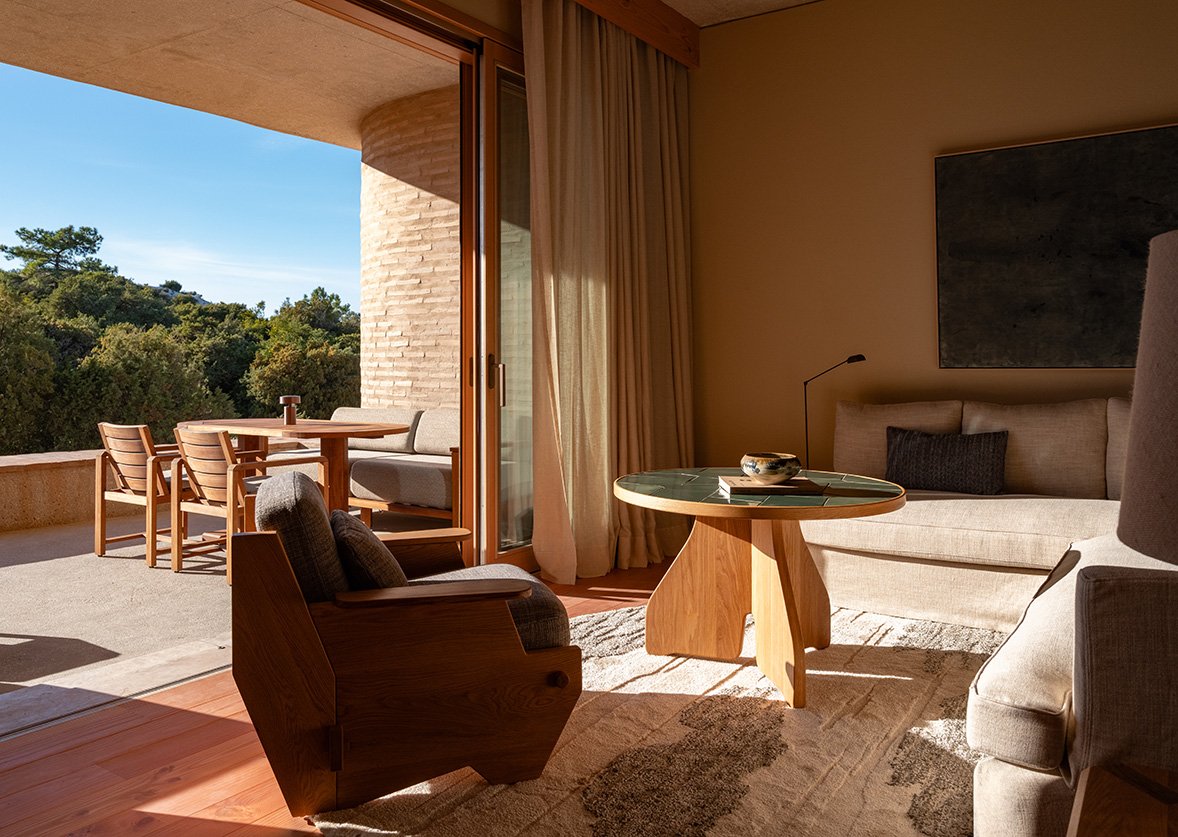
A dune suite at Na Praia, Comporta
Uva is the eighth generation of his family to keep land in Portugal. São Lourenço do Barrocal, his Alentejo farmhouse hotel, opened in 2016 after fourteen years of reconstruction. Barrocal looks inland. Na Praia turns to the sea. The line holds.
The buildings
Studio KO drew the architecture. Doxiadis+ handled the landscape. Estúdio Lisboa, Uva's own Portuguese firm, kept the language consistent with Barrocal. The walls are raw earth and local clay. The timber will weather grey in the Atlantic winds. Nothing is painted. Nothing reaches above the first ridge of dune.
Forty-two rooms. Three suites. Sixty-three houses. Five villas, each with a private pool and a path that opens directly onto the beach. The interior palette holds to the coast: sandy neutrals, pale wood, texture pulled from lichen and juniper. The Dune Suite bridges the interior and the untouched dune beyond it, an arrangement that feels less like a room and more like a shelter in the sand.
The plans were approved for a site four times the size of what stands now. Eighty per cent was returned to the dunes before construction began.
Léa FontaineThe table
Five restaurants. One is an oceanside grill where the fish arrives from the stilt piers at Carrasqueira, thirty minutes south. Another pulls vegetables from a women-run farm in the rice country behind the dunes. The menus move with what the estuary and the fields are sending that week. In April it is asparagus and razor clams; in July, tomatoes and line-caught bass; in October, the first eels of the season.
The bar faces the sea and opens to the breeze by six. A chef's table sits inside the spa pavilion and serves a set menu built around the morning's catch. There is a poolside room, and a quieter fifth space that will host long lunches in the pines. Breakfast runs until noon. Nobody is keeping time too closely.
The spa
The spa sits low in the dunes, halfway between the villas and the sea, and looks as if it has been carved out of the sand. Movement studios. Water therapies. Treatment rooms with cedar beds and salt air coming in through the windows. The programme leans on the proximity of the Atlantic, which is the point. A ten-minute walk puts you in the surf.
The spa pavilion, carved into the dune
The brief
Conservation was the commission. Uva's family line, the one held at Barrocal for eight generations, is custodianship of the land. Resident biologists walk guests across the estuary and into the cork oak behind the property. Boats leave the stilt pier at dawn for the birds. The sand track stays as narrow as the buggies allow. A hotel of this scale in Comporta is not a small thing. Na Praia has the weight of something smaller.
The verdict
Comporta has been filling up for a decade. The cabins grew walls. The walls grew pools. The pools grew logos. Na Praia is the first piece of the peninsula that feels built for the land rather than against it. The villas are discreet. The grill is the size it needs to be. The beach belongs to the sea.
Book the Dune Suite. Walk the two kilometres at low tide. Let the plans that were not built stay unbuilt.
Na Praia opens in spring 2026. Rates and reservations through napraia.com. The hotel is a member of The Leading Hotels of the World.
Photography by João Lança Morais, courtesy of Robb Report / Na Praia