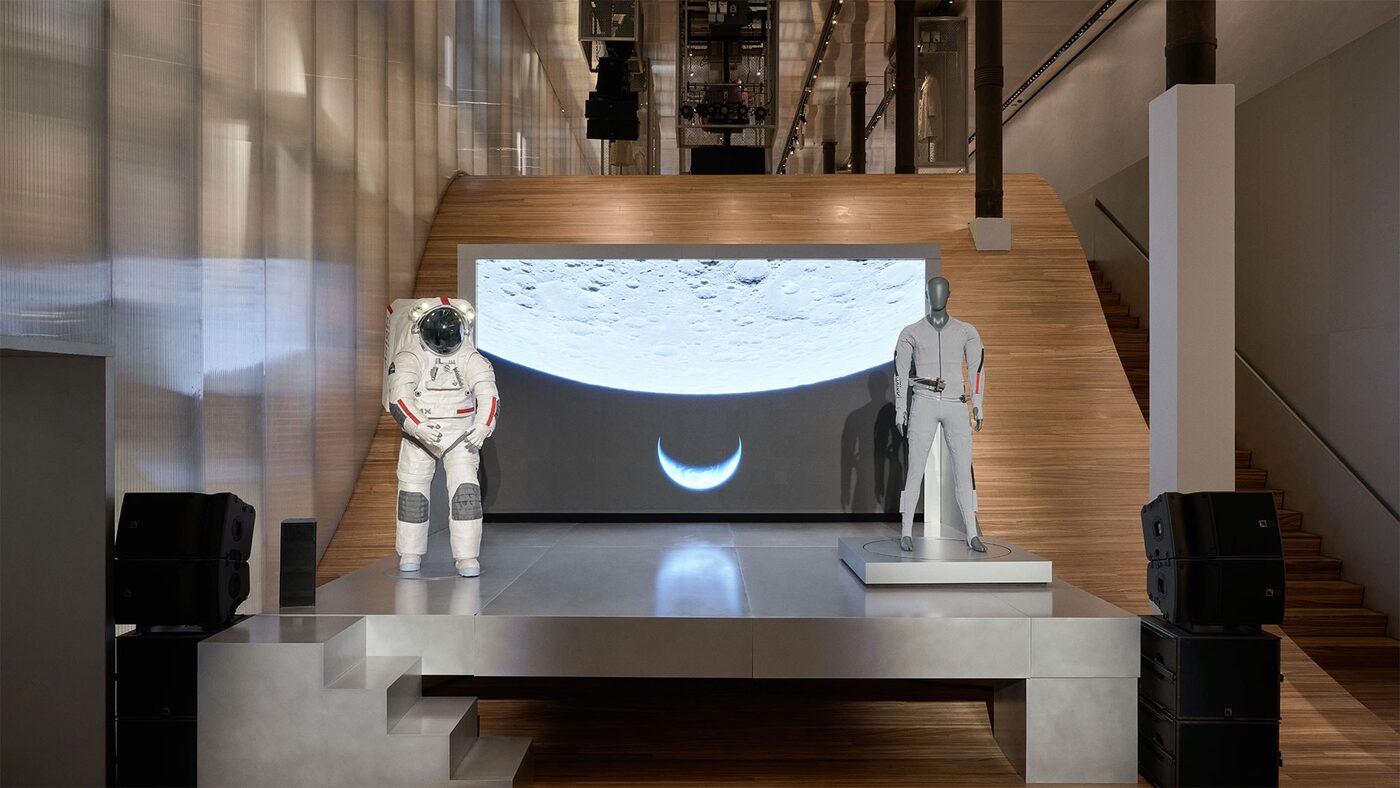
The spacesuit everyone recognises stood at one end of the stage, white and monumental. The news was the grey piece beside it, a knitted second skin threaded with water lines. In New York, Prada and Axiom Space showed the garment astronauts will wear closest to the body when they walk on the Moon.
The unveiling came on June 7. Axiom Space and Prada presented the Liquid Cooling and Ventilation Garment, the LCVG, the working inner layer of the AxEMU lunar spacesuit. On a low steel platform, the full suit faced a mannequin wearing the new layer, the lunar surface glowing on a screen between them.
The acronym undersells the job. A moonwalk can run to eight hours, and a body working that hard inside a sealed suit produces serious heat. The LCVG exists to carry that heat away and keep the air around an astronaut’s face breathable. It is plumbing, knitwear and life support in a single garment.
The idea is older than the Moon landings themselves. Apollo crews wore water-cooled underlayers threaded with tubing, and every NASA suit since has carried a version of the same garment. What changed in New York is who makes it, and how.
Cold water
Inside the garment, cold water moves through a network of fine tubes routed over the body’s major muscle groups. The water absorbs metabolic heat and carries it to the suit’s portable life-support system, which expels it into space. Older cooling garments ran a single loop; this one carries a fully redundant second circuit, so a failure in the primary leaves a working backup.
A separate run of tubing handles air. It delivers fresh oxygen across the face and pulls exhaled carbon dioxide back through the life-support system’s scrubber before the oxygen recirculates. Russell Ralston, who leads spacecraft development at Axiom Space, described the garment as working every minute an astronaut spends outside the vehicle, managing temperature and breathing while the body is pushed to its limit.
The knit
Prada’s contribution sits in the fabric itself. The house brought its engineered knitting to the construction, with 3D modelling shaping the knit so cooling and ventilation hold steady while the wearer moves. Up close the surface reads as ribbed channels running the length of the torso, parting and rejoining around the closures like cabling on a fisherman’s sweater.
Material selection mattered as much as structure. Prada’s work with high-performance fibres guided the sourcing of yarns that can be worn again and again across long-duration missions. A garment that must perform identically on its twentieth wearing is a familiar problem in Milan, normally with lower stakes attached.
The assignment suits the house. Miuccia Prada built its modern identity on industrial nylon in the 1970s, and the group’s Luna Rossa sailing programme has treated performance fabric as a design problem for decades. That same instinct now leaves the atmosphere.
A house that built its name on industrial nylon now knits the layer between a human body and the vacuum.
The Splendid EditShell to skin
The two companies started at the outside. In 2024 they unveiled the AxEMU’s outer layer, built to take the thermal swings and micrometeoroid risk of the lunar South Pole. The LCVG moves the collaboration inward, to the layer where comfort and reliability are felt directly on the skin.
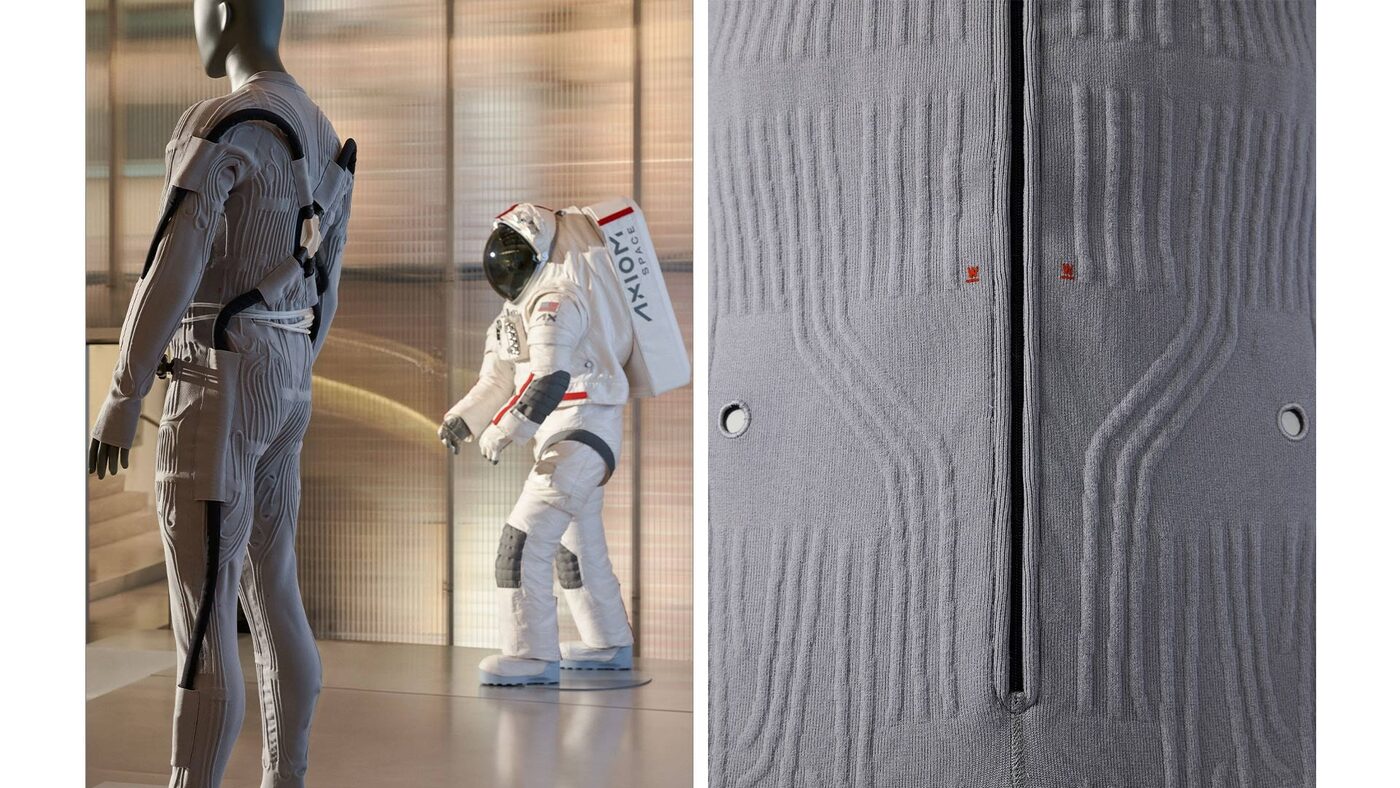
The LCVG and its engineered knit. Courtesy of Prada
Lorenzo Bertelli, Prada Group’s chief marketing officer, noted that the houses had promised more after the AxEMU reveal, and framed the new garment as that promise kept, built on Prada’s patternmaking, design and materials know-how. Jonathan Cirtain, Axiom Space’s chief executive, called it something neither company could have produced alone.
That claim is easy to test against the parts list. The tubing, the life-support interface and the redundancy budget belong to aerospace. The knit structure, the fit and the fibre choices belong to a fashion house. Neither half works without the other.
Artemis
The LCVG is bound for NASA’s Artemis IV mission, when astronauts return to the lunar surface for the first time in more than fifty years. When they step out of the lander, the grey knit will sit between their skin and everything else.
Fashion’s space ambitions usually end at the costume. This one ends at the hardware review. Prada has put its knitwear inside a machine for keeping people alive, and that garment will log more consequential hours than anything the house sends down a runway.