Carpet to the ceiling, chandeliers overhead, a room built to feel like the inside of a private client's wardrobe. Richard Quinn showed Spring 2027 on Saturday night, and he used the space to answer a question most designers leave alone: what actually happens before the gown reaches the room.
The show ran on the third day of London Fashion Week, the Saturday of a schedule that closes on Monday 21 September. Quinn set his Spring 2027 collection inside a plush, fully carpeted space hung with chandeliers. The staging pointed away from the runway and toward the atelier, the mirrored fitting rooms and the ballrooms where these clothes are meant to be worn.
His theme was the ritual of dressing. For most people, getting dressed takes little thought. For the clients Quinn builds for, it is closer to choreography, a sequence of season, occasion, undergarments, shoes and jewellery worked out in advance and handed down. He staged that sequence rather than describing it, and the gowns arrived as the end of a process the audience does not usually see.
The private archive
Quinn has spent several seasons letting London look into a world it rarely reaches. Last season he sent the collection into outer space. This time he turned inward, toward the walk-in wardrobes and the getting-ready hours that precede a Quinn client's evening. His show notes spoke of the heightened drama of getting dressed, and the set answered with mirrored walls and deep pile underfoot.
The clothes carried the same logic. Encrusted eveningwear, gowns weighted with hand-applied detail, pieces made to be kept rather than cycled out. Quinn treats a wardrobe the way a collector treats art, as something assembled slowly and held for decades. The word he keeps returning to is archive, a personal one, built one commission at a time.
He reached for the 1980s to set the tone. It was a decade when excess read as aspiration and wealth wanted to be seen, and the reference suited a collection that makes no apology for volume or shine. The drama was the point, and the craftsmanship underneath it was the argument for the price.
Quinn does not sell a dress. He sells the whole evening it belongs to, mirrors and ballroom included.
The Splendid EditBack to ready-to-wear
The bigger news sat underneath the spectacle. Saturday's show marked the return of Richard Quinn ready-to-wear, and it landed alongside the launch of a new brand website. The bespoke gowns remain the headline, but the label now has a route to a wider customer and a place to sell to her directly.
That combination changes the shape of the business. A couple of hundred private clients can sustain an atelier. A working ready-to-wear line and a functioning shopfront reach the woman who wants a piece of the fantasy without commissioning it from scratch. Quinn is opening the door a little wider without giving up the room behind it.
London has quietly become a place for this kind of occasion wear. Michael Stewart's Standing Ground has taken sculptural eveningwear onto the couture calendar, and Quinn has built a business around the art of dressing up. The city that trades on nightlife and art schools now also trades on gowns, and the two designers make the case from different directions.
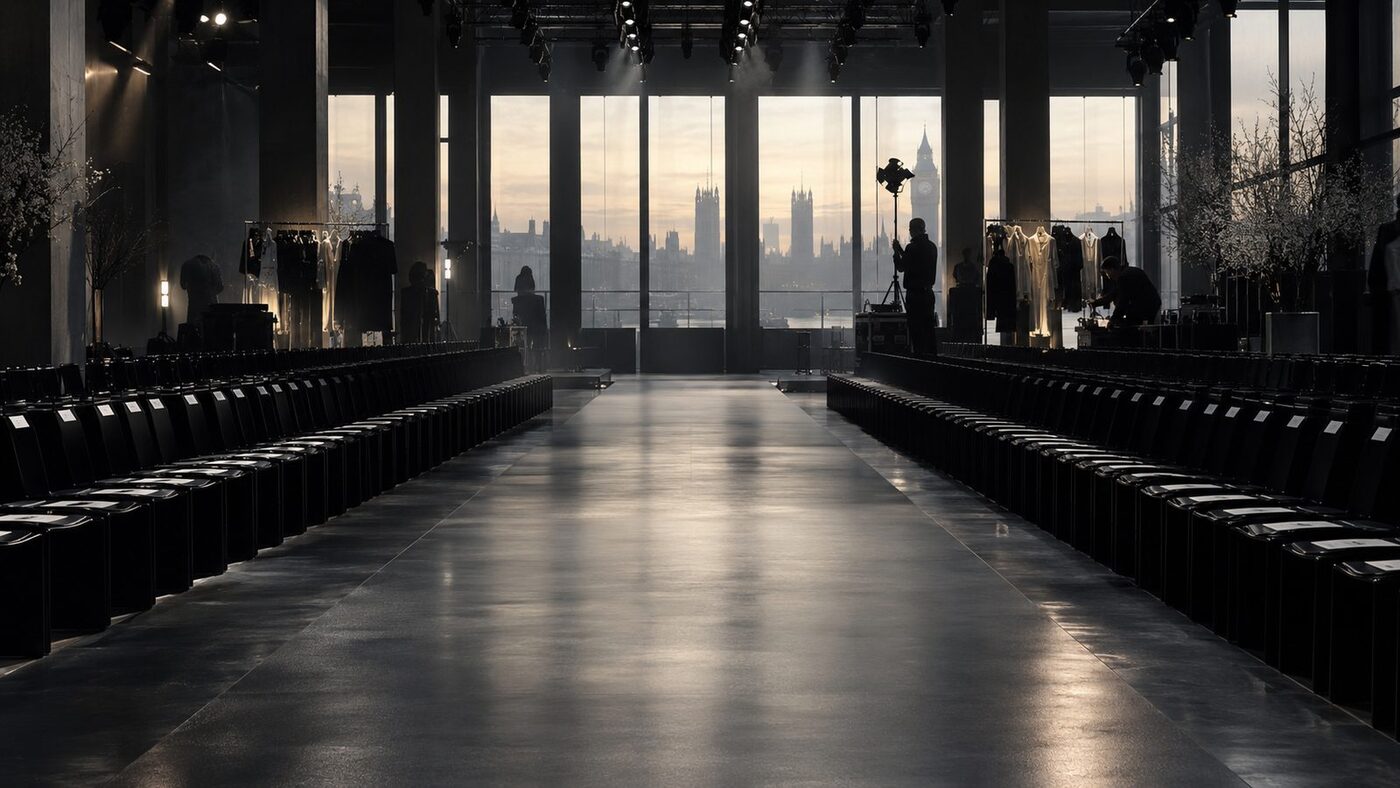
Richard Quinn showed Spring 2027 on 19 September, the Saturday of London Fashion Week. Courtesy of Fashion PR Firm
The couture question follows Quinn around now, and Saturday did nothing to quiet it. His command of hand-work has grown to a point where Paris looks like a plausible next address. For the moment he stays in London, where he has become one of the surer bets on the schedule, and where his idea of excess still finds a woman willing to pay for it.