Six Senses has opened its first UK hotel inside the restored shell of Whiteley's, a Grade II-listed department store in Bayswater that once sold everything from a pin to an elephant. The building is back. It has been made, improbably, into something better.
William Whiteley opened his store on Queensway in 1863. He had attended the Great Exhibition of 1851 as a young draper's apprentice from Yorkshire and returned to London convinced that the future of retail was the department store: a single building where anything could be bought. The business grew to fill an entire block. When fire destroyed much of the original structure in 1887, Whiteley rebuilt on a grander scale. The store he completed in 1911 had a baroque facade, a central dome, and a staff of six thousand.
The building closed as a retail destination in 2018. The £1.5 billion redevelopment that followed was led by Foster + Partners, with EPR Architects handling the heritage work. The Grade II listing protected the facade and the central atrium. Everything else was rebuilt, reconfigured, or reimagined around those bones. Fourteen branded residences occupy part of the new structure. The retail floors have been renewed. Six Senses takes the rest.
The design
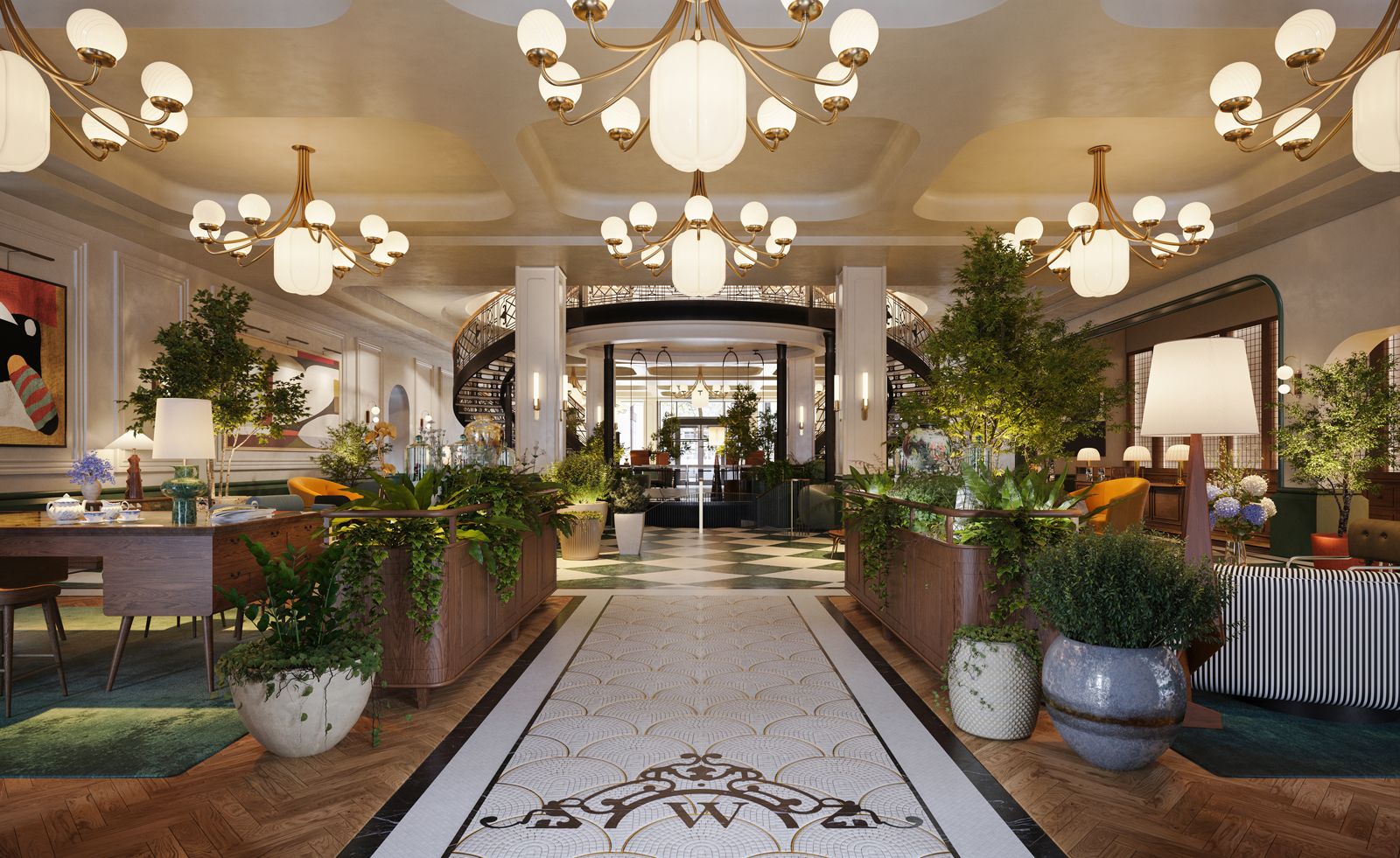
AvroKO drew the interiors of the hotel. Their brief was to work with the building's retail past rather than erase it. Haberdashery cabinets run along corridors. Vitrines display objects that read less as decoration than as inventory. Counter-like interventions appear at reception and in the bar, recalling the proportions of a shop floor. The reference is post-Victorian and art deco in equal measure, with early modernist details folded in where the architecture permits.
The 109 rooms and suites sit across several floors. The scale of the building means the rooms are generous by London standards. Ceilings are high. Materials are warm: aged timber, polished stone, linens in cream and ochre. The effect is a hotel that reads as both new and deeply familiar, as though Whiteley himself had commissioned it with a century's hindsight.
The Whiteley Suite occupies a position of particular significance. Two bedrooms, marble bathrooms, and a tree-lined private terrace. The terrace faces away from the street and onto the building's inner courtyard, where the restored dome sits above the atrium. On a clear afternoon the light through the glass falls in the same pattern it has since 1911.
The haberdashery cabinets and counter-like interventions make the point without labouring it: this building was always about desire, about things beautifully displayed and carefully chosen. Six Senses has simply changed what is on offer.
Léa FontaineThe table
Whiteley's Kitchen is the main dining room. Executive chef Eliano Crespi runs a kitchen that is vegetable-forward with Asian inflections: fermented, charred, pickled, bright. The sourcing is seasonal and the menu shifts accordingly. Breakfast is unhurried. Dinner is an occasion.
Whiteley's Bar sits adjacent. The cocktail list has been designed to work with or without alcohol, which is a practical decision given the spa crowd that drifts through from mid-afternoon. The non-alcoholic options are not afterthoughts. Shrubs, ferments, and housemade tonics appear alongside the spirits programme. The room is the right length for an evening: long enough to settle into, short enough to feel contained.
The vaulted pool, Six Senses London, Bayswater — Photography by Martin Morrell / Wallpaper*
The spa
The spa covers 2,300 square metres. Ula Saniawa produced a ceramic installation that runs through the lower levels; the work sets a tone that is earthy and considered rather than clinical. The facilities include a magnesium pool, cold plunge, sauna, hammam, and flotation capsule. These are the standard instruments of the category. Six Senses uses them with more rigour than most.
The biohacking recovery lounge and the Hum2n longevity clinic sit alongside the spa and push into territory that most hotel wellness programmes avoid. Hum2n offers diagnostics, IV therapies, and recovery protocols used by athletes. The Alchemy Bar is something else entirely: guests come to make their own skincare products, selecting ingredients from a dispensary of oils, botanicals, and actives. It sounds like a workshop; it behaves like one. The Earth Lab runs conservation workshops, a nod to the Six Senses brand's longstanding commitment to environmental programmes.
The neighbourhood
Bayswater sits between Notting Hill to the west and Paddington to the east, with Hyde Park forming its southern boundary along the Bayswater Road. Queensway, the street directly outside, has been improving for years. The Whiteley's redevelopment anchors that improvement with considerable force. The park is three minutes on foot. The restaurants of Westbourne Grove are ten minutes. The rest of central London is within cycling distance or a short ride on the Central line.
For London Fashion Week in February and September, the address is well-placed. The shows run across venues from King's Cross to the South Bank, and Bayswater sits on the western edge of that geography. The Whiteley Suite and the larger rooms on the upper floors have already become known quantities among the buyers, editors, and designers who move through the city during show season. The spa provides a reason to stay an extra night. The bar provides a reason to stay even later than that.
Six Senses London is the brand's first UK property. The hotel occupies the restored Whiteley's building at 1 Redan Place, Bayswater. Fourteen branded residences sit within the same development. Book through sixsenses.com.
Photography by Martin Morrell / Wallpaper*