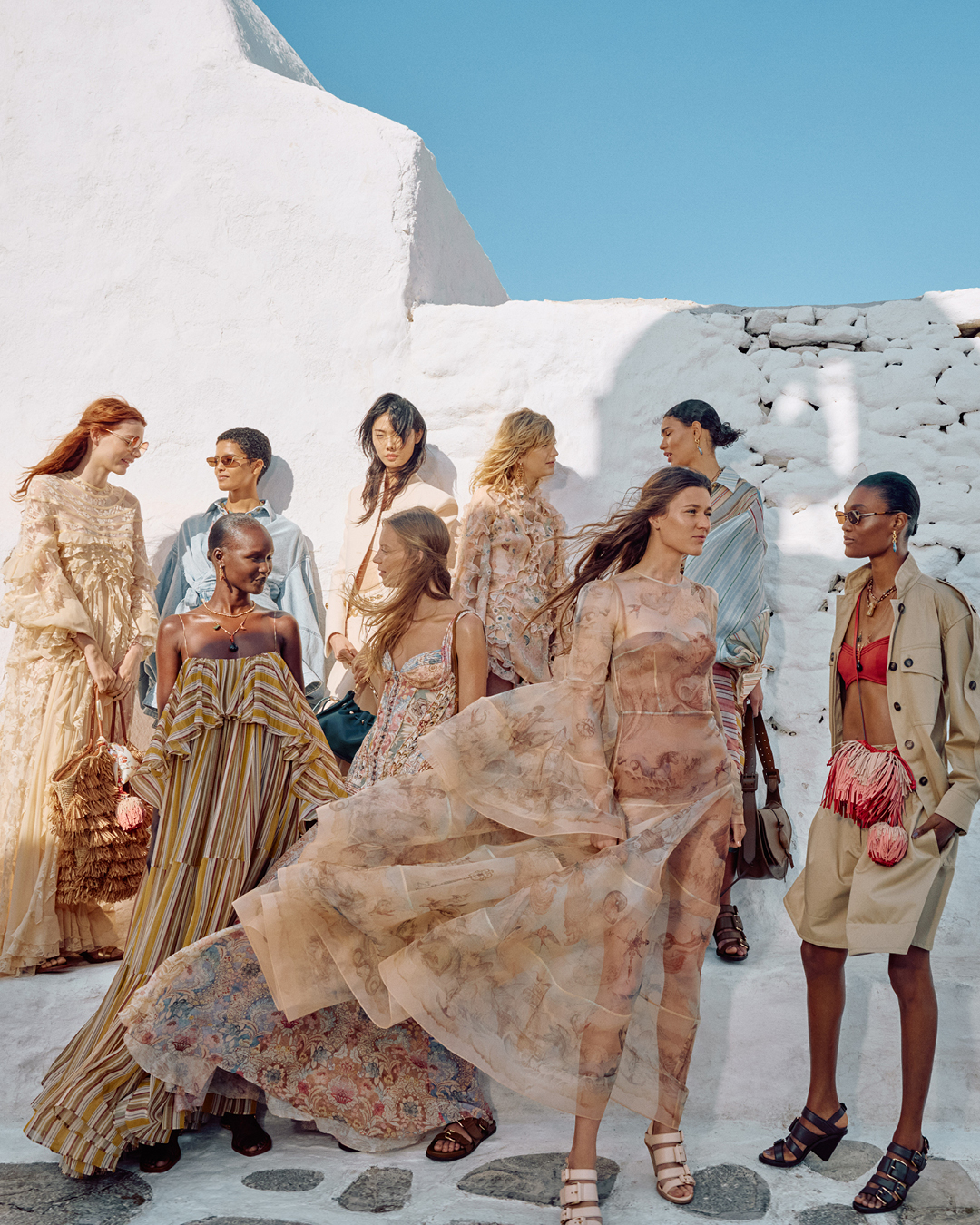
Australian Fashion Week has moved to the Museum of Contemporary Art at Circular Quay, placing the runway against the Sydney Opera House and the harbour. Zimmermann opened the schedule with a Cruise 2026 collection that made the case for Sydney as a fashion capital in its own right.
There is a particular quality of light in Sydney that European fashion cities cannot replicate. It is wide and clean and slightly bleached, and it changes the way fabric behaves on a body. Nicki Zimmermann has understood this for three decades, and the Cruise 2026 collection she presented at Australian Fashion Week’s new Circular Quay home was an exercise in designing for that light rather than against it.
The collection moved between botanical prints on draped silk, structured linen suiting in shades of sandstone and eucalyptus, and eveningwear that caught the harbour breeze as models walked the waterfront runway. Broderie anglaise appeared throughout, reworked into tailored separates that felt neither bridal nor beachwear. The palette drew from the Royal Botanic Garden across the water: waratahs, banksias, grevillea in burnt orange and dusty pink.
A new address
The move to the Museum of Contemporary Art is the most significant change to Australian Fashion Week’s identity since its founding in 1996. The previous home at Carriageworks in Redfern served the industry well, but Circular Quay offers something Carriageworks could not: a setting that communicates internationally. The MCA’s brutalist façade sits directly opposite the Opera House, and the outdoor runway space uses the harbour as a backdrop that no set designer could improve upon.
The relocation reflects a broader ambition. Australian Fashion Week has spent years building credibility with international buyers and press, and the Circular Quay address is a statement that the event belongs alongside Copenhagen, Seoul and Shanghai in the conversation about fashion weeks that matter beyond their domestic market. The harbour setting photographs beautifully, which in 2026 is not a superficial consideration but a strategic one.
Sydney does not dress like Paris or Milan. It dresses like a city where the ocean is never more than twenty minutes away and the light forgives nothing. That is not a limitation. It is a point of view.
Camille AshworthBeyond Zimmermann
If Zimmermann set the tone, the designers who followed expanded the vocabulary. Aje, founded by Adrian Norris and Edwina Robinson, presented a collection that leaned into architectural volume. Oversized cotton shirting was cut with exaggerated proportions, balanced by slim tailored trousers in natural fibres. The brand has built its identity around what it calls “Australian luxury,” a phrase that once sounded aspirational but now describes an identifiable aesthetic: relaxed construction, earth tones, raw-edged finishes that suggest the garment was made by hand even when it was not.
Bianca Spender continued her exploration of draping as architecture. Working almost exclusively in silk and viscose, Spender creates garments that depend on the body for their structure. Nothing is rigid. Everything moves. The result is a kind of dressed-up ease that suits Sydney’s climate and temperament, and that translates to any warm city where women want to look considered without looking constrained.
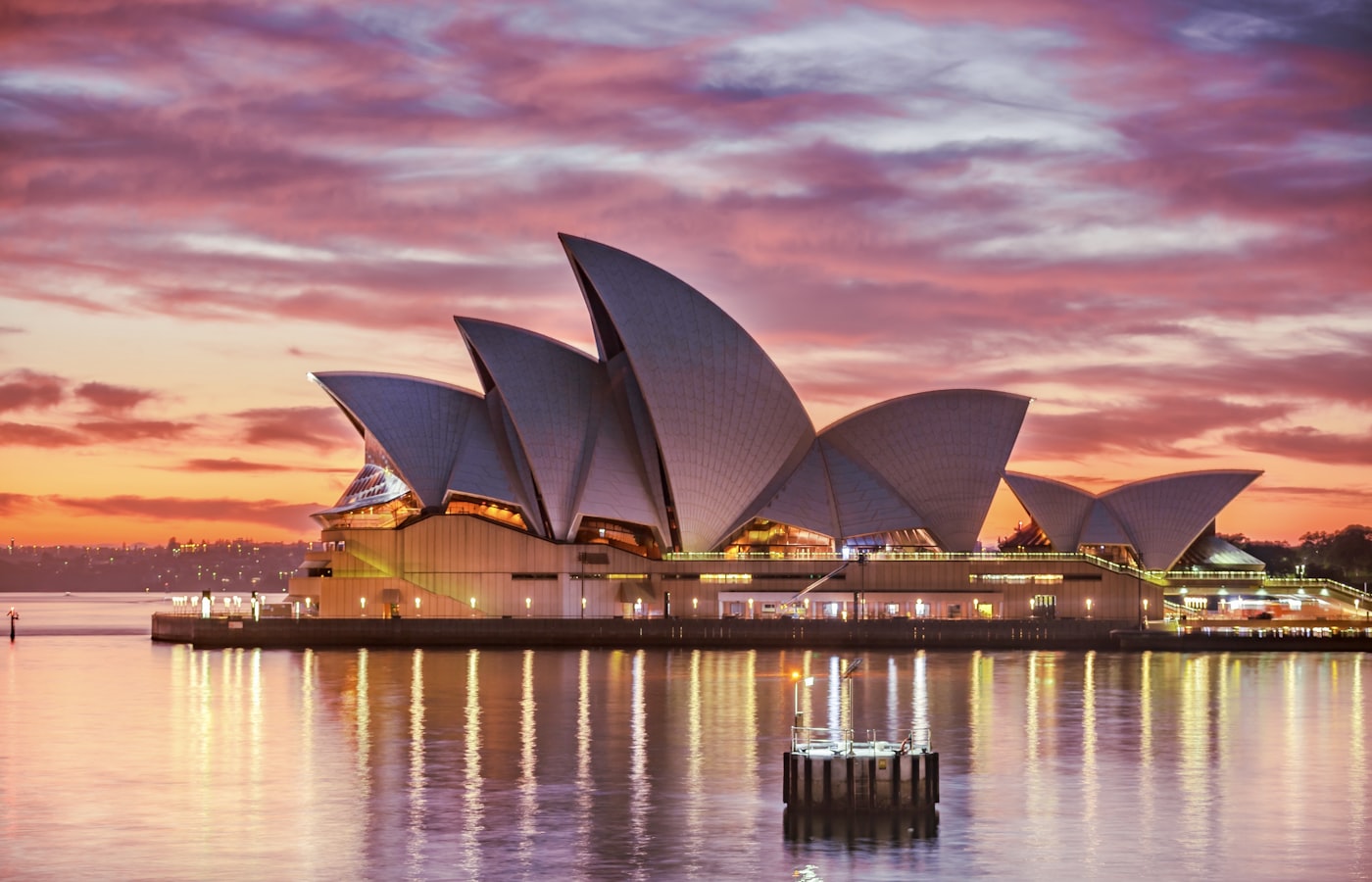
Circular Quay at sunset, the new home of Australian Fashion Week 2026. Photography courtesy of The Splendid Edit
The Maticevski effect
Toni Maticevski, who has dressed Cate Blanchett and Lady Gaga, brought a different energy. His Melbourne-based house operates at the sculptural end of Australian fashion, and his AFW showing featured gowns with voluminous skirts constructed from metres of duchess satin. In a schedule dominated by linen and cotton, Maticevski’s formality was a reminder that Australian fashion contains extremes. The country that produced resort wear also produced one of the southern hemisphere’s most technically accomplished couturiers.
Emerging names strengthened the programme. First Nations designer Grace Lillian Lee presented woven textile pieces that drew on her Torres Strait Islander heritage, translating traditional fibre art into contemporary silhouettes. Jordan Dalah, whose label has gained attention for its draping inspired by his Lebanese-Australian background, showed tailoring that moved between Middle Eastern and Antipodean references with a confidence that felt entirely natural in a city built on migration.
What Sydney means now
The question Australian fashion has always faced is whether it can be taken seriously outside Australia. The answer in 2026 is not that the world has suddenly discovered Australian designers. It is that Australian designers have stopped waiting for permission. Zimmermann sells in every major department store from Bergdorf Goodman to Harrods. Aje has expanded into the UK and US. Maticevski dresses red carpets globally. The infrastructure is there. What Circular Quay provides is the image.
Sydney’s fashion identity has never been about trend cycles or street-style spectacle. It is about a relationship with the body that is informed by climate, by proximity to the ocean and by an outdoor culture that treats formality with suspicion. The best Australian designers do not try to compete with European rigour. They offer an alternative to it. In a global fashion landscape that grows more homogeneous with each season, that distinctiveness is worth more than ever.
As the final show ended and the lights over the harbour took over from the runway spots, the case felt made. Australian Fashion Week at Circular Quay is not a fashion week trying to be something it is not. It is a fashion week that has finally found a setting equal to its ambition.