Tiffany has built two centuries on the engagement ring. Its new campaign keeps the ring and moves the subject. The promise no longer travels from one person to another; it settles on the woman wearing it.
The house calls the campaign Love and Celebration. It opened on 6 July with a short film starring Mikey Madison, who won an Academy Award and has become one of the more watched faces in American film. She plays the old garden game, the one where petals fall to he loves me, he loves me not. The refrain lands somewhere new. It arrives as I love me.
Madison is a pointed choice. She has built a reputation on characters who keep their own centre, and the film leans on that quality. The camera stays with her rather than a partner or a proposal. The garden game plays out as a private rite, and by the last petal the sentiment has turned from a wish about someone else into a line about herself.
On her hand sits the Sixteen Stone by Tiffany, cut now as a solitaire. The ring can still mark an engagement. It can also mark a plainer decision, to wear something that holds its weight without anyone else in the room. Tiffany lets the shift stay quiet, which is why it reads as a position rather than a slogan.
Lineage
The Sixteen Stone is not a new idea. Jean Schlumberger drew it in 1959 as a wedding band. The French jeweller had joined Tiffany in 1956 and spent the following decades turning precious metal into rope, tassel, ribbon and cross-stitch. He grew up around cloth. His family ran textile mills in Alsace, and the language of thread never left his hand.
The design borrows the logic of a sewing cross-stitch. Schlumberger's X motif reads as diamonds strung on fine metal thread, an illusion held together by craft. The stones sit in pairs, hand set to catch the most light, round brilliant cuts pressed against the hard geometry of the X. The originals came in 18k yellow gold and platinum. Over time the motif grew into rings, bracelets, necklaces and earrings, each carrying a different count of stones around the same figure.
The solitaire
The 2026 version keeps the vocabulary and changes the sentence. Where the 1959 band ran the motif around the finger, the solitaire lifts a single diamond above it. The precision that defined the house for close to two hundred years stays intact. The silhouette is the part that has been rewritten, and it is the part that reframes the whole idea. Tiffany released a set of short craft films beside the campaign, tracing the design from Schlumberger's first sketch to the finished stone.
That lineage matters here. A solitaire is the most familiar shape in the jeweller's window, the default engagement ring in a thousand shop displays. Building it on Schlumberger's cross-stitch gives the ordinary silhouette a specific history and a specific hand. The result reads as heritage put to a modern argument.
A diamond has always been a promise. Tiffany is widening the list of things it can promise.
The Splendid EditA wider love
Romantic love still sits at the centre of the house. The Love and Celebration campaign simply widens the frame around it. Tiffany makes room for family, for chosen company, for the private moment that answers to no one. The engagement ring stays in the picture. So does the woman who buys one for herself.
The move fits a longer shift in fine jewellery. The client who once waited to be given a diamond increasingly buys her own, and the trade has spent several seasons learning to speak to her directly. Tiffany has the advantage of history on this point. Its name has meant the proposal for so long that turning the ring toward the wearer reads as a statement rather than a gimmick.
None of this asks the buyer to give up the older meaning. A Sixteen Stone can still mark a proposal, still sit in a blue box on the right morning. Tiffany is adding a reading rather than replacing one, and the campaign keeps both in the frame.
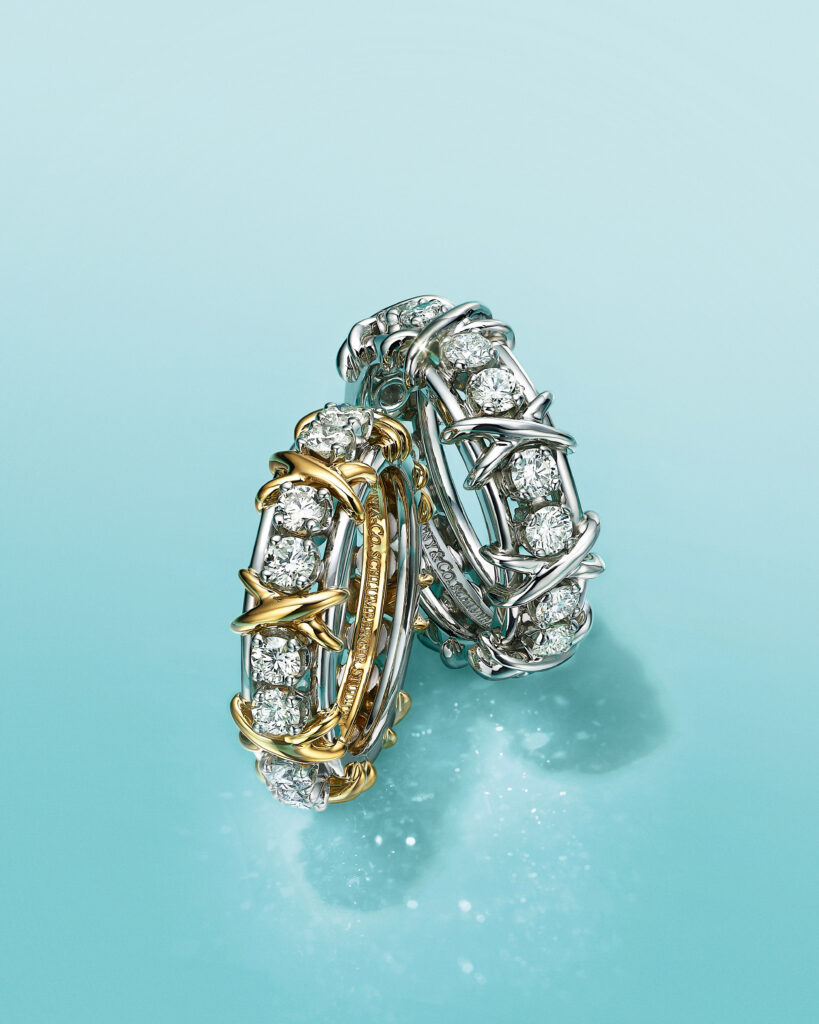
A Sixteen Stone by Tiffany ring, its diamonds hand set in pairs along Jean Schlumberger's cross-stitch motif. Courtesy of Tiffany & Co.
New York
Tiffany has been a New York house since 1837, when Charles Lewis Tiffany opened the doors. The city runs through the campaign, in the light and the skyline and the particular ease of the film. Madison carries it without strain, which is the point. The ring is meant to look like part of a life, not a prize at the end of one.
The engagement ring has spent a century as a message from one person to another. Tiffany is betting it can also be a message a woman sends herself. The Sixteen Stone, drawn once for a wedding, now argues for a wider occasion. It is a small change in who the ring is speaking to. It moves more than it appears to.