For over a century, Admiralty Arch has stood at the threshold between Trafalgar Square and the ceremonial sweep of The Mall — a monument that belonged to everyone and to no one. This spring, it opens its doors as London's most historically resonant hotel, and the city will never quite look the same.
There are buildings that exist in a city as furniture — useful, present, taken for granted — and then there are buildings that carry the weight of the place itself. Admiralty Arch belongs to the second category. Since 1912, it has marked the point at which London's civic life meets its royal geometry, standing at the head of The Mall with a gravity that most purpose-built landmarks spend entire construction budgets trying and failing to achieve. It was commissioned by King Edward VII as a memorial to Queen Victoria, designed by Sir Aston Webb — who also gave Buckingham Palace its present face — and it has watched every coronation procession, every state funeral, every jubilee pass beneath its three arches for more than a hundred years.
The central arch, by tradition, is reserved for the Royal Family. The outer two carry everyone else. This distinction, quiet and unremarked upon by most of those who walk through, is the kind of detail that tells you everything about what sort of building this is. It has always understood hierarchy. It has always understood ceremony. The Waldorf Astoria, arriving this spring as the building's new custodian, would do well to have absorbed the lesson.
A conversion fourteen years in the making
The story of how Admiralty Arch came to be a hotel is long enough to have acquired its own mythology. The government first floated the idea of a private lease in 2012, when the building was vacated after decades of use as civil service offices. A 250-year lease was signed, and the project passed through various hands before the Reuben Brothers — the London-based private investment group — took ownership in 2022 and brought the vision to its current, imminent reality.
That the conversion took so long is not surprising. Grade I listed buildings of this complexity — a structure that is simultaneously a ceremonial arch, a working bridge between two wings of office space, and a landmark of national significance — do not surrender to renovation schedules. Every intervention had to be justified to Historic England, every material choice weighed against the original fabric of the building. The result, designed by Archer Humphryes, one of London's most considered practices in the luxury hospitality space, is a hotel that works within its constraints rather than against them.
The 100 rooms and suites are distributed across a building never originally intended to accommodate guests. Some of the most remarkable spaces occupy what were once government offices and formal reception rooms, their proportions and period detailing preserved and reframed rather than stripped and replaced. There are 17,500 square feet of residential space on offer — a figure that sounds abstract until you consider that much of it is draped in views that no other London address can match: directly down The Mall toward Buckingham Palace on one axis, across Trafalgar Square and toward the National Gallery on the other.
The table at the centre
The Waldorf Astoria has always understood that a great hotel lives or dies by its restaurants. At Admiralty Arch, it has done something more than merely recruit celebrity chefs. It has engineered two distinct dining propositions that, taken together, make a coherent argument about what serious hospitality in London might look like in 2026.
Coreus is Clare Smyth's contribution — and it is unmistakably hers. The restaurant occupies a suite of rooms in what was formerly the home of the First Sea Lord, a detail Smyth has leaned into with characteristic precision. Coreus is organised around the produce of the British Isles: sustainably sourced seafood, meats from family farms, local oysters, vegetables drawn from seasonal suppliers. The name suggests the heart of something — a core, a kernel, the essential matter — and Smyth's approach to British ingredients has always been characterised by this quality of extraction, of finding the irreducible thing in a turnip or a scallop and presenting it without ceremony or disguise.
Alongside Coreus, the Whiskey & Seaweed bar occupies the adjacent space, its name marrying the maritime history of the Admiralty with the coastal character of the menu. It is the kind of adjacency that works: a dining room and a bar that share a logic without sharing a mood.
Coreus will be the epitome of a modern fine dining restaurant — relaxed, informal luxury.
Clare Smyth MBE, Chef-Owner, CoreusThe rooftop belongs to Daniel Boulud, whose Café Boulud arrives on the sixth floor with a south-facing terrace angled directly toward the Palace. Boulud's register is different from Smyth's — all-day, more generous in its references, French classicism opened up to global influence — and in the context of a rooftop overlooking the most photographed stretch of London, the lightness of touch feels exactly right. Breakfast, pastries, afternoon tea, and dinner: the full arc of a day, organised around a view that does most of the work.
What London has been waiting for
London's luxury hotel market is, by any measure, well supplied. The city has long had a concentration of great houses — properties that have defined the terms of serious hospitality for a century or more. But the arrival of a hotel within a building of genuine national significance, rather than a fine period building that happens to have been converted, is a different kind of proposition. Claridge's, The Connaught, The Berkeley, The Savoy: these are magnificent hotels. None of them is, structurally and historically, a monument.
Admiralty Arch is a monument. The distinction matters. There is a quality of encounter with a building like this that no amount of thread count or in-room technology can manufacture. When you check in here, you are not simply occupying a room with a view. You are occupying a position in the city's self-understanding — one that has been occupied, in various forms, by people who shaped the country. Winston Churchill used the building. Ian Fleming knew it. The First Sea Lord once ate breakfast looking at the same view that hotel guests will now eat their Café Boulud pastries in front of. History is not wallpaper here. It is structural.
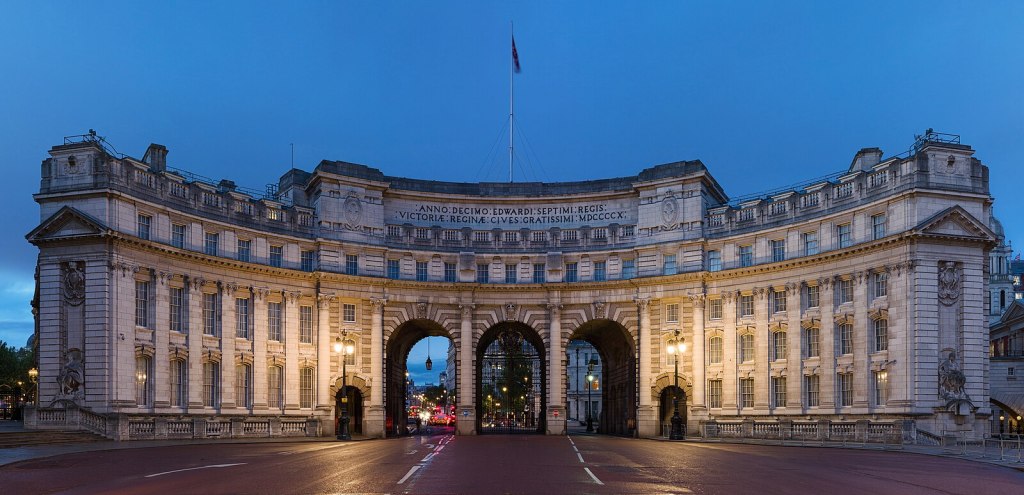
Photography by David Iliff (CC BY-SA 3.0) / Courtesy Waldorf Astoria London — Admiralty Arch at the end of The Mall, London
The ballroom, the spa, and the question of restraint
Beyond the restaurants, Admiralty Arch offers what a certain kind of guest will require: a ballroom accommodating 300, a spa and wellness facility, and the full range of Waldorf Astoria service infrastructure. These are not afterthoughts, but they are also not the point. The point is the building. Every grand ballroom in London is competing with this building's staircase, its carved stone, its position at the hinge of the city's ceremonial axis. The wisest thing the hotel can do is ensure that its ancillary programming serves the architecture rather than competing with it.
Archer Humphryes, the interiors practice responsible for the design, has a track record in precisely this discipline — the art of making a luxury interior feel like an extension of its container rather than a statement in its own right. Early indications suggest they have read the building correctly. The public areas work within the existing spatial logic; the rooms exploit the building's unusual geometry rather than flattening it into something more conventionally rectangular and manageable.
Whether the Waldorf Astoria Admiralty Arch becomes London's most coveted address or merely its most talked-about is a question that will be answered in the months following its opening this May. What is not in question is the significance of the moment. A building that belonged to the nation for over a century has been handed a new purpose — one that, if executed well, allows more people to experience its interior than the civil servants and admirals who preceded them ever could have imagined. The arch has waited. Now it opens. One suspects it has learned something from the patience.