Amanjiwo employs two anthropologists. They give lectures, they lead the temple walks, and their names are on the resort’s own list of what it offers.
Patrick Vanhoebrouck and Jean-Pascal Elbaz are the two. Between them they cover the ancient temples and the sacred sites of Central Java, and guests who book the Cultural Trails stay get their scheduled lectures included. It is an odd thing to find on a hotel inventory, somewhere between the spa menu and the airport transfer.
The resort sits in a limestone amphitheatre in the Kedu Plain, at the foot of the Menoreh Hills, roughly ninety minutes by road from Yogyakarta International. Borobudur is a few minutes down the hill. Ed Tuttle designed the place and it opened on 16 October 1997, built from local coral-beige limestone in the shape of a pillared temple, a rotunda at the top with two crescents of pavilions fanning out below it and a pool at the bottom of the slope.
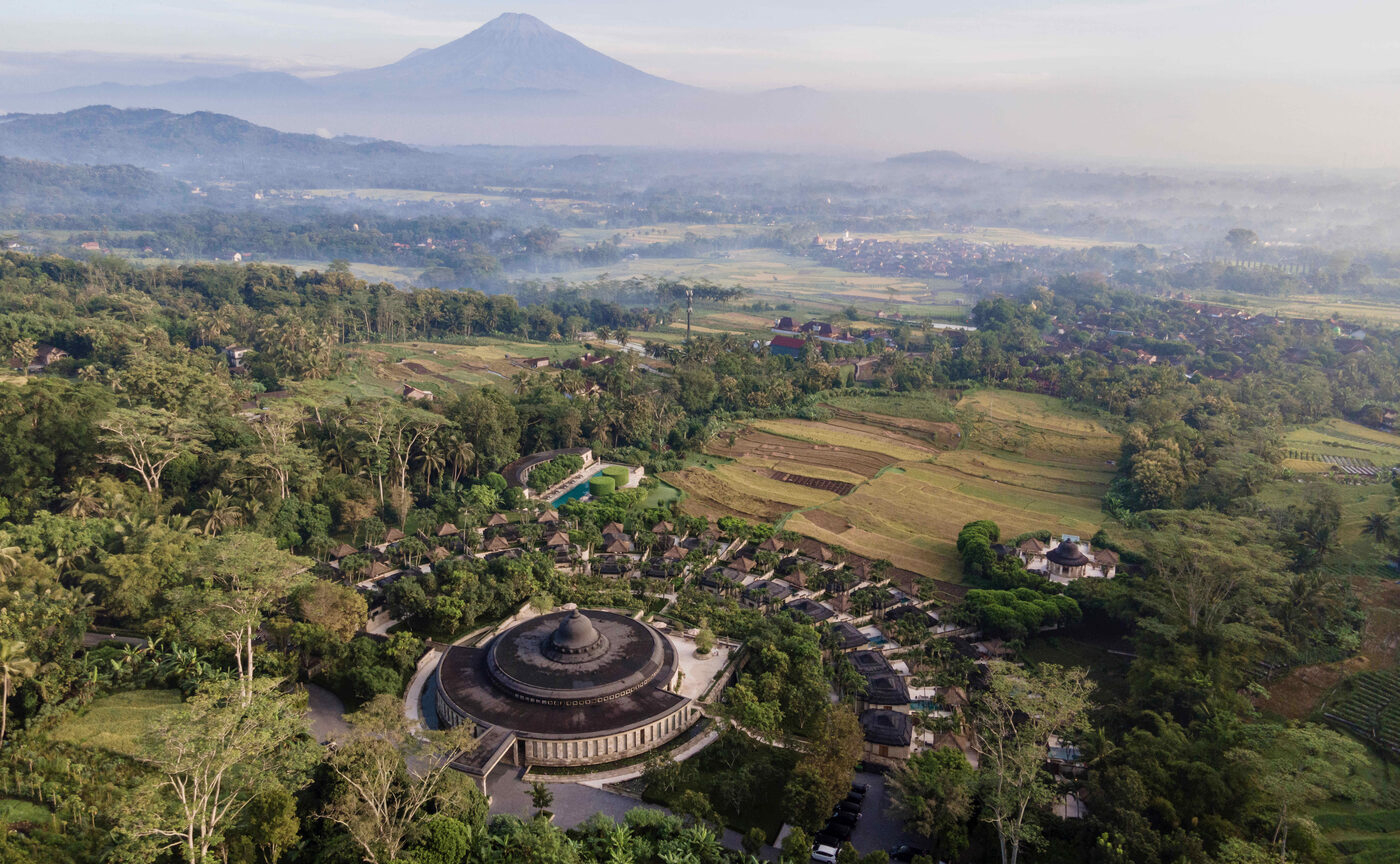
Amanjiwo from above, Magelang, Central Java · Courtesy of Aman
Three of nine
Cultural Trails in Java is a three-night stay that runs until 31 March 2028. It carries round-trip transfers from Yogyakarta International, daily breakfast, daily traditional afternoon tea, in-room refreshments, a scheduled shuttle around the Borobudur area and the anthropologist’s lectures.
Then it hands over a list of nine and asks for three. A tour of Borobudur. A Javanese blessing ceremony. A class in Aksara Jawa, the Javanese script. A cooking class. A Javanese dinner. Breakfast at Gubug Sawah, the pavilion that sits on the edge of the rice field. A hike in the Menoreh Hills. The morning markets at Borobudur and Muntilan. A village tour on mountain bikes.
Three is the right number. Nine would be a syllabus. Guests booking the two-bedroom Dalem Jiwo Villa are met at the airport and find champagne waiting.
First light
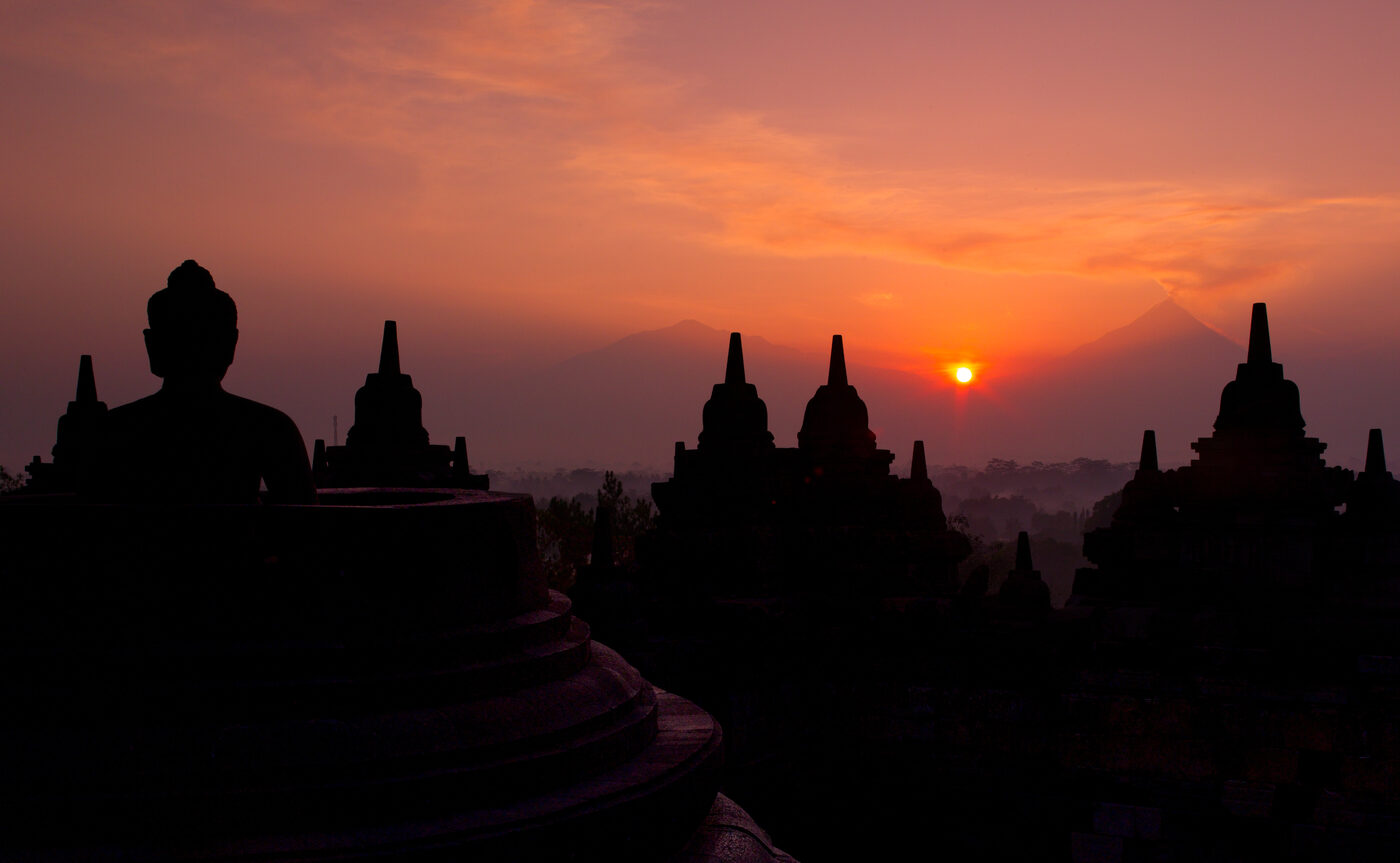
The sunrise visit runs separately and starts before dawn, with a transfer down to the temple and a VIP entrance that shortens the walk in. Guests climb to the upper terraces while the plain is still dark, and watch the stupas take shape against the sky as the mist lifts off the Kedu and the volcanoes come up on the horizon behind them.
Borobudur dates to the ninth century and is the largest Buddhist monument in the world. The reliefs run for kilometres around the terraces, and a certified guide walks the story of them with you once the light is good enough to read the stone.
Nine would be a syllabus. Three is a stay with room left in it.
The Splendid EditThe pavilions
Thirty-six suites sit in the two crescents, all of them 243 square metres, all of them turned outward. Six categories: Borobudur Pool, Borobudur, Menoreh Pool, Menoreh, Garden Pool and Garden. The pool pavilions carry a six-metre private pool and a thatched balé; the others have walled gardens and terraces that run straight out of the living space onto raised terrazzo platforms.
Views split between the temple stupas, the Menoreh Hills with the rice terraces below them, and the gardens. The Dalem Jiwo Villa has two bedrooms, its own pool and an uninterrupted line to Borobudur.
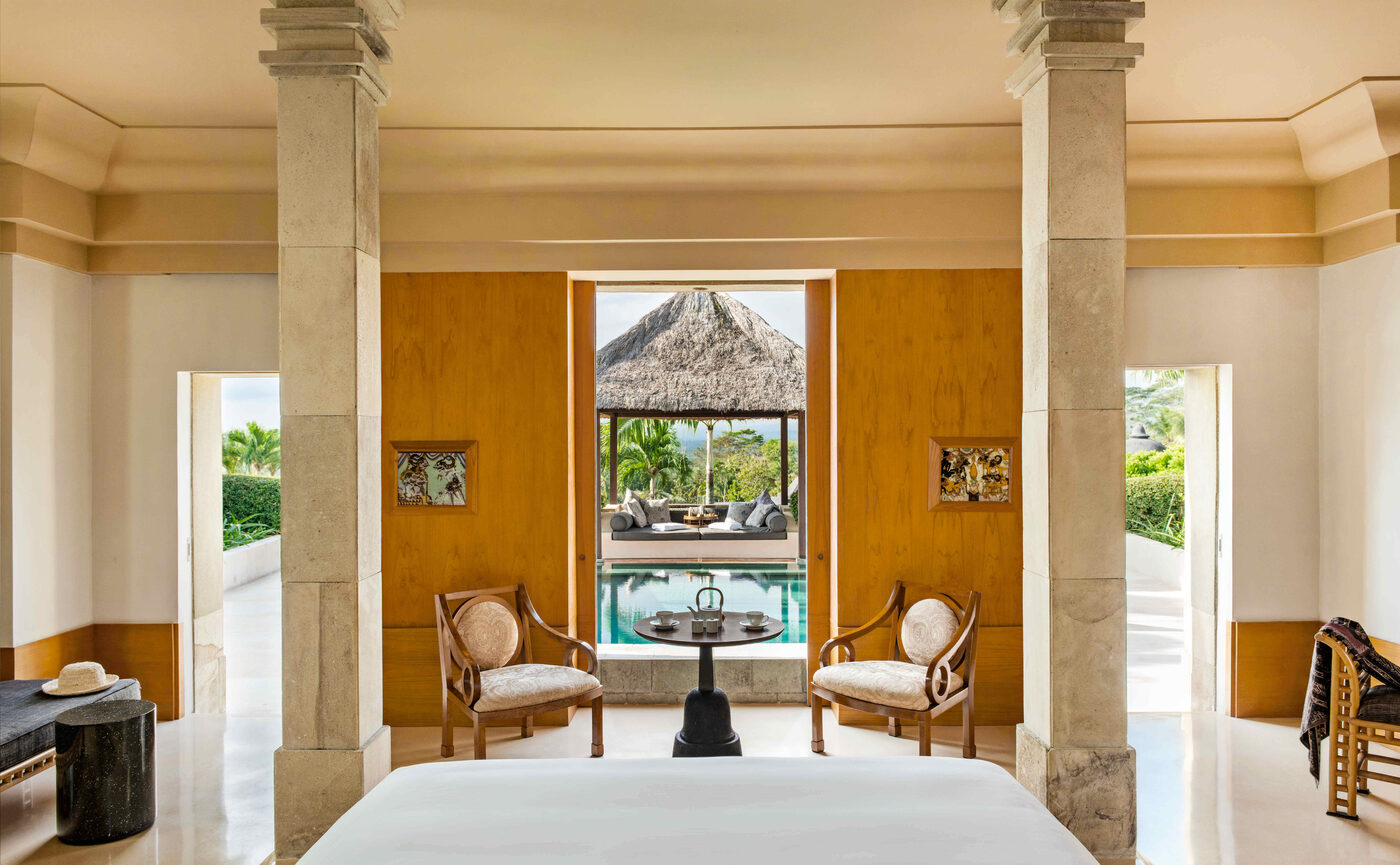
A Garden Pavilion at Amanjiwo · Courtesy of Aman
Beyond
Two more UNESCO sites lie within an hour’s drive: the Prambanan temple complex and Yogyakarta’s Cosmological Axis. Closer in are Pawon and Mendut, both built around 800 AD, and the ancient complex at Ratu Boko. The Hindu temples on the Dieng Plateau are seventh and eighth century. Local legend puts two thousand temples on these plains once.
Mount Merapi is the active one, and its flanks are steep enough to make a proper day of it. The Menoreh Hills are gentler, with clove plantations, villages that have not changed much and small temples turning up where the path bends. Dining happens at The Restaurant and Bar, at the Pool Terrace, or at Joglo Sawah out in the fields. Guests arriving with time to spare can take the seven-hour train through Java instead of the flight.
Most resorts near a monument sell proximity and leave the reading to the guest. This one keeps two scholars on hand and gives them a slot in the week.
Offer inclusions, experience details and dates are as published by Aman and remain subject to change. Details through aman.com.
Photography courtesy of Aman — © Aman, Amanjiwo, Central Java