
Matthieu Blazy chose a decommissioned subway station on the Bowery for his second Chanel collection. Eighty-one looks that span a century of New York dressing, celebrated by the full constellation of the house’s métiers — Lesage, Lemarier, Goossens, Massaro, Maison Michel, Montex — and staged on a platform where the only train that arrived carried the clothes.
The Bowery platform was the venue for Karl Lagerfeld’s last Chanel show in New York, held at the Met in 2018. Blazy’s choice of a decommissioned transit station was deliberately democratic. A subway station belongs to everyone who uses it: there are students and gamechangers, statesmen and teenagers. The vintage turnstiles served as entrance to a collection that took fashion back to the street, back to the woman in lumberjack plaid and tourist-shop irony, back to the everyday heroism of New York dressing. The platform — that liminal space between arrival and departure — became metaphor for what Blazy is doing at Chanel: holding its history while rewriting it.
The collection opened with quiet practicality: a black quarter-zip sweater, jeans. The woman on the go, moving through the city. Then Blazy cycled through a century of New York referenced in Chanel’s archive. Art Deco references reimagined as digital prints, rendered on slip dresses and tweed jackets. Lesage embroidery created ice-cube cabochons and geometric patterns that caught the light like subway tiles. Lemarier’s fringed featherwork appeared on 1920s-silhouetted gowns and high-necked evening pieces, each feather painstakingly positioned. Goossens metalwork took the form of hummingbirds and deco cabochons that sat heavy on shoulders and hems.
The details rewarded looking closely. Massaro slingbacks were topped with shaved shearling animal-print uppers, a play on the downtown aesthetic that felt effortless. Maison Michel fascinators in silver and gold sat atop chignons, a nod to the racing set that Chanel dressed in the 1930s. Montex embroidery shimmered like fish scales on a 1930s slip dress, the kind of quiet virtuosity that separates couture from everything else. A lumberjack plaid appeared woven into wool bouclé tweed, transformed from workwear into evening. An “I Heart NY” t-shirt — the tourist-shop riff — was rendered in sequins on a black silk base, worn with a Chanel suit. There was a coat that referenced the 1931 Gloria Swanson film “Tonight or Never” — a picture Chanel designed costumes for — its pattern handwoven into tweed.
What Blazy proved on that Bowery platform is that Chanel’s codes live as naturally underground as they do in the Grand Palais — the subway was the democratic stage the house needed.
Sienna Caldwell, The Splendid Edit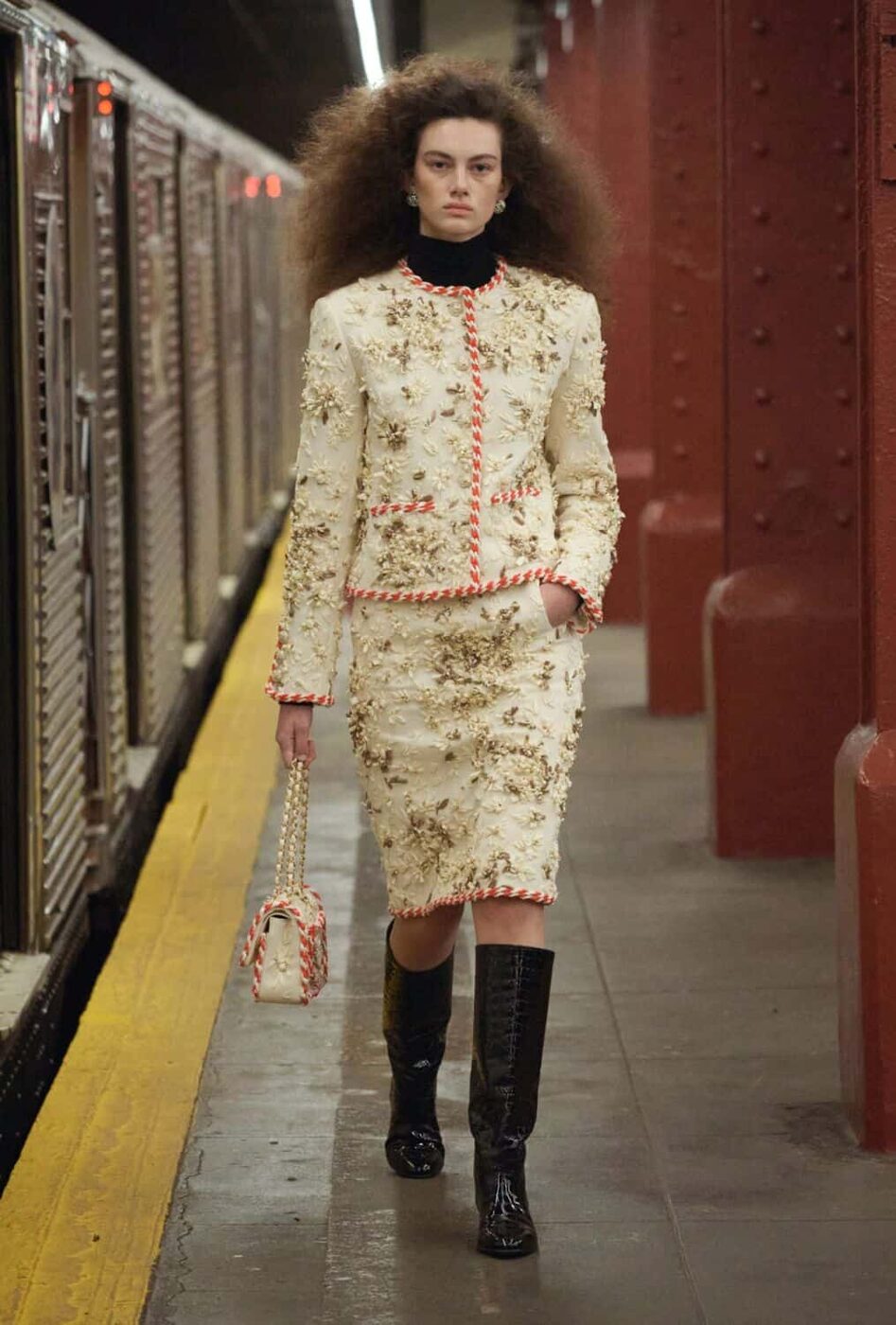
Look 42: Lesage embroidery meets downtown ease. Photography courtesy of Chanel / 10 Magazine
What Blazy proved on that Bowery platform is that he can hold Chanel’s exacting history — the codes, the codes, the codes — while rewriting it for a new New York. The subway as metaphor works perfectly. It is a space of transit, of everyone, of real life moving through it in real time. And yet, Blazy found Chanel’s codes in the texture of it, in the democratic spirit of it. The collection was, quite simply, the most American Chanel show the house has staged in years.