Dior has made its Christmas card a cartoon. The 2026 holiday film, Christian Dior's Night in Color, was drawn by hand by Sylvain Chomet. It runs on a fiction about Marlene Dietrich, a gown that has to reach Hollywood by morning, and a workroom full of bees.
The film arrived on 4 November. Jonathan Anderson commissioned it as part of his work at the house, where he took creative direction in 2025. He has said that animation has long interested him, and that he first came across Chomet's films as a student. The result is a short set on Christmas Eve, told in traditional hand-drawn animation of the kind made in the 1940s.
Animation suits the brief. A holiday campaign has to carry warmth and a little myth, and a drawn film can hold both at once. Dior has used film in its campaigns before, though a hand-drawn short is new ground for the house. The choice places the season closer to story than to spectacle.
The film
The story opens in Los Angeles. Marlene Dietrich is on a soundstage, preparing to shoot a film, when the director decides to switch the production from black and white to color. Hollywood sends word to Paris. It needs a Dior gown, and it needs it bright.
The dress is loosely based on the Junon gown that Christian Dior made in 1949, a sweep of petal-shaped panels shaded like a peacock's tail. In the film the ateliers are given one night to finish it. That shift from monochrome to Technicolor was also one of Anderson's first ideas for the Dior Cruise 2027 collection, so the film and the clothes grow from the same root.
The short moves between three worlds. There is Dietrich's trailer on the Hollywood lot, lit for the camera. There is Christian Dior's apartment in Paris, with its screens and its flowers. And there is the atelier, where the real work happens, drawn by hand down to the pins and the paper patterns.
The bees
Christian Dior called the women of his ateliers his bees. Chomet takes the nickname and makes it literal. The seamstresses become winged, striped characters who work the gown through the night while the city sleeps.
Three of them carry the names of real people. Paulette is Paulette Boncoure, and Yvonne is Yvonne Ansermier. Madame Marguerite is Marguerite Carre, the technical director of the couture ateliers under Dior, known in her day as Dame Couture. The film gives the back room the front of the story.
The invisible hours of a couture atelier become the story's real heroines.
The Splendid EditDietrich
The friendship behind the fiction was real. Marlene Dietrich wore Dior on screen and off, and she made the house a condition of her work. For Alfred Hitchcock's Stage Fright, released in 1950, she insisted on dressing in Dior. The star and the couturier stayed close through the 1950s.
The gowns she wore in that film were pure New Look, full in the skirt and sharp at the waist. The look read as glamour and as proof of how far a Paris house could travel. Hollywood and the Avenue Montaigne have been trading ever since, and the film sets its whole plot on that exchange.
Chomet knows the period he is drawing. His research took him to La Galerie Dior in Paris, among the house's sketches and miniature dresses. He studied fashion for a year before he moved to animation, so the detail of a collar or a hem is not lost on him.
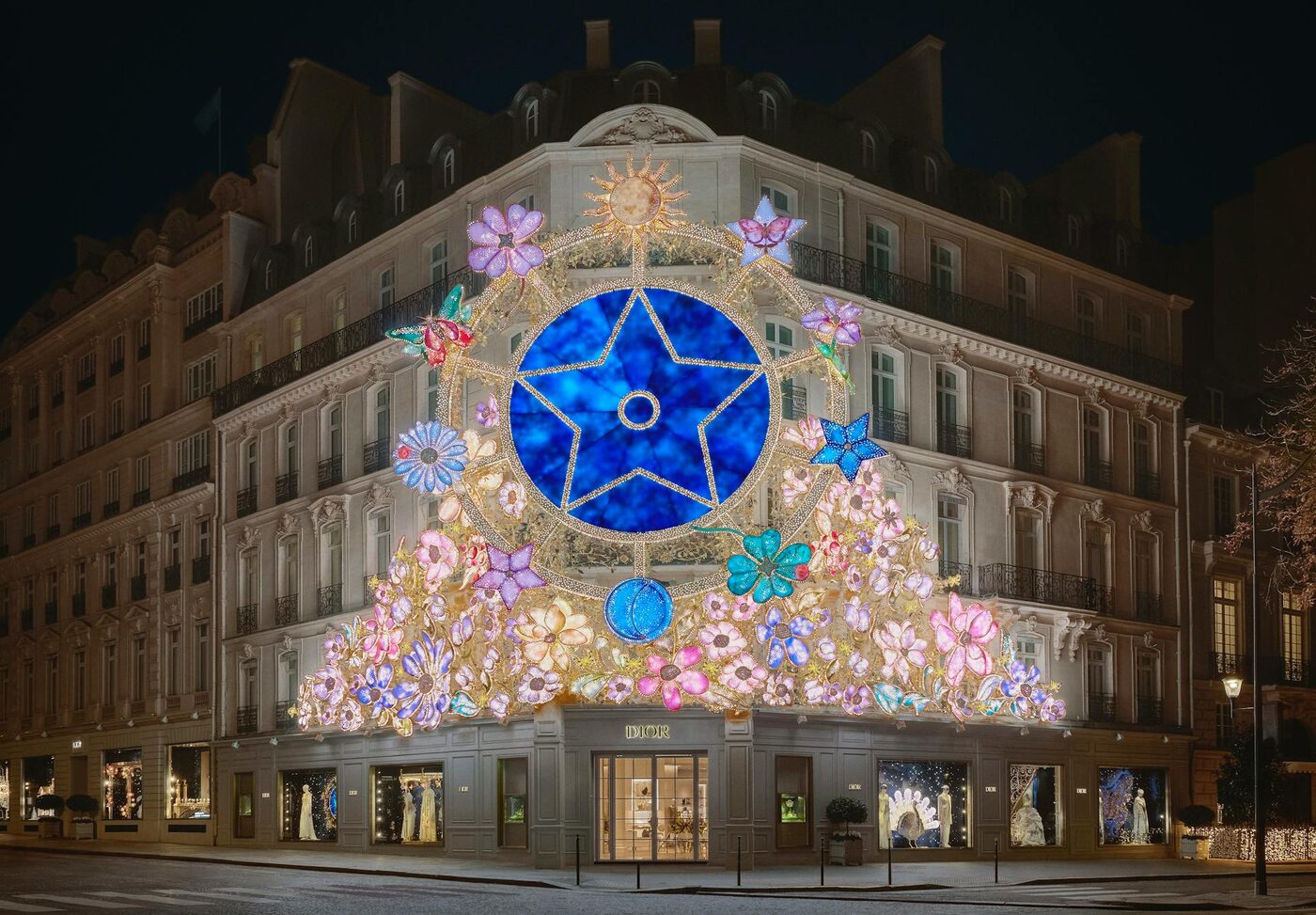
The Dior flagship at 30 Avenue Montaigne, Paris, in its holiday illuminations. Courtesy of Dior
The cast
The voices come from film and music. Robert Pattinson, a longtime Dior face, narrates, and Louis Garrel plays Christian Dior. Camille Cottin plays Dietrich. Rihanna voices a character called the Lucky Star, a nod to the talisman Dior carried all his life.
Josh O'Connor is the Chair. LaKeith Stanfield is Ron, the director who calls Paris. Greta Lee, Nine d'Urso and Nadia Tereszkiewicz play the bees. The screenplay is an original, written by the house rather than drawn from a book or an older short.
Chomet is an unusual choice and a fitting one. His Triplets of Belleville, from 2003, and The Illusionist, from 2010, both earned Oscar nominations, and both work in the slow, drawn style Dior wanted. His line is warm and a little melancholy, which suits a story told after dark.
The characters will not stay on screen. Dior is moving them into its boutique windows around the world for the season, set beside a holiday collection of ready-to-wear, accessories and homeware. After a year spent under Anderson rethinking what it is, the house has answered the question with a drawn fable. It looks back at the real Dior and the real Dietrich, and it lets the workroom, for once, play the lead.