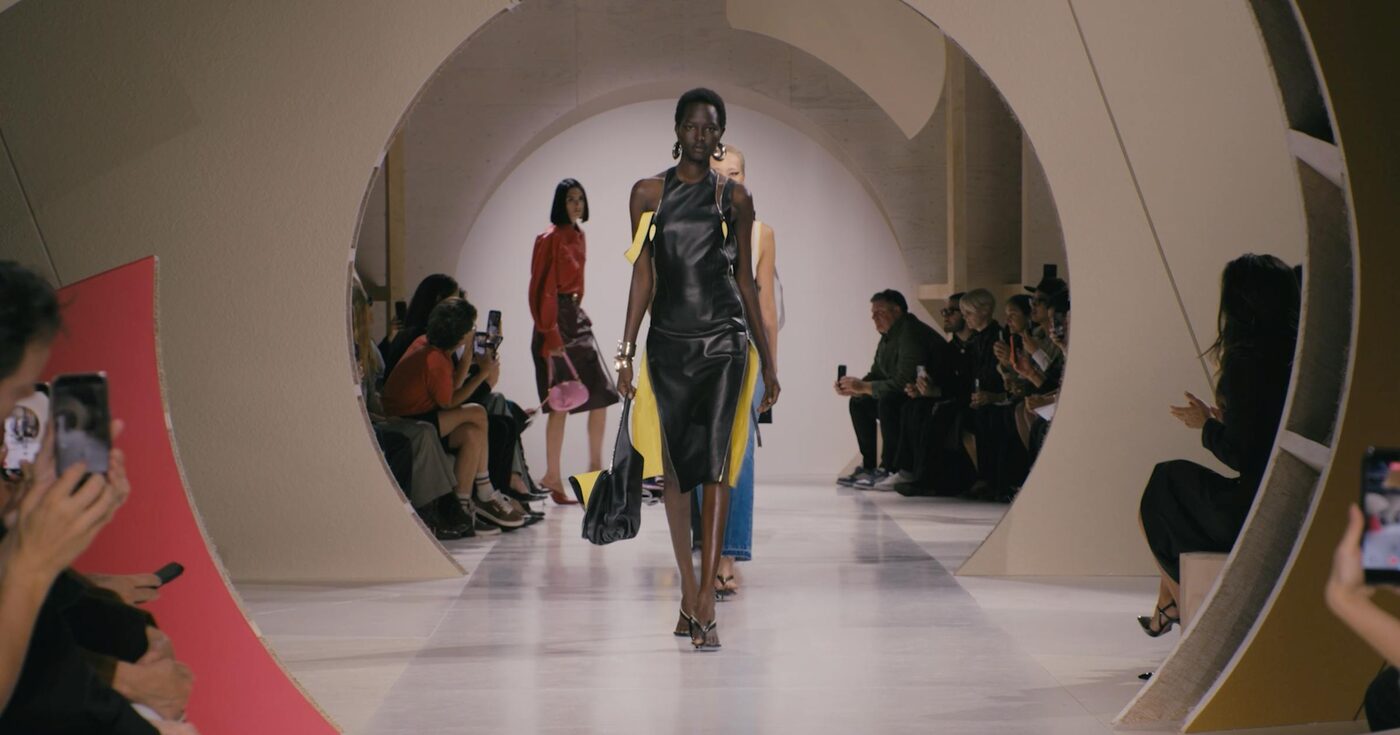
Sarah Burton showed her Summer 2027 collection for Givenchy in Paris at the start of October. She cut the house down to three things. A shirt, a suit, a dress.
The set did the talking before the clothes arrived. Models walked out of a pale wall sliced into circles, each look framed for a second inside a portal of raw plaster. The runway ran narrow and bright. Phones went up on both sides. The first woman came through in black leather, a slim dress split to the thigh and lined in acid yellow, a soft bag held low in one hand.
Burton has talked about precise simplicity, about cutting through the noise of a crowded season. The collection read as an argument for that. She reduced the Givenchy wardrobe to its load-bearing pieces and built everything out from them, and the reduction gave the clothes room to be seen.
The cut
Tailoring held the body and draping let it go. A trouser was sliced along its front crease and swung open, so the leg moved and the fabric followed a beat behind. Sleeves were cut away from the shoulder and pitched forward to sit like lapels. One dress hung from a single length of brass bent around the torso, with fine chains falling from the metal to the hem.
The shirt carried most of the collection. Burton built it in stiff white cotton, in leather, and once in a couture satin doublé the colour of crushed strawberry. She cut it hard at the shoulder and loose through the body, a piece of engineering dressed as a basic. The suits ran straight and double-breasted, worn with flat brogues, nothing lifted off the floor.
Leather ran through the collection as a hard counterpoint to the drape. One black dress came out with a shoulder slipped off the body, cut close and finished clean. The bags followed the same logic. They looked soft enough to fold, and several seemed to peel back on themselves as the models walked, the surface turning over at the seam.
For most of its life Givenchy dressed a single woman. Burton is cutting for a crowd, and the cut is the whole argument.
The Splendid EditColour
The palette ran to strong, near-primary tones, the kind that photograph flat and loud. A dress in vivid green leather came through mid-show and held the eye against all the black around it. Burton has said she wanted the clothes to carry some joy, and the colour did that work plainly, without a slogan behind it.
Detail stayed small and exact. A pair of slim high-rise jeans was belted with the top of an archival Givenchy compact, a disc of gold guilloche set at the waist like a buckle. A little black dress carried a fringe of bugle beads along the hem. Eva Herzigova walked a satin dress with a fin standing at the neck. Late in the show the clothes turned to embroidery and handwork, with nods to Japan and to turn-of-the-century dressing.
The archive
Hubert de Givenchy opened the house in 1952 and built it around one idea of a woman. Audrey Hepburn became the face of that idea, and the clothes followed her line for decades, long after the founder left in the mid-nineties. The reference most houses reach for is the little black dress. Burton reached further back, to the ruffled white blouse of that first 1952 collection, and answered it with a shirt.
That choice reset the terms. A blouse belongs to one kind of woman. A shirt belongs to anyone who puts it on. Burton kept the precision the house is known for and widened the door, so the archetype gave way to a range of women with their own reasons for wearing the clothes.
The house
Burton ran Alexander McQueen for more than a decade before this, and she carried the McQueen instinct for construction into a quieter room. Two years into the Givenchy job, she has stopped introducing herself and started building. Summer 2027 was less a debut gesture than a set of tools laid out in order.
The casting made the point about range. Last season Burton put her tailoring on the writer Constance Debré and on the photographer Don McCullin, people chosen for what they had done rather than for a single look. The clothes are built to hold different bodies and different lives. The show kept coming back to that idea, look after look.
Givenchy sits inside LVMH, among the group's fashion houses, and it has spent years looking for a steady hand after a run of short tenures. Burton reads like the answer to that. The clothes do not raise their voice. They hold their shape, and they let the woman inside them move.