Louis Vuitton turned its Art Basel stand into a shipping dock. Under the glass dome of the Grand Palais, fourteen versions of the Capucines sit in open crates stamped FRAGILE, waiting to be looked at.
Last week the contemporary art world came to Paris for Art Basel, and Louis Vuitton arrived as an associate partner with a retrospective rather than a sales counter. The stand gathers seven years of ArtyCapucines, the project that hands one of the house's bags to a contemporary artist and lets the result be whatever the artist decides. The show opened to the public on October 23.
The project
ArtyCapucines began in 2019. Each edition invites an artist to reinterpret the Capucines, and the house artisans build the result in their workshops. The brief is open. Fourteen artists have now taken it, working the bag through colour, texture and form until the leather does things leather is not supposed to do.
The techniques pile up across the display. Embroidery, assemblage, surfaces built by hand and others cast like sculpture. One bag grows a creature along its side. Another wears a painter's dots. The Capucines is a formal top-handle shape, one of the house's quieter icons, and the project keeps testing how much it can carry before it stops being a bag.
The name reaches back to the start. Louis Vuitton opened its first store in 1854 on the rue Neuve-des-Capucines, and the bag borrows the street. That detail sits under the whole exhibition, which keeps returning to where the house came from.
The crates
The staging is the argument. The bags are shown alongside the artworks that inspired them, set among open crates, plinths and structures in brushed aluminium and cotton canvas. Everything reads as freight caught mid-transit, the stamps and the FRAGILE marks included.
It is a tribute to how Louis Vuitton started, building trunks to protect and move precious objects. Here the trunk logic is turned on the bags themselves. A Capucines in a crate is a Capucines the house is telling you to treat as cargo worth guarding, which is a confident thing to say about a handbag at a fair full of paintings.
The move works because it is literal. The crate does the talking. It puts the leather goods in the same packing material as the art around them and leaves the viewer to decide whether the two belong in one box.
A handbag at an art fair has to earn the room. Louis Vuitton crates it like a painting and dares you to disagree.
The Splendid EditThe signature
The newest edition goes to Keith Haring. His dancing figures and graphic lines run across the bags, held close to the shorthand that made his work legible on a wall or a subway tile. The repetition suits leather, and the figures move the way they always did.
Next to the Haring bags sits a Louis Vuitton trunk from the 1930s, signed by Haring himself in the 1980s. The pairing makes a point the house clearly wanted on the record. Its relationship with artists did not start with ArtyCapucines in 2019. It was already there, marked on a trunk, decades before anyone thought to turn the Capucines into a canvas.
That is the quiet thesis of the retrospective. Seven years of commissions, staged as freight, anchored by a trunk an artist touched a lifetime ago. Louis Vuitton is not asking whether a bag can hold art. It is showing that the question was answered long before the question was asked.
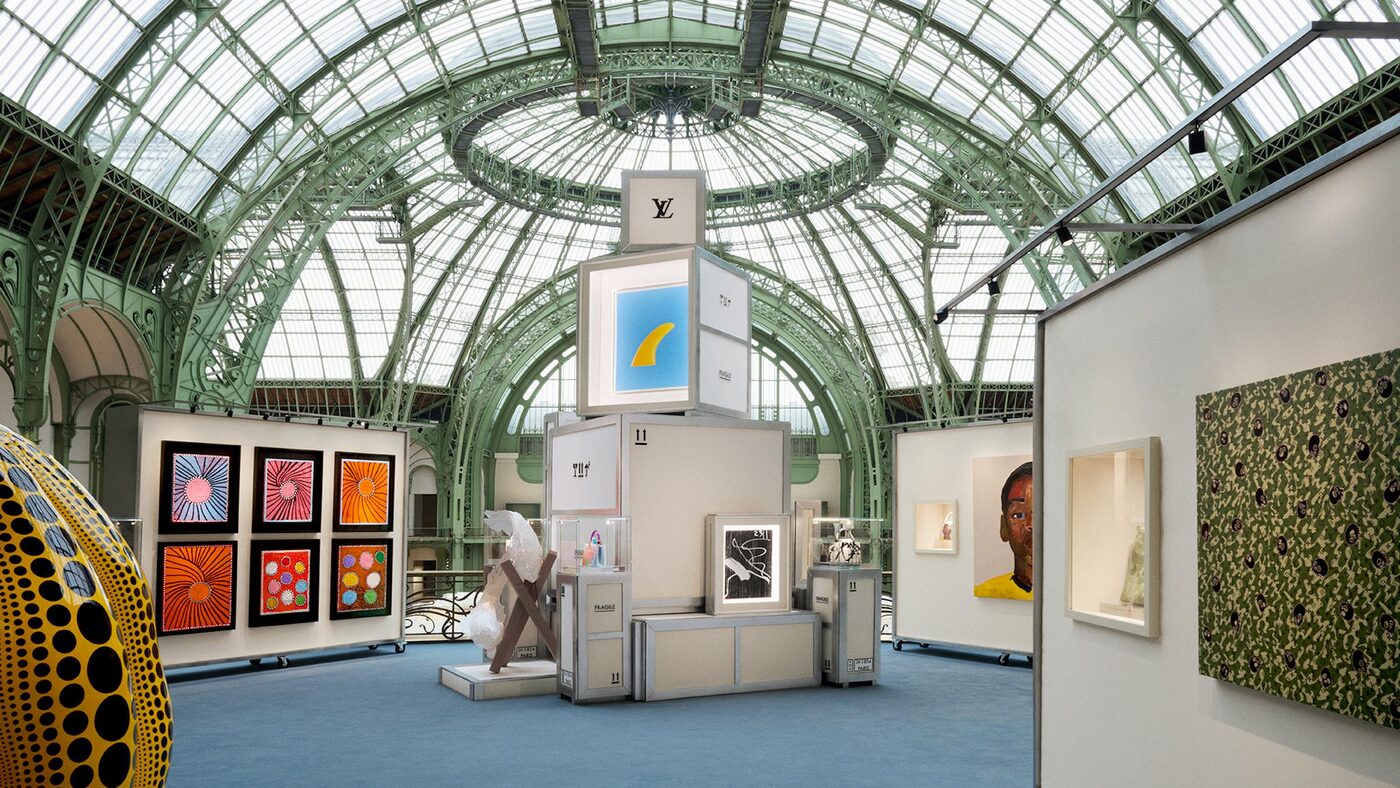
The ArtyCapucines retrospective under the Grand Palais dome at Art Basel Paris 2026. Courtesy of Louis Vuitton