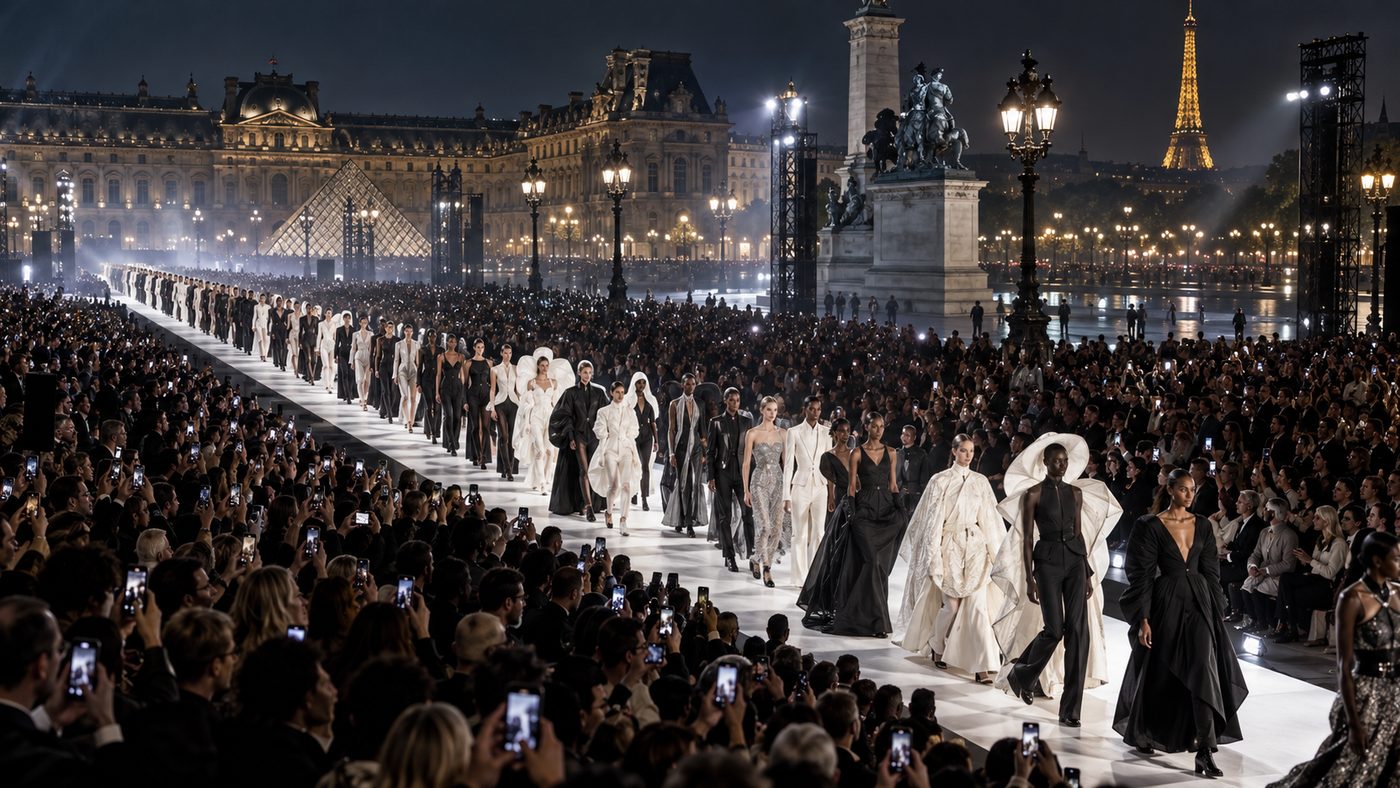
Matieres Fecales made the most-opened collection of the Spring 2027 season on Vogue Runway. It finished ahead of Prada, Dior and Chanel. An independent Paris label, with none of their scale, took the top line of a list built from reader clicks.
Vogue published the ranking on 9 October. It covers the Spring 2027 shows and presentations, and it measures one thing: how many people opened a collection. Not how many images each visitor scrolled through. Not sales, not social reach, not global awareness. A count of who clicked in.
That narrowness is worth holding onto. The list is a record of attention on one platform, read by one audience. It is evidence, not a verdict. Within those limits, the top line still says something sharp about the season.
What it says is that reach and budget no longer decide who gets looked at first. The houses on this list spend on campaigns, flagships and global press. The label above them spent on an idea and a casting call. For one season, on one platform, the idea won.
The list
Here is the Spring 2027 top ten, in order.
- Matieres Fecales
- Prada
- Christian Dior
- Chanel
- Gucci
- Saint Laurent
- Miu Miu
- Burberry
- Victoria Beckham
- Jil Sander
Four names were new to the top ten against the previous season: Matieres Fecales, Burberry, Victoria Beckham and Jil Sander. The rest reshuffled. Prada climbed from third to second. Dior slipped from first to third. Chanel moved from second to fourth. Gucci went from fourth to fifth. Miu Miu dropped from fifth to seventh. Saint Laurent rose from ninth to sixth.
Read together, the movement is small. The same houses circle the top, trading places by a rank or two from one season to the next. What breaks the pattern is the name above them all, which sat outside the ten entirely last time.
The show
Matieres Fecales is run by Hannah Rose Dalton and Steven Raj Bhaskaran. It carries no advertising budget, no store network, none of the machinery the houses above it spend on. What it brought to Paris was a proposition a reader could grasp in a single line.
The show ran to ninety-nine looks, every one worn by a model of color. Dalton and Bhaskaran used the casting to argue about opportunity and plurality, and about the lives behind the images fashion sells. Rihanna arrived late, and her entrance pulled a second wave of attention. The ranking cannot separate the effect of one guest from the rest, and it does not try to.
Ninety-nine looks gave the show its scale. A casting decision gave it an argument. The two were inseparable.
The Splendid EditThe size mattered. Ninety-nine looks build a kind of abundance on screen, and abundance invites clicks. The casting gave that abundance a point. A collection whose meaning sits in the cut of a sleeve is harder to open and discuss than one that states its case before the first look lands.
None of this reads as an accident of spectacle. Dalton and Bhaskaran have built the label on this kind of staging, where the garment and the message arrive together. The scale was large enough to travel and specific enough to mean something, which is the combination that carries a collection from seen to discussed.
The map
Paris holds most of the list. Matieres Fecales, Dior, Chanel, Saint Laurent, Miu Miu and Victoria Beckham all showed there. Milan takes three places through Prada, Gucci and Jil Sander. London keeps one, Burberry. No New York collection appears.
That absence is not a measure of New York’s season. A platform ranking tracks the habits of a particular readership, and readerships have their own geography. The four capitals do not share one scoreboard, whatever a single list implies.
The read
The houses near the top carried the season’s big questions of leadership. Jonathan Anderson’s Dior, Matthieu Blazy’s Chanel and Demna’s Gucci each opened with built-in curiosity about a new hand. Saint Laurent’s rise to sixth came during a season of unusual scrutiny; its gold Spring 2027 show was later confirmed as Anthony Vaccarello’s last for the house. Jil Sander reached tenth under Simone Bellotti with a quieter language.
For a label with no marketing department, that is the lesson other small houses will take from the season. A show earns attention when its idea is clear enough to carry beyond the room, through a casting choice, a location, a collaboration, a reason to talk. A defined stake does the work, especially one that ties the clothes to questions of identity and access.
Set against all that institutional weight, the number one stands out more, not less. An independent label made the collection readers most wanted to open, in a season crowded with debuts and marketing budgets. Attention, though, is only the first move. The harder questions come after: whether the audience returns, whether buyers and clients convert the interest, whether a point of view holds up once the device that won the room is no longer new.