The Spring/Summer 2027 collections open on 10 September with a house that has not held a runway show in almost ten years. They close on the 15th with a designer New York last watched in 2006. Between those two dates the calendar keeps handing back names it once lost.
The preliminary schedule runs to roughly seventy shows and presentations. The headline slots do not belong to the newest labels. They belong to the ones coming home. Diane von Furstenberg takes the first appointment of the week. Sabyasachi takes one of the last. Tommy Hilfiger slots back between them after years of staging his own spectacles off the official grid.
The opener
Diane von Furstenberg has the 9:30 slot on Thursday morning. It is the label's first proper runway show in close to a decade, and it hands the room to Henry Zankov. He arrives as artistic director from a knitwear practice of his own, a designer built on gauge and colour rather than the wrap dress that made the house.
Putting the season's first light on a debut is a decision with weight. New York tends to open soft and build toward its known quantities. Handing the curtain to a new hand at an old label reverses that habit. The city is betting its first impression on someone with everything to prove.
Kolkata to Chelsea
Sabyasachi Mukherjee shows on 15 September. It is his first New York runway in about twenty years. He last presented here in 2006 with a collection called Snail, an argument for slow luxury made long before the phrase entered the trade vocabulary. He left, built one of India's defining houses in Kolkata, and stayed away.
The return follows a silver jubilee. In 2025 the label marked twenty-five years with a show in Mumbai fronted by Deepika Padukone, a night of hand embroidery, heavy silks and archival dressing staged at the scale of a state occasion. What travels to New York is that vocabulary: dense surface work, Bengal craft, colour that does not apologise. It lands in a week the American schedule has spent years trying to make feel essential again.
He is not a stranger to the address. Since October 2022 the label has kept a flagship at 160 Christopher Street, roughly five thousand square feet of Romanesque Revival in the West Village, opened with a capsule called The New York Edit. The store made the commercial case for the house on American ground. The runway is the part that stayed missing, and now that gap closes too.
A calendar measures a city's confidence by who it can call home.
The Splendid EditHis placement matters as much as his presence. To close the week with Kolkata craft, rather than a homegrown name, says something about where New York thinks its energy now comes from. The audience for hand embroidery has moved. The schedule is following it.
Back on schedule
Tommy Hilfiger rejoins the official calendar this season. For several years he ran his shows as standalone events, unmoored from the CFDA grid, staged as arena-sized productions with their own logic. Returning to the schedule is a quieter move. It reads as a vote of confidence in the calendar itself, at a moment when the calendar needed one.
He is not alone in the middle of the week. Calvin Klein, Michael Kors, Carolina Herrera and Tory Burch anchor the commercial spine. Khaite, Proenza Schouler, Altuzarra, Ulla Johnson, LaQuan Smith and Prabal Gurung carry the critical weight. Conner Ives and Magda Butrym bring debuts of their own. The returns give the week its story, but the regulars give it its floor.
What connects the marquee names is a shift in how designers weigh a New York slot. For a stretch, the ambitious answer was to leave the grid: build a private production, chase a Paris berth, stage the anniversary at home in Mumbai. This season the ambitious answer is to book the appointment. That reversal is the real news, quieter than any single show and harder to fake.
The rule
This is also the first New York season under the CFDA's fur ban. No animal fur of any kind appears on any runway inside the official schedule. The policy is written plainly, and the trade has spent the summer working out how to talk about the alternatives without overstating them.
For a returning designer, the rule is a small tax on nostalgia. For the city, it is a line drawn. New York has often let the other capitals set the terms and then adjusted. Here it moved first, and the rest of the season will be read against it.
Five days, seventy shows, and a running theme the schedule did not plan so much as accumulate. New York spent a decade watching names leave for standalone spectacle, for Paris, for Mumbai. This September it counts them coming back. The clothes will decide whether the homecoming holds. The invitation, at least, has already been accepted.
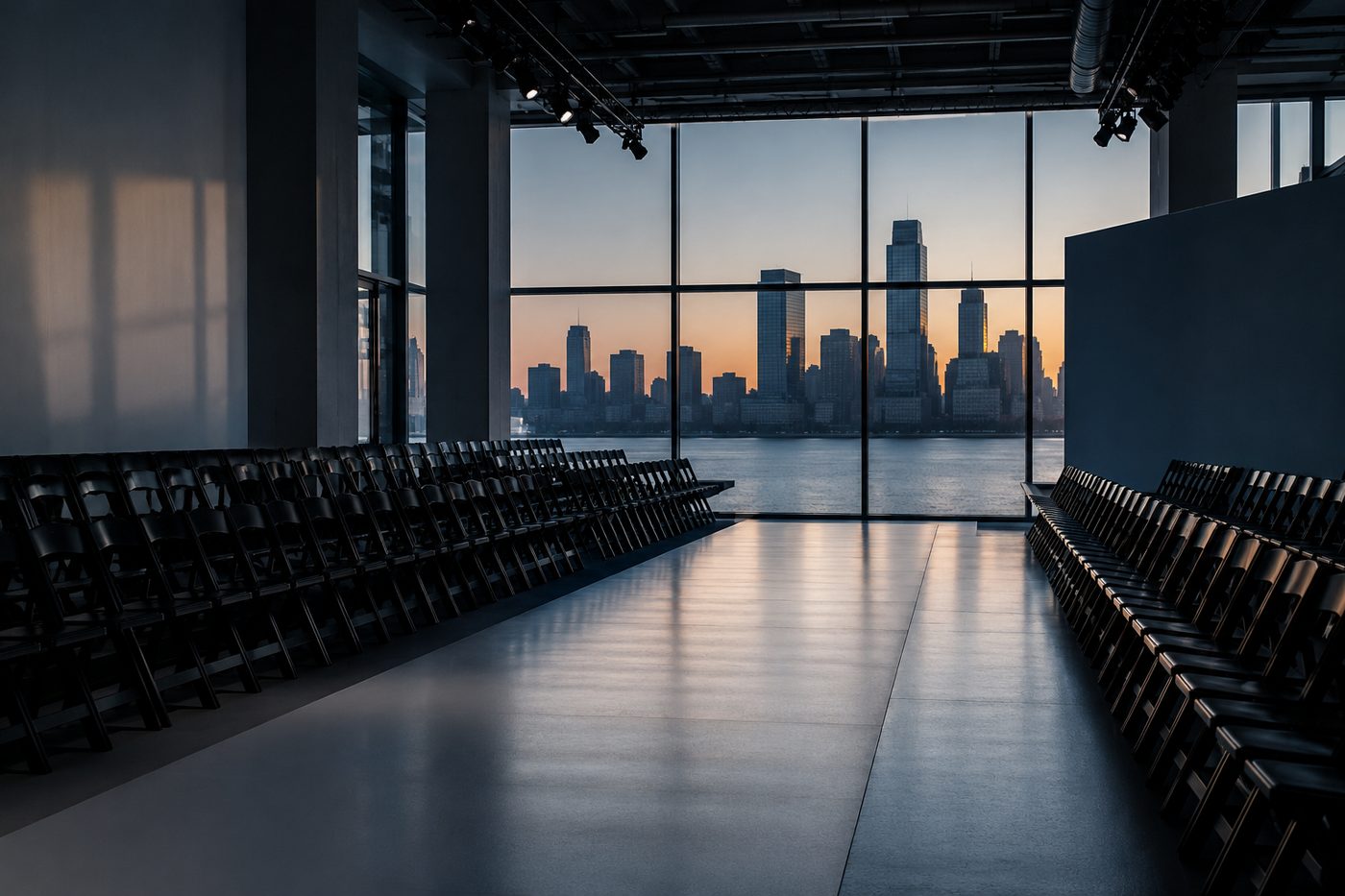
A New York runway before the week begins. Courtesy of Fashion PR Firm