Gotham Hall filled at noon on the tenth for the second collection Rachel Scott has made for Proenza Schouler. The fall debut in February set the terms. Spring answered with more colour, more give and a clearer sense of who the clothes are for.
The show read as a designer working with a wider margin. Saturated colour ran through the room. Silhouettes leaned sensual. The house craft that Scott brought with her sat in the seams rather than on the surface. Where the February debut felt measured, the spring lineup let go, and the loosening looked like confidence.
The house
Proenza Schouler was built in 2002 by Jack McCollough and Lazaro Hernandez, two Parsons graduates who turned a thesis collection into a downtown label. For more than twenty years they defined a certain New York idea, sharp, eclectic, a little cerebral. In 2025 they left for Loewe, and the house they founded needed a hand that could carry the name without copying it.
That hand was Rachel Scott. She founded Diotima, a label rooted in Jamaican craft and hand technique, and won recognition from the industry before most shoppers knew the name. Her appointment made her the first Black woman to lead an established American fashion house. The weight of that fact is real, and Scott has kept the attention on the clothes rather than the headline.
Her arrival was a bet on making. Diotima was never about volume. It was about crochet worked by hand, about technique carried from one place and set down in another. Bringing that instinct to a house with scale is the project, and spring was the season she started to prove it could hold.
The clothes
Colour did the early talking. A chrome-yellow pointelle cardigan swelled softly from the waist, knit to bend rather than cling. Sharp shoulders gave way to curving hips. Dresses skimmed the body while cowls, flanges and pleats built room around it. The tension between close and loose ran through the whole show.
The craft sat in the detail. A tiger motif never arrived as a simple print. It was hand-knit, pieced in woven intarsia, pleated into the cloth, or raised through hand tufting. Each pass asked for hours, and the effort stayed legible on the garment. This is the argument Scott keeps making, that the hand is the luxury.
She also went back to the archive. The PS1, the slouchy satchel that carried the house through the early 2010s, returned reworked. It is the piece a generation of shoppers still associates with the name, and reopening it signals that Scott intends to build on the house memory rather than clear it away.
Nothing in the room asked to be read as reinvention. Scott is not tearing the label down and starting again. She is editing it, keeping the downtown intelligence that McCollough and Hernandez left behind and threading her own material through it. The bag makes that plain. So do the knits.
The hand is the luxury, and Scott stitches the whole argument into a single yellow cardigan.
The Splendid EditThe woman
Scott kept returning to the freedom of New York women. The premise is simple. In this city a gown can be worn casually, and a casual piece can pass for evening. Nobody polices the line. That looseness shaped the collection more than any single reference did.
The result stayed feminine without turning prim. It read as sensual without fetishising the body. Those are hard registers to hold at once, and holding them is the point. The clothes flatter without flattening the person inside them, which is a harder trick than it sounds and the reason the room warmed to it.
It is also a commercial position. A house rebuilding after a founder exit needs clothes that sell as much as clothes that photograph. Scott's spring answered both. The colour and the craft carry the image, and the ease carries the hanger.
The New York framing matters beyond the runway. Proenza Schouler has always been a city label, made by two men who read the place as a young studio and sold it back to the world. Scott inherits that reading and shifts it a degree, toward a woman who dresses for herself and treats the rules as optional.
The stakes
Two collections in, the shape of Scott's Proenza Schouler is coming into focus. It is a New York house that treats hand technique as its centre, dresses a woman who sets her own rules, and reads its own archive as raw material. February proved she could steady the ship. Spring showed she could move it.
The season around her runs thick with debuts and returns, and the American names are under pressure to explain why they still matter. Scott's answer is craft you can see up close and clothes a woman actually reaches for. Gotham Hall bought it at noon. The floors will decide the rest.
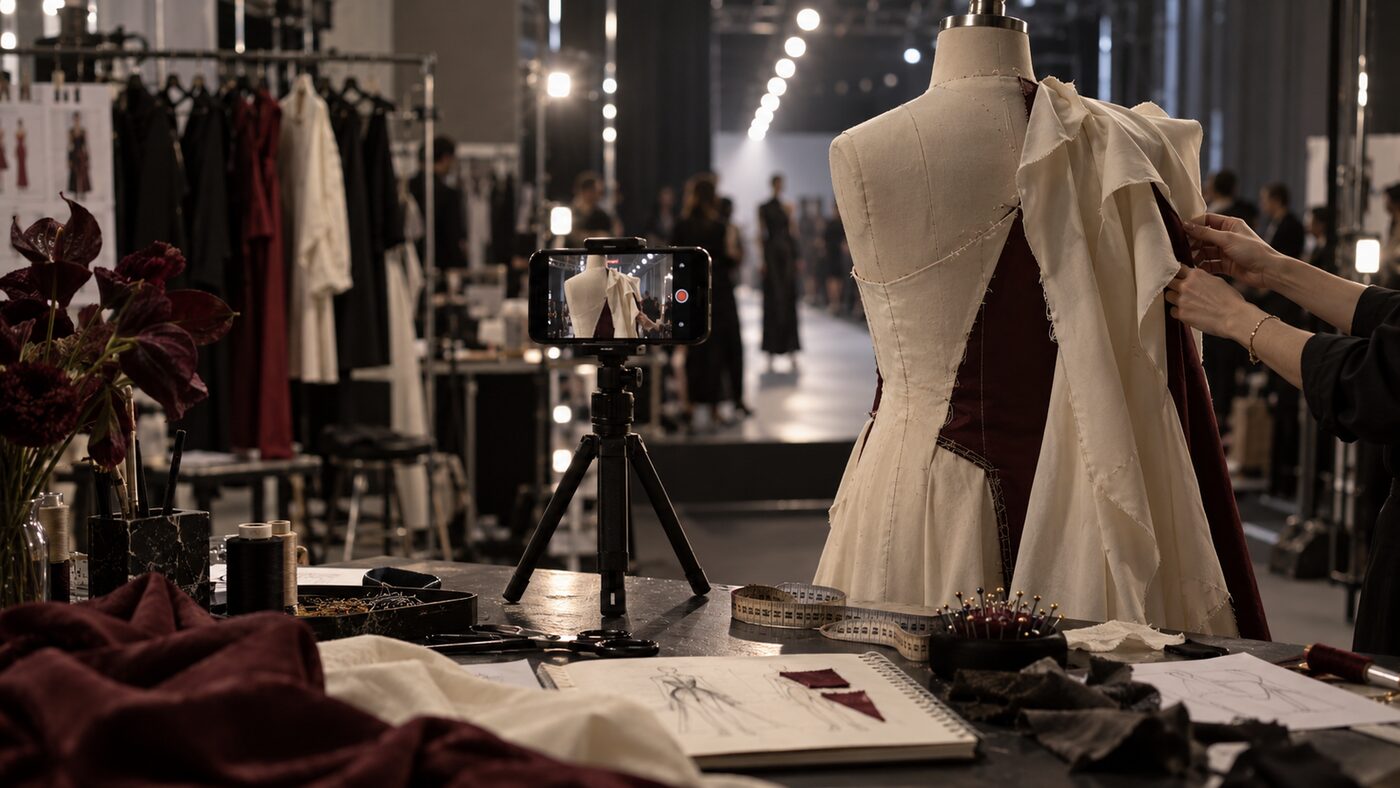
Backstage craft in the hours before a New York show. Courtesy of Fashion PR Firm