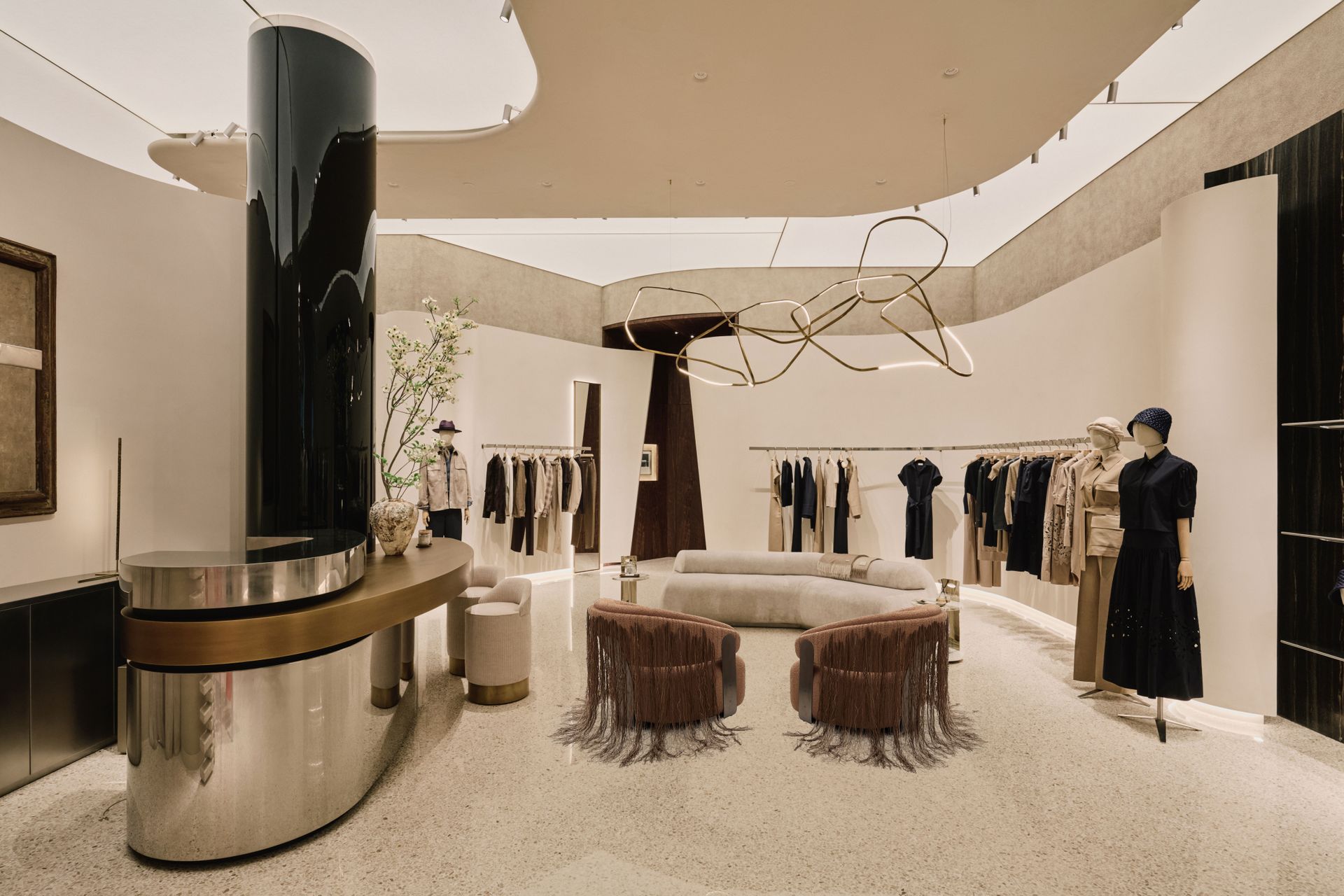
Stefano Aimone has opened Agnona's first Milanese flagship at via Santo Spirito 12. The doorway gives onto a wall of brick that ripples like fabric. Seventy-three years of Piedmontese weaving find a city address.
The screen at the entrance is the first thing you read. Brick laid in waves, stacked so the courses break and run in soft horizontal lines, an echo of warp and weft. Aimone calls it a weave. The reference points back to Valsesia, the village in the Piedmontese foothills where Francesco Ilorini Mo built Agnona in 1953, and where he was born in a red-brick farmhouse.
Aimone has run the brand for five years. He stepped in as CEO and creative director with one instruction to himself, which was to start with the archive. Seventy years of wool, cashmere, silk and linen, all developed in the foothills, all entirely made in Italy. The work was to find the present tense in that material library.
Ilorini Mo supplied the houses that built post-war French couture. Givenchy, Balmain, Dior, Hermès, Pierre Cardin. The fibres travelled from Piedmont to Paris and came back as garments on the runways of the 1950s and 1960s. Agnona's own ready-to-wear line followed in the 1980s, with monobrand shops opening in Tokyo, Osaka, New York, Milan and Venice. The Milan address is the first of that lineage to be rebuilt for the new century.
Brick, brass, wool
Inside, the palette holds in creams, ivory and walnut. A brass chandelier hangs in the central room, twisted into the shape of a knot, the light caught in its loop. Low armchairs sit beneath it, draped in heavy wool that falls in folds at the floor. The room is built for the hand as much as the eye.
On the walls, two canvases by the Sardinian artist Maria Lai. The notes across the cotton are written in white and black wool, stitched by hand. Lai died at ninety-three and these are among her late works. The thread carries from the loom to the page to the gallery wall without ever leaving the same conversation.
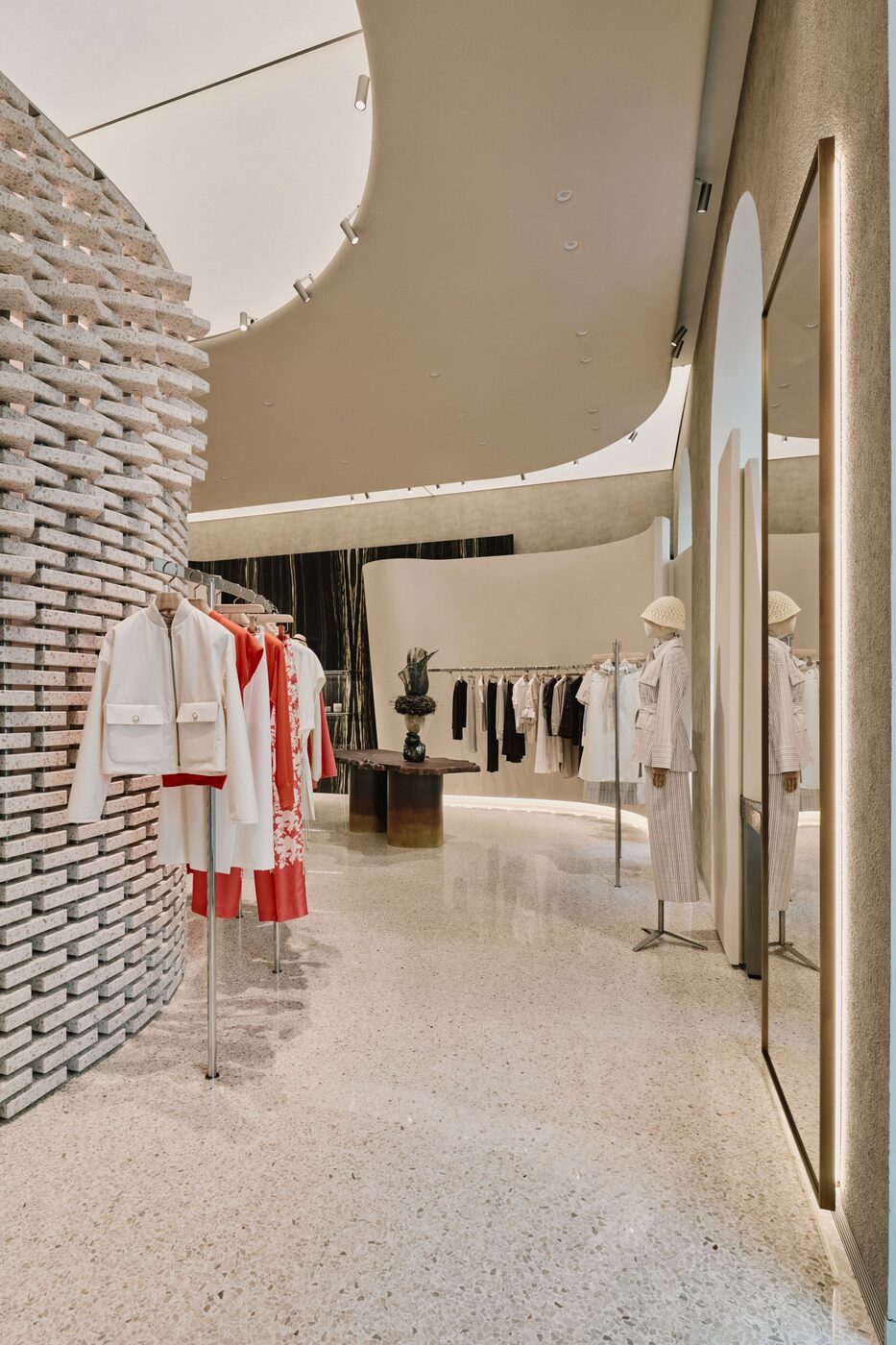
Inside the Agnona flagship, via Santo Spirito 12. Photography courtesy of Agnona, via Wallpaper*
The table
At the centre of the room sits a monolith of canaletto walnut, dark and grained, veined with brass after the Japanese kintsugi tradition. The breaks are made visible and then made beautiful. On the surface rests a sculptural intervention by the artist Lorenzo Vitturi, built around the motif of a nest. A rounded stone base, a blown-glass egg, organic forms in wicker, wool and natural fibre, finished with a soft plume of Peruvian yarn.
Each element carries a fragment of Ilorini Mo's biography. The stone for the village. The yarn for the trade. The nest for the brand he leaves behind. Aimone has assembled a portrait in objects, and placed it where every visitor will eventually circle the table to read it.
The fabric was always the first language. The store learns to speak it again.
Isabelle RoweThe collection
On the rails, the present collection reads like a study in weave. Double-faced wool-cashmere blends thicken into long coats. Linen and silk drape across the body without weight. Cotton poplin dresses carry peekaboo embroidery at the hem, the eyelets sized to catch a single thread of light. Everything is rendered in beige, ivory and walnut, broken occasionally by a saturated cherry red or a wash of pastel.
Aimone keeps the line lean. Caban blazers cut loose at the shoulder. Belted overcoats that fall to the calf. Polo shirts in fine knit. The pieces speak quietly, and they speak to one another. The store is built to let them.
The Milan flagship sits a few doors down from Santo Spirito's quieter end of Montenapoleone, off the main parade. Aimone has slowed Agnona down, and let it stand still long enough to be seen. The thread holds.