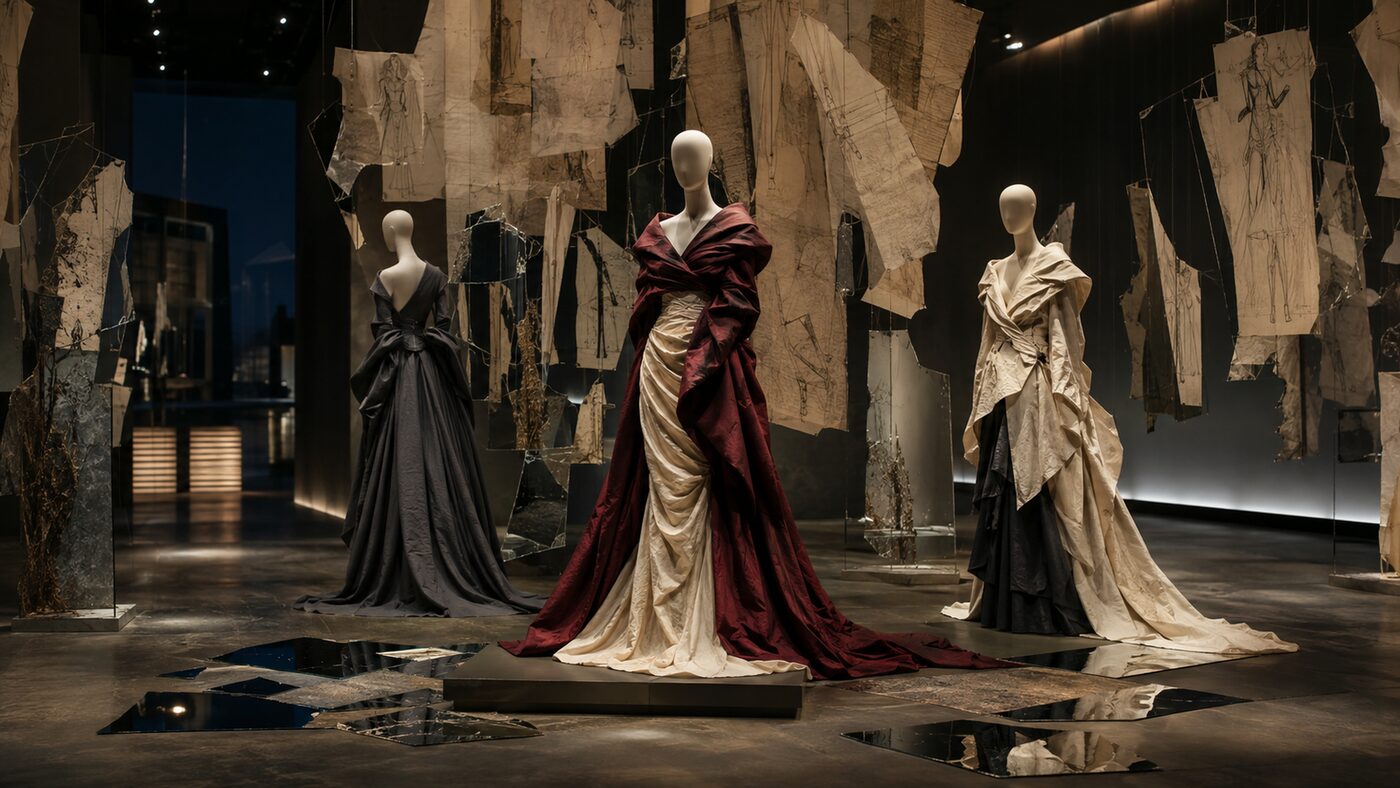
The Costume Institute has named its next subject. John Galliano gets a full retrospective in 2027, and the museum has written his downfall into the plan. The show intends to keep the work and the harm in the same room.
The Metropolitan Museum of Art announced John Galliano: Horizons on 31 July. It will open at The Met Fifth Avenue on 9 May 2027 and run through 9 January 2028. Andrew Bolton, curator in charge of the Costume Institute, is organising the show and writing the catalogue that goes with it.
The exhibition will fill the Condé M. Nast Galleries and draw on the museum's own holdings, which it describes as the largest collection of Galliano's work anywhere. As is custom, the show becomes the frame for the following spring's Met Gala, in this case the 2027 edition.
The arc
The timeline starts in 1984. Galliano left Central Saint Martins that year with a graduation collection called Les Incroyables, built on the fashions of the French Revolution, and a London store bought the whole thing off the runway. His own label followed, sharp on ideas and short on money, kept alive by editors who believed in the cut.
Givenchy came in 1995, the first time a British designer ran a French couture house. Dior came a year later. From 1996 to 2011 Galliano set the pace at the Paris house, staging couture as theatre and mining history for silhouette. The bias cut, the tailoring, the reference-heavy shows: that vocabulary shaped a visible chapter of Dior's modern life.
After a long absence he returned at Maison Margiela in 2014. His Artisanal collection for spring 2024, shown under a Paris bridge, was read across the industry as a high point of his second act. The retrospective carries the story through to that show.
The span is the point. Few designers have worked at this level across a namesake label and two French houses, and fewer still have left a paper trail the Costume Institute could assemble at this depth. The Met is treating the archive as a body of work worth studying whole, not a set of famous dresses to line up behind glass.
The reckoning
The museum is not staging this as a clean comeback. In 2010 and 2011 Galliano was recorded making antisemitic and racist remarks in a Paris bar. He lost his job at Dior and at his own label, and a French court convicted him of making public insults based on origin and religion. The facts are settled and the Met has chosen to name them.
The show addresses that conduct directly, along with his later treatment for addiction and his public acknowledgment of what he said. According to Associated Press reporting, Bolton and the planning team consulted Jewish community leaders, and the Anti-Defamation League voiced support for an approach that holds the harm in view while examining his efforts at repair.
A museum can catalogue talent and misconduct on the same label. The harder task is making a visitor read both at once.
The Splendid EditThree movements
The exhibition is built in three parts. Bearings comes first and sets the chronology of the career against the wider history around it. This is where the museum places the misconduct, its consequences and his reckoning with it, so the reckoning shapes everything a visitor sees afterward.
Horizons, the second movement, maps the sources Galliano returned to across four decades: history, geography, art, performance and storytelling. Atlas of Transformation, the third, follows the work from idea to garment through research books, sketches, toiles and fittings. The order is deliberate. The record of harm is not a footnote at the exit.
The Met has not published a full object list. Which Dior gowns, which Givenchy looks, which Margiela pieces make the cut remains open, and the museum has asked that nothing be treated as confirmed until it says so. What is fixed is the shape: process and reference on one side, accountability set at the door.
Why now
The timing sits against a house in transition. Dior has just opened a new era under Jonathan Anderson, whose first collections look forward. Horizons looks back, at the years when Galliano built one of the most talked-about and most compromised chapters in that same house's history.
Museum recognition carries weight, and a retrospective can read as endorsement if its framing stays vague. The Met has set itself a harder brief. It wants visitors to hold the craft and the conduct together rather than pick one. Whether the finished galleries manage that will come down to the wall text, the range of voices included and how much room the museum gives the communities the remarks targeted.
The show will be one of the most argued cultural events of 2027 because it lands on a question the industry has not answered. How should institutions study influential work when the maker caused real harm. The Met has committed to a version that refuses both erasure and applause. The galleries open in May 2027, and the debate starts long before the doors do.
The Splendid Edit on the Costume Institute's John Galliano: Horizons. Exhibition details from The Metropolitan Museum of Art; accountability context reported by the Associated Press.
Image courtesy of Paris Runway