Peter Funch set up on the sidewalks of New York and let the city walk past. Gucci called the result GucciCore. The campaign reads like a census of the people who live there.
The images landed in the third week of October. Demna built them around a plain premise. For a few weeks, Gucci would stop advertising a collection and start advertising a wardrobe. That change runs through everything about how the pictures work.
The city
Funch shot across New York in ordinary weekday light. His subjects move through the frame rather than hold a pose inside it. Some carry coffee, some carry nothing. The clothes sit on them the way clothes sit on people who dressed themselves that morning and had somewhere to be.
The casting is wide by design. Gucci described the series as a portrait of plurality in the city, and the pictures hold to that line. Ages, builds and faces change from shot to shot. No single model anchors the campaign, which is the point of it.
New York is not a neutral choice. The United States has carried luxury spending while China has cooled, and Gucci needs the American shopper more than it has in years. Setting the campaign on these streets reads as a bid for that customer. It also returns the house to the city where Demna staged his loudest Gucci statement to date.
The photographer
Funch comes to this with a history. His series Babel Tales was built from crowds photographed at fixed New York locations, then composited into single frames that never existed in one instant. He has spent years watching how the city gathers and scatters.
GucciCore puts that eye to commercial use. The method stays documentary even when the subject is a peacoat. The result looks observed rather than arranged, which is the harder effect to produce and the more convincing one to sell.
The clothes
The wardrobe is deliberately plain. Peacoats, trench coats, business suits, clean shirts and pencil skirts carry the campaign. These are the pieces a person reaches for without thinking. Gucci lays its own Italian polish over them, in the cut, the leather, the weight of a lapel.
Demna has made a career of this contrast. At Balenciaga he dressed the everyday in couture terms. Here he works the other direction, pulling the house down to the level of the street and letting the quality show through the ordinariness. The Horsebit and the logo stay quiet, and the tailoring does the talking.
The glamour is there, folded into the construction rather than pinned on top. A trench holds its line, a suit sits square on the shoulder. The leather is heavy and the finishing is clean, and that is where the price justifies itself. A customer who buys a Gucci peacoat is buying the making, not the slogan.
The wardrobe
GucciCore is not a seasonal collection. The house calls it a permanent wardrobe, a set of pieces meant to stay in the lineup and grow over time instead of clearing out each spring. The idea cuts against the industry calendar, where houses reset their shelves four times a year.
The collection first walked in May, when Demna staged a show in the middle of Times Square and used the billboards as the set. This campaign is the quieter companion to that spectacle. The show claimed the loudest corner of New York. The pictures return to the sidewalks below it.
A permanent line asks for a different kind of loyalty. Gucci wants a customer to learn a shape, trust it, and replace it when it wears through. That is how the old houses built their names, on the coat you buy twice rather than the dress you buy once. Demna is betting the brand can still sell that patience.
GucciCore works best when it forgets it is an advertisement and remembers it is a crowd.
The Splendid EditThe read
GucciCore is the fourth chapter in a project Demna began the day he arrived. La Famiglia, Generation Gucci and Primavera each studied a kind of person. This one studies a kind of place. The through-line is character, and the city gives him the largest cast yet.
The strategy sits on top of a hard year. Kering reported in October that Gucci sales fell six percent in the third quarter, and the house remains the group's heaviest problem to solve. A permanent wardrobe is a commercial answer as much as a creative one. It asks the customer to buy the basics and keep coming back to the same shelf.
Whether that works is a question for the receipts, not the pictures; what the campaign settles is tone. Demna has found a register for Gucci that runs calmer than Times Square and lasts longer than a trend. The clothes are built to be worn out, in both senses of the phrase. The city he borrowed to sell them will keep supplying the crowd.
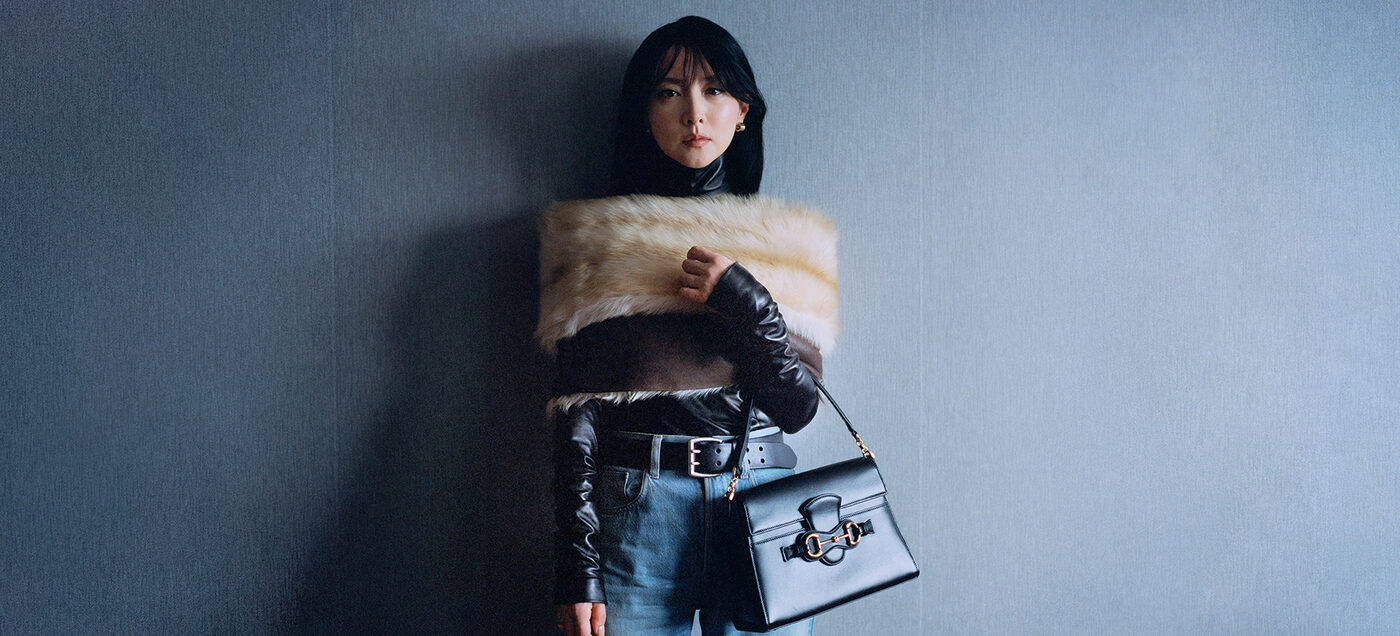
A Gucci campaign image, from the house under Demna. Courtesy of Gucci